


It's a principle of life that old things get thrown away, but if you hold on to them they begin to acquire the value of antiques. This applies particularly to photos. Few things are less interesting than last year's snapshots, but those old sepia prints are part of the historical record.
What, you might think, could be more appropriate to Double Ten National Day than this collection of photographs covering Taiwan's history from 1945 to the present, put together by the government's official Central News Agency (CNA)? They range from rice harvesting in Ilan to street protests in Taipei, and are in black-and-white up to the late 1980s and in color thereafter. Some of them are well-known and have been frequently reproduced, such as those dating from 1979 of the "Formosa Incident" detainees -- Annette Lu, Shih Ming-teh, Chang Chun-hung, Huang Hsin-chieh, Chen Chu, Yao Chia-wen and Lin Hung-hsuan in court surrounded by military and police personnel.
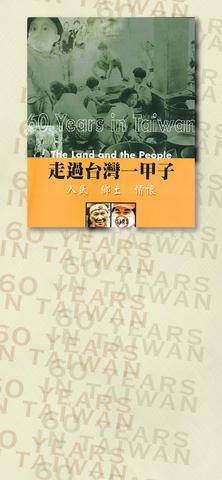
These law-enforcement agents cannot have had much idea of the significance of those proceedings. They no doubt assumed the accused were simply "wrong-doers," rather than national heroes in the making. And indeed this book's main strength is that it demonstrates what can't be demonstrated too often, that what appears as reality in one era is revealed as something quite different after the passage of the years. This is the reason why the older photos here are invariably more interesting than the more recent ones.
"Is that really Ximending?" we exclaim. "How it's changed!" We forget that it will change again, and what's up-to-the-minute now will in the future seem quaint and old-fashioned, and before very long at that. Just looking at the clothes is sufficient to make the wise realize that, whatever the young may think, fashion is the one thing that can be guaranteed, always and without fail, to leave you behind.
CNA is in no doubt about its public role, and the limitations that went with it in former times. In his Introduction, for example, chairman Su Tzen-ping writes, "As a news outlet, CNA has aspired to report events fairly, which is why we regret that the photographic record of the Feb. 28 Incident of 1947, and the `White Terror' that followed in the 1950s was unbalanced. This deliberate slip of memory of course had much to do with CNA's role in that authoritarian period. Therefore, we are pleased all the more that the opposition's political movement during the 1990s was faithfully recorded, as were the disturbances following the presidential election."
There are many fascinating images here. There's the first-ever Double Ten parade in 1949, the first Taipei City Council elections (in 1950); people intent on the results of the 1952 US presidential election; Elisabeth Taylor in Taipei for the Golden Horse awards in 1979, boys catching cicadas in Renai Road and Chen Shui-bian
(
Nowadays, though, people are likely to take a different view. Today, images of all kinds proliferate to such a degree that still photos, certainly from the present era, command increasingly less and less interest. It's not only that there are thousands of photos published daily in the press. Ordinary individuals, too, have no problem recording anything they care to. Just a couple of years ago people's faces would routinely light up if you pointed a camera in their direction. Not any more. Only very old photos continue to attract us, simply by virtue of the fact that what they show is so long ago it's as if it had never been.
It may, however, be the case that today's youth, far from being put in touch with the past by photos, feel ever more remote from it, simply because the images of it are so primitive by current standards. With this come increasing expectations from, for instance, our politicians. When our images of ourselves are so extravagantly glossy, sophisticated, inter-active and so on, what are our leaders doing looking not very different from their 1980s predecessors?
Earlier this week, while looking at photos of the former Hong Kong street protester "Long Hair" taking the oath in his T-shirt in that city's legislature, surrounded by his be-suited and embarrassed fellow-legislators, it was impossible to believe that here was the future already born and taking its place among the elect (not to mention the elected). Here was someone who had been made famous by TV images, and had now come knocking at the door of history demanding to be given a place in a real-time, power-wielding existence.
All in all, there's something only marginally relevant about Sixty Years in Taiwan. We don't expect our photos to be printed in hardback books any more. We expect to look at them once, then either throw them away, switch channels, or forward them by e-mail to our friends. The media change, and real people run to catch up.
Interestingly, it's not the black-and-white photos that seem uninteresting in this book -- it's the color photos from the 1990s. That, the young surely feel, must have been a truly primitive era. And though the long perspective may add a patina of charm, the recent past looks dreary indeed. Even yesterday appears dull to many. So, move over the present! The future has already arrived!

In late October of 1873 the government of Japan decided against sending a military expedition to Korea to force that nation to open trade relations. Across the government supporters of the expedition resigned immediately. The spectacle of revolt by disaffected samurai began to loom over Japanese politics. In January of 1874 disaffected samurai attacked a senior minister in Tokyo. A month later, a group of pro-Korea expedition and anti-foreign elements from Saga prefecture in Kyushu revolted, driven in part by high food prices stemming from poor harvests. Their leader, according to Edward Drea’s classic Japan’s Imperial Army, was a samurai
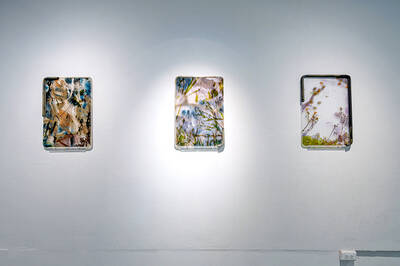
Located down a sideroad in old Wanhua District (萬華區), Waley Art (水谷藝術) has an established reputation for curating some of the more provocative indie art exhibitions in Taipei. And this month is no exception. Beyond the innocuous facade of a shophouse, the full three stories of the gallery space (including the basement) have been taken over by photographs, installation videos and abstract images courtesy of two creatives who hail from the opposite ends of the earth, Taiwan’s Hsu Yi-ting (許懿婷) and Germany’s Benjamin Janzen. “In 2019, I had an art residency in Europe,” Hsu says. “I met Benjamin in the lobby
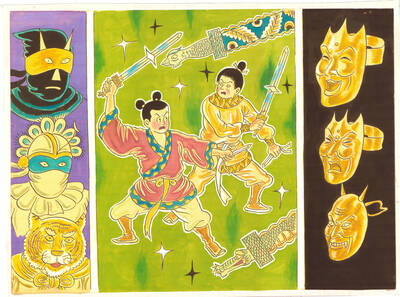
April 22 to April 28 The true identity of the mastermind behind the Demon Gang (魔鬼黨) was undoubtedly on the minds of countless schoolchildren in late 1958. In the days leading up to the big reveal, more than 10,000 guesses were sent to Ta Hwa Publishing Co (大華文化社) for a chance to win prizes. The smash success of the comic series Great Battle Against the Demon Gang (大戰魔鬼黨) came as a surprise to author Yeh Hung-chia (葉宏甲), who had long given up on his dream after being jailed for 10 months in 1947 over political cartoons. Protagonist

A fossil jawbone found by a British girl and her father on a beach in Somerset, England belongs to a gigantic marine reptile dating to 202 million years ago that appears to have been among the largest animals ever on Earth. Researchers said on Wednesday the bone, called a surangular, was from a type of ocean-going reptile called an ichthyosaur. Based on its dimensions compared to the same bone in closely related ichthyosaurs, the researchers estimated that the Triassic Period creature, which they named Ichthyotitan severnensis, was between 22-26 meters long. That would make it perhaps the largest-known marine reptile and would


 RSS
RSS