


It's a sunny afternoon on the sea northeast of Hualien. The waves gently swell and a sea breeze cuts the heat. A boat slowly sets out from the port of Hualien, moving eastward, into the vast Pacific Ocean. Soon the land fades away and there is calm, just the thud of the motor and slap of the waves on the bow. Suddenly, one of the tourists on the boat screams out, "There it is! It came out!"
"Wow! Where did it go?" The guide on the whale/dolphin-watching boat asks, using a microphone to make himself heard over the din of excited exclamations.
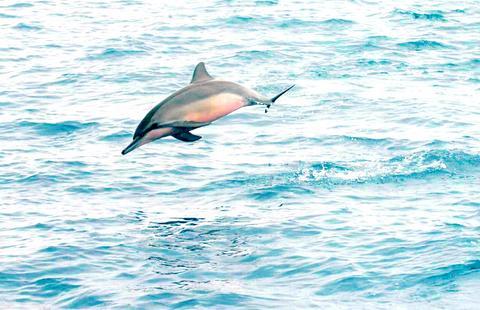
PHOTO: CHIANG YING-YING, TAIPEI TIMES
"Oh, OK, now look, around three o'clock. A group of dolphins. Oh wow, look at this group! There is one doing the flips. One, two flips," the instructor continues. "Now, they are into the water again. You see, dolphins are fast and agile animals ... oh, now look, nine o'clock."
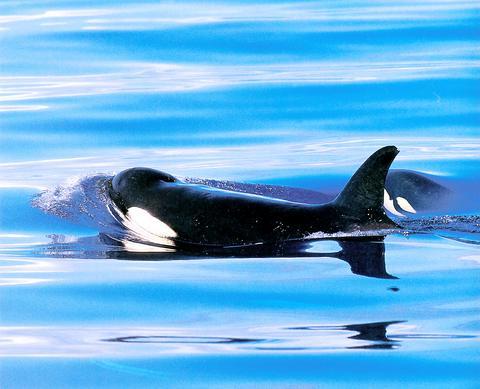
PHOTO COURTESY OF TOURISM BUREAU
The dolphins were like dancers, with more than a dozen leaping out of the water from different directions. The guide said these were spinner dolphins. They were black and gray, with white bellies. Young dolphins appeared to have pink-colored bellies. The guide said the dolphins were famous for "showing off" and they would often flip out of the water, especially in response to seeing humans.
Not long after, another whale/dolphin watching boat joined us and chased the dolphin groups at high speed.
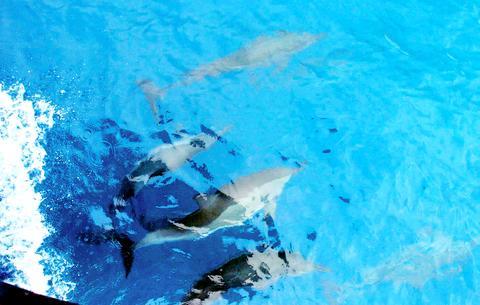
PHOTO: CHIANG YING-YING, TAIPEI TIMES
The whale/dolphin-watching business has been developing since the first boat went on its maiden whale- watching trip in 1997. Now there are 33 boats along the east coast of Taiwan, taking out an estimated 220,000 tourists a year. The Taiwan Cetacean Society (
But such rapid development also gradually brings about side effects. As much as whales and dolphins bring excitement to tourists and tour operators on Taiwan's east coast, the business has negatively impacted the whales and dolphins and their ecosystem. Academics and even some businesspeople have begun to worry.
Whales and dolphins generally congregate off the coasts of the three counties of Ilan, Hualien and Taitung. According to Lin Chen-li (林振利), manager of Turumoan Whale-Watching (多羅滿賞鯨號), on an average day-trip, one used to be able to see five kinds of whales or dolphins. "For this year, so far we have seen only one kind of dolphin around Hualien," Lin said.
Lin thinks the reason for this decrease in the number of species seen on whale/dolphin-watching trips, is the number of boats disrupting the environment. In Hualien there are seven whale-watching boats. In Wushi port in Ilan there are 16 whale-watching boats. On average, each boat goes out on about two trips a day, seven days a week. In the busy season, some boats take five trips a day.
In Taiwan, there are more dolphins to be seen than whales. The likelihood of seeing a dolphin is 90 percent, while the chance of seeing a whale is 10 percent. According to research from the Taiwan Cetacean Society, there are 29 species of cetaceans around Taiwan's coast. Most of them appear in between April and October.
They include the 25m-long blue whale, humpback whale, killer whale, bottle-nose dolphin, pan-tropical spotted dolphin, spinner dolphin and Risso's dolphin. The pan-tropical spotted dolphin and spinner dolphin are the two most visible species.
Going for a whale-watching trip costs around NT$800 for a two-hour cruise. The cost was NT$1,200 seven years ago. In recent years, because of keen competition, the price can be as low as NT$500 during the summer vacation.
As a result, perhaps, bad practices have become common, like boats chasing the cetaceans, frightening them off. Some of the boats have such big engines and motor so fast that they disrupt the whales and dolphins' lives.
According to research by marine biologist Bernd Wusigon, the presence of rapidly moving vessels -- from the small (5m to 10m) to mid-size (10m to 20m) -- can be disturbing to both baleen and toothed whales at distances below 5km. The species become more vulnerable and sometimes the noises affect the reproduction rate. Research by professor Chou Lien-siang (
The owner of Turomoan Whale-Watching, Lin Chen-li agreed. He said originally, whale watching was
developed to promote eco-tourism, to teach people to preserve oceanic resources. But now the fast-growing business tends to neglect the essentials. Some whale-watching boats are even equipped with Karaoke. Unfortunately this only adds to the noise bombarding the whales and dolphins.
"On the sea, we [humans] are the guests and they [whales] are the real hosts. When you visit someone's home the minimal courtesy is to respect them, not to bother them too much. But a lot of people lack such basic manners."
The Fishery Bureau (
In terms of the management of whale watching, there is still a lot of room for improvement compared with countries such as New Zealand, South Africa and Iceland, said Professor Chou Lien-hsiang during the Symposium on Cetacean Ecology and Conservation (
In the attempt to improve the tourist whale-watching service, the fishery bureau has now set up an evaluation system for whale-watching businesses. Owners that keep to the guidelines get the government-approved eco-tourism badge.

In late October of 1873 the government of Japan decided against sending a military expedition to Korea to force that nation to open trade relations. Across the government supporters of the expedition resigned immediately. The spectacle of revolt by disaffected samurai began to loom over Japanese politics. In January of 1874 disaffected samurai attacked a senior minister in Tokyo. A month later, a group of pro-Korea expedition and anti-foreign elements from Saga prefecture in Kyushu revolted, driven in part by high food prices stemming from poor harvests. Their leader, according to Edward Drea’s classic Japan’s Imperial Army, was a samurai

Located down a sideroad in old Wanhua District (萬華區), Waley Art (水谷藝術) has an established reputation for curating some of the more provocative indie art exhibitions in Taipei. And this month is no exception. Beyond the innocuous facade of a shophouse, the full three stories of the gallery space (including the basement) have been taken over by photographs, installation videos and abstract images courtesy of two creatives who hail from the opposite ends of the earth, Taiwan’s Hsu Yi-ting (許懿婷) and Germany’s Benjamin Janzen. “In 2019, I had an art residency in Europe,” Hsu says. “I met Benjamin in the lobby

April 22 to April 28 The true identity of the mastermind behind the Demon Gang (魔鬼黨) was undoubtedly on the minds of countless schoolchildren in late 1958. In the days leading up to the big reveal, more than 10,000 guesses were sent to Ta Hwa Publishing Co (大華文化社) for a chance to win prizes. The smash success of the comic series Great Battle Against the Demon Gang (大戰魔鬼黨) came as a surprise to author Yeh Hung-chia (葉宏甲), who had long given up on his dream after being jailed for 10 months in 1947 over political cartoons. Protagonist

A fossil jawbone found by a British girl and her father on a beach in Somerset, England belongs to a gigantic marine reptile dating to 202 million years ago that appears to have been among the largest animals ever on Earth. Researchers said on Wednesday the bone, called a surangular, was from a type of ocean-going reptile called an ichthyosaur. Based on its dimensions compared to the same bone in closely related ichthyosaurs, the researchers estimated that the Triassic Period creature, which they named Ichthyotitan severnensis, was between 22-26 meters long. That would make it perhaps the largest-known marine reptile and would


 RSS
RSS