


War Trash is set during the Korean War of 1950 to 1953 and its narrator is a Chinese male who volunteers to go to Korea and fight on the side of the northern Communists and against the South, where a UN force led by the US is committed. After experiencing widespread atrocities, sudden death and meaningless cruelties, he is captured. Most of the book is taken up with his experiences in American-run prisoner-of-war camps.
It's easy to state the virtues of this novel. Ha Jin is at the very roots of his being a non-confrontationalist. The last things his thoughtful and mild-mannered books contain are outright heroes and villains. Instead, he sees the world as full of confusion and half-truths, self-seeking mixed with altruism, kindness mixed with greed, anger mixed with resignation. Even before you open such a novel as War Trash you can be certain that what you will not find is a story of Communist villains versus free-world heroes. There will be no talk of evil empires or capitalist conspiracies, wars on terror or embattled democracy. Instead, you can expect to find compassion and confusion, irony and skepticism, acute observation and a strong sense of the sheer pity of it all.

This is not to say that there won't be plenty about the evils of war. There will be, and there is. This is Ha Jin's first novel to deal with the subject, and, genial though he usually is, he's clearly horrified by what men do to each other in battle, and knows he'd be evading his responsibility if he failed to show war in its true and loathsome colors.
It may nevertheless be wrong to talk of observation. This book has been researched from documentary evidence, and in a note at the end Ha Jin writes that whereas all the main characters are invented, most of the events described are taken from published sources. Even so, the author's perceptive eye as to human behavior is as alert here in this novel dealing with events he can never have experienced as it is in his earlier books such as Waiting and The Crazed where we assume he's writing more directly from his own experience.
The world of the US-run prison camps is not depicted as one where the captives are an undifferentiated mass. There are, of course, both Koreans and Chinese being held there, but the Chinese too are by no means all of the same mind. Some, such as the narrator, have led most of their lives in Chinese Nationalist Party- (KMT)-dominated regions of the country, and others seize the opportunity to be sent to Taiwan rather than be repatriated back to China. Repatriation carries its dangers -- the Communist Party had instructed these volunteers never to surrender, so the status of ex-prisoners is itself problematic. In addition, some Chinese prisoners had had anti-Communist slogans forcefully tattooed onto their bodies which could only add to their woes once they arrived home.
There are some particularly horrifying scenes depicting extreme violence perpetrated against prisoners wanting to return to China by prisoners planning to opt to be sent to Taiwan. Only seconds separate one man's calling out a pro-Communist slogan and his body being dismembered by supporters of the opposite camp and his heart being held aloft on the tip of a knife. (The prison camp, as is so often the case, is partly run by the prisoners themselves, and tension between the two political groupings runs high).
It's typical of Ha Jin that he makes his narrator a graduate of a Nationalist military academy, and yet at the same time someone who chooses to be repatriated to China. He simply wants to go home, to meet up again with his fiancee and look after an aged parent. This side-lining of political commitment, and highlighting instead the human, the domestic and the ordinary, is typical of all his tales, some of which have been compared to the stories of Anton Chekhov, another markedly non-political writer.
The narrator initially ends up in the US, but decides, at the age of 73, to return to China, the land that has bred him and will retain his bones. But his life in Korea doesn't lead easily to this eventual pair of destinations. Because he's perceived as an educated man who also speaks some English, he is co-opted to help in the screening, propaganda and administration work of the camp, and hence to see into the stories of many of his fellow prisoners -- Ha Jin here deftly using the memoirs he's been reading when preparing to write the novel.
Few things could be more appropriate to the present confrontational age than this tolerant, horrified, detailed look back at the Korean War. What the world needs at present is exactly this kind of humane skepticism. War is always the worst of all possible options, and we can't be told this often enough. That all sides act brutally in conflict is another truth we should never forget. Ha Jin, born in China, living in the US since 1985, and writing in English but about East Asia, has in this book seized his opportunity. In these brutally confrontational times, his is a voice of moderation, realism, sanity and wisdom. It's impossible to believe that, in taking on this Korean subject-matter, Ha Jin isn't commenting on the present state of the world. So read this book, and meditate on its message. If for Korea you read Iraq, I doubt if Ha Jin will complain.
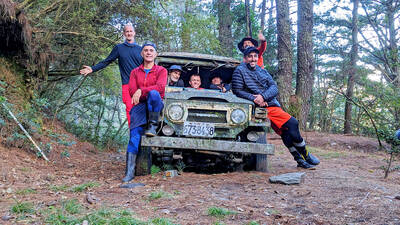
The year was 1991. A Toyota Land Cruiser set out on a 67km journey up the Junda Forest Road (郡大林道) toward an old loggers’ camp, at which point the hikers inside would get out and begin their ascent of Jade Mountain (玉山). Little did they know, they would be the last group of hikers to ever enjoy this shortcut into the mountains. An approaching typhoon soon wiped out the road behind them, trapping the vehicle on the mountain and forever changing the approach to Jade Mountain. THE CONTEMPORARY ROUTE Nowadays, the approach to Jade Mountain from the north side takes an
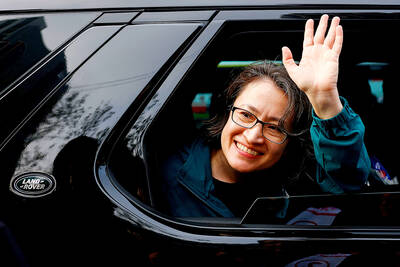
Relations between Taiwan and the Czech Republic have flourished in recent years. However, not everyone is pleased about the growing friendship between the two countries. Last month, an incident involving a Chinese diplomat tailing the car of vice president-elect Hsiao Bi-khim (蕭美琴) in Prague, drew public attention to the People’s Republic of China’s (PRC) operations to undermine Taiwan overseas. The trip was not Hsiao’s first visit to the Central European country. It was meant to be low-key, a chance to meet with local academics and politicians, until her police escort noticed a car was tailing her through the Czech capital. The

Last week Joseph Nye, the well-known China scholar, wrote on the Australian Strategic Policy Institute’s website about how war over Taiwan might be averted. He noted that years ago he was on a team that met with then-president Chen Shui-bian (陳水扁), “whose previous ‘unofficial’ visit to the US had caused a crisis in which China fired missiles into the sea and the US deployed carriers off the coast of Taiwan.” Yes, that’s right, mighty Chen caused that crisis all by himself. Neither the US nor the People’s Republic of China (PRC) exercised any agency. Nye then nostalgically invoked the comical specter
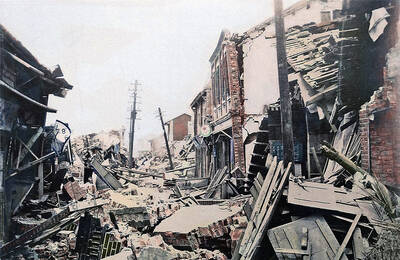
April 15 to April 21 Yang Kui (楊逵) was horrified as he drove past trucks, oxcarts and trolleys loaded with coffins on his way to Tuntzechiao (屯子腳), which he heard had been completely destroyed. The friend he came to check on was safe, but most residents were suffering in the town hit the hardest by the 7.1-magnitude Hsinchu-Taichung Earthquake on April 21, 1935. It remains the deadliest in Taiwan’s recorded history, claiming around 3,300 lives and injuring nearly 12,000. The disaster completely flattened roughly 18,000 houses and damaged countless more. The social activist and


 RSS
RSS