


There is no snow to be found in September, but Snow Mountain (
Now is a good time to go, too, with October approaching and typhoon season on the way out. Arguably, the only better time is in March and April, when the winter freeze is gone and spring shows its colors.
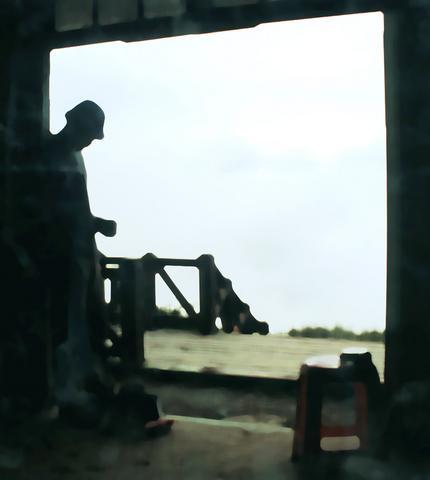
PHOTO: DAVID MOMPHARD
Hike between now and December, however, and you can be fooled into thinking Taiwan has an autumn. The mountains are blanketed by conifer forests at higher altitudes and the crisp air and crunch of pine needles belie the fact that you're in the subtropics.
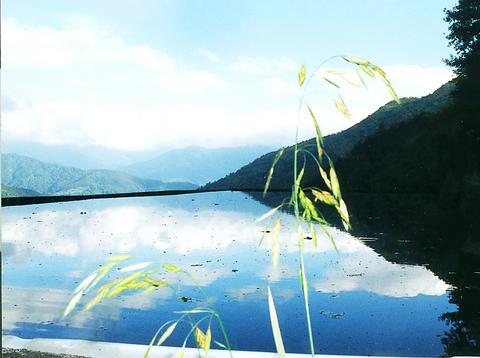
PHOTO: DAVID MOMPHARD
You start at Wuling Farms (
The farm also boasts the only fish in Taiwan you can't eat. Taiwan's endemic and endangered landlocked salmon (
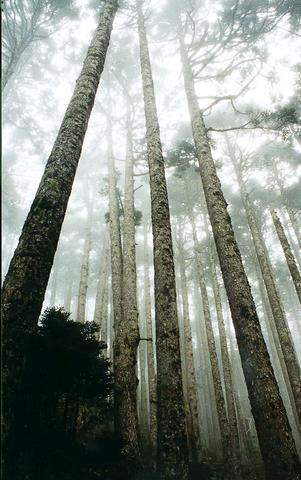
PHOTO: DAVID MOMPHARD
Besides, you've come to conquer the mountain. If you've come from Taipei, it's noon at the earliest and you have about four hours of climbing ahead of you. Your destination is Chika hostel (

PHOTO: DAVID MOMPHARD
What Chika lacks in aesthetic accommodation it more than makes up for with the fact that you didn't have to lug a tent. Hikers are easily able to make it here by afternoon's end provided they've started early enough. Another hostel, 369, is found at the end of your second afternoon on the trail.
Dawn at Chika is when you awaken to the fact that you're on vacation. The sun gets up late from behind the mountainsides and burns off a fog that lurked through the night. Flowers yawn and stretch and early birds whistle annoying morning tunes. Chika is also where your real hiking begins. From behind the hostel you're going to travel nearly straight up, through another series of switchbacks, to a ridge that runs between the mountain's east and main peaks.
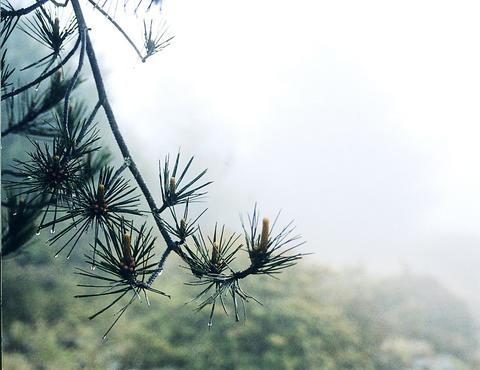
PHOTO: DAVID MOMPHARD
It's a scenic slog and you won't mind taking your time. Nor should you. You'll have climbed to an altitude of 3,000m by day's end and a headache or altitude sickness could flatten your fun if you don't take it easy.
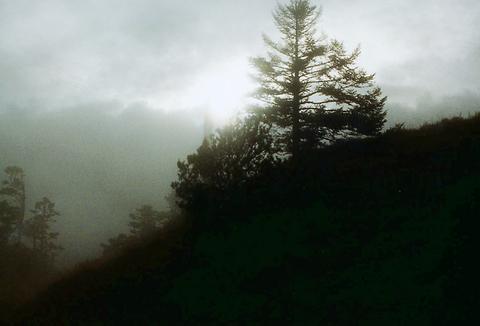
PHOTO: DAVID MOMPHARD
All along the trail are signs marking the area's flora of interest, deciduous trees and conifers and some 60 different types of flowering plants. Conservation authorities would presumably do the same for the area' s fauna, if the animals could be relied upon to take up their designated posts each day. You might see a small sign for the kind of tree frog you hear clearing it's throat at night or a family of Swinhoe deer posed behind another sign staked into the ground.
Alas, they've more important things to do and your chances of spotting a Swinhoe Gray are about as likely as your chances of spotting one of those landlocked salmon. You can always take a NT$500 note from your wallet to get a close look at what you're missing.
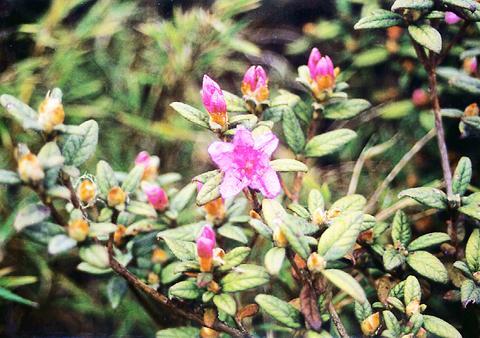
PHOTO: DAVID MOMPHARD
The birds that grace the back of the NT$1,000 note can also be spotted in this area -- in theory at least. They're a male and female Swinhoe pheasant. The bird and deer get their name from Robert Swinhoe, the British consul and amateur zoologist who "discovered" 93 species of bird and 17 species of mammal during his first two weeks in Formosa in 1856.
Your chances of spotting wildlife will diminish once you reach the ridge. Signs carved with Chinese characters here warn of high winds that sweep the ridge and have scoured it of all but the heartiest plants. If there are clouds in the vicinity you can watch as they run up the side of the mountain and filter through the peaks of the central mountain range.
Atop the ridge you're not far from 369 hostel and you want to make an early day of it. If you want to see the sun rise from the summit, you'll need to be on the trail by 3am. If you're not getting up for the sun, do so for the view. The peaks become a tufted pillow of clouds as they day grows hotter and more humid. If you're not on the peak by, say, 10am you might only see the inside of a cloud.
It's three hours hike from 369 hostel to the peak. You'll be coming back the way you came and so you need only pack a flashlight, water, something to eat and your camera. It's another 900m to the summit and you'll want to go as light as possible. You'll make your way first past a stand of dead birch trees, then into a thick forest, rise above the tree line via switchbacks to small valley called the Ice Funnel.
Here is the final leg of your climb; a trail of switchbacks over scree. If you saw the bald peak of Snow Mountain from Wuling Farms you'll recognize this as the place you thought would take only a few simple steps to the top. Hardly. After two days of carrying a backpack uphill these last few hundred meters seem to never end.
If you're lucky you'll be rewarded with a clear dawn and a gradient of colors from purple to yellow as the sun rises. With wisps of cloud on the horizon the sun will rise like a match lit in slow motion. You'll also have an excellent view of Tapachien Mountain to the north, "Taiwan's Matterhorn." If it's cloudy, you see this as well on the NT$500 bill. It's there behind the family of Swinhoe deer.
Don't be put off if the clouds have spoiled your view. On your way back down you'll pass back through the trail you came up, through the Black Forest of pine and deciduous trees. This is by far the most breathtaking stretch of the Snow Mountain trail and is enchanting when shrouded in clouds. Even if you come only this far and forego the peak you'll still have seen some of Taiwan's most pristine, old-growth forest.
Getting to the bottom of the mountain, as the saying goes, is more important than getting to the top. Snow Mountain's well-maintained trails make this an easy task. The two-and-a-half days you've just spent huffing and puffing will be retraced in a four-hour jaunt back to Wuling Farms.
GETTING THERE:
★ From Taipei, take the early morning train to Ilan. Turn left out of the Ilan train station and walk a block to the bus depot. Board the mid-morning bus to Wuling Farms (
★ The bus to Wuling will end at the visitors' center. Check with the driver to see when the last bus out of Wuling departs for Ilan, then check in at police headquarters to let them know your itinerary. From there, continue down the road to the trailhead.
★ You have about two hours of walking from the visitor's center to the trailhead. This is a rather uninteresting road through a tea plantation that is best seen from the back of a flatbed truck, if there's one heading your way.
★ If you've taken the 6:45am or
7:10am fast trains out of Taipei, you'll get to Ilan and then Wuling Farms in plenty of time to reach Chika hostel by dinnertime. Otherwise, you'll need to spend the night at the farm.
HIKING HINTS:
★ Water resources on the mountain are scarce, but are available at Chika and 369 hostels as well as Wuling Farms.
★ It's cold at high altitudes even in September. Pack warm clothing and a sleeping bag.
★ Finding dry wood can be a challenge. You'll need a camp stove if you want a hot meal.

In late October of 1873 the government of Japan decided against sending a military expedition to Korea to force that nation to open trade relations. Across the government supporters of the expedition resigned immediately. The spectacle of revolt by disaffected samurai began to loom over Japanese politics. In January of 1874 disaffected samurai attacked a senior minister in Tokyo. A month later, a group of pro-Korea expedition and anti-foreign elements from Saga prefecture in Kyushu revolted, driven in part by high food prices stemming from poor harvests. Their leader, according to Edward Drea’s classic Japan’s Imperial Army, was a samurai

Located down a sideroad in old Wanhua District (萬華區), Waley Art (水谷藝術) has an established reputation for curating some of the more provocative indie art exhibitions in Taipei. And this month is no exception. Beyond the innocuous facade of a shophouse, the full three stories of the gallery space (including the basement) have been taken over by photographs, installation videos and abstract images courtesy of two creatives who hail from the opposite ends of the earth, Taiwan’s Hsu Yi-ting (許懿婷) and Germany’s Benjamin Janzen. “In 2019, I had an art residency in Europe,” Hsu says. “I met Benjamin in the lobby

April 22 to April 28 The true identity of the mastermind behind the Demon Gang (魔鬼黨) was undoubtedly on the minds of countless schoolchildren in late 1958. In the days leading up to the big reveal, more than 10,000 guesses were sent to Ta Hwa Publishing Co (大華文化社) for a chance to win prizes. The smash success of the comic series Great Battle Against the Demon Gang (大戰魔鬼黨) came as a surprise to author Yeh Hung-chia (葉宏甲), who had long given up on his dream after being jailed for 10 months in 1947 over political cartoons. Protagonist

Peter Brighton was amazed when he found the giant jackfruit. He had been watching it grow on his farm in far north Queensland, and when it came time to pick it from the tree, it was so heavy it needed two people to do the job. “I was surprised when we cut it off and felt how heavy it was,” he says. “I grabbed it and my wife cut it — couldn’t do it by myself, it took two of us.” Weighing in at 45 kilograms, it is the heaviest jackfruit that Brighton has ever grown on his tropical fruit farm, located


 RSS
RSS