


At Christ Tabernacle Church in Queens, New York on a recent Friday night, Adam Durso, the church's youth pastor, raised a microphone in exaltation. "Yo, God is so ill," he shouted, using a hip hop term of praise.
It was more than two hours into the weekly service, and neither the pastor nor his congregation, a multiracial group of about 350 teenagers and adults, was ready to quit. The DJ played a hip hop beat, and shouts of praise rose from the pews. "Come on," Durso encouraged, "tear the roof off this place in praise to God."
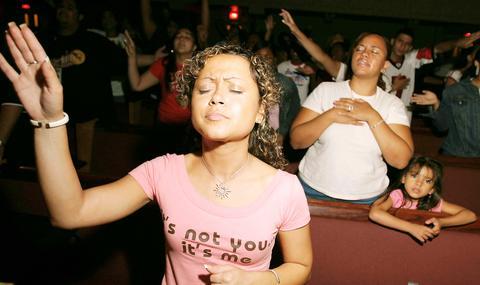
PHOTO: NY TIMES
Eleven years after the Reverend Calvin O. Butts III of the Abyssinian Baptist Church in New York's Harlem district ran a steamroller over rap CDs, in what has come to symbolize the antagonism between hip hop and the church, the two worlds seem to be inching closer together. The singer R. Kelly and the rapper Mase, who left the music business for five years to become a minister, have new hit albums filled with gospel messages, and one of this summer's most popular songs was Jesus Walks, an overtly Christian rap by Kanye West.

PHOTO: NY TIMES
From the church side, a growing number of ministries are adopting both the rhythms and the bluntness of hip hop culture. Butts remains critical of some rap music, but younger ministers like Durso are using its attitudes and beats to spread the gospel. In the New York area alone, at least 150 churches or ministries use hip hop in some form, said Kim Stewart, a booking agent for Christian rappers. These include many storefront churches or campus ministries, she said.
"Hip hop is the language and the cry of this generation," said Durso, 27, who mixes guest rappers and videos with conservative evangelical preaching in his Friday services, which are called Aftershock. The results are part revival meeting, part Friday night out.
Christian rappers, who once presented themselves as squeaky clean alternatives to their secular peers, are increasingly spinning graphic tales of urban life, with little aroma of church sanctimony. Corey Red and Precise, a New York duo that performed at Aftershock, rhymed about their pasts as drug dealers, lacing their rhymes with sexual frankness and references to gunplay. Strutting the stage in a do-rag and football jersey, Corey Red rapped, "I put the heat to your knot," pointing a finger to his head like a gun, even as he talked about being saved.
For churches, making peace with hip hop is a matter of survival, said Ralph Watkins, who teaches African-American culture and religion at Augusta State University in Georgia. "Mainline churches have identified hip hop culture as an enemy, and that's their problem," he said. "If you walked in to 90 percent of your mainline churches who have not embraced this culture, you're going to find an absence of young people."
In Jesus Walks, Kanye West cites a comparable unwillingness on the part of the rap business to address matters of faith. He rhymes, "They say you can rap about anything except for Jesus/ That means guns, sex, lies, videotapes/ But if I talk about God, my record won't get played, huh?"
West, the son of a Christian marriage counselor, said that when his father heard the song, he said, "`Maybe you missed your calling.' I said, `No, maybe this is my calling.' I reach more people than any one pastor can."
Church resistance
The resistance that many churches have shown to hip hop culture resembles previous battles over gospel music or drums in church, said Alton Pollard III, the director of black church studies at the Candler School of Theology at Emory University in Atlanta.
"This is just the latest version" of the battle, he said. "It's about the continuing need for new expressions of what it means to be human, and the church oftentimes is not able to keep up, whether we're talking about jazz, the blues, soul or gospel music."
But unlike gospel and soul, "hip hop didn't start in the church," said Phil Jackson, a youth pastor who last year started a hip hop ministry called The House in one of Chicago's poorest neighborhoods.
"So there still exists some antagonism. But for this generation, the only way to make the gospel relevant to them is through hip hop. In my neighborhood we don't need another church on Sunday morning. We need something to speak to young people."
Corey Red and Precise, who call their style hardcore gospel, are emblems of the uneasy crossover. Corey Red, whose surname is Sullivan, rejected the church as a teenager, turning to hip hop and small-time crime. When he was stabbed in a street confrontation and critically injured, he said, he felt Jesus in a way that he never had in church.
"It took God to visit me outside the four walls" of the church, he said. "That's why I love the Lord, because he came into the street and met me where I was. Even though the people inside the four walls wrote me off, like `He's finished, he's not going to see 25 years old.'"
The experience put him at odds with both his secular and his Christian peers, he said. Even now, he uses the word "religion" as a pejorative and sees his faith as tangential to the business of churches. "I'm not Christian by following the institutionalized religion of Christianity," he said. "I'm Christian like what the word really means, a follower of Christ."
Tough business
He and Precise occupy a precarious niche, recording for Life Music, a Christian label started by Derek Ferguson, the chief financial officer of Bad Boy Entertainment, Sean Combs's company. Bad Boy stars who rap about sex and material excess earn instant fortunes, but Corey Red and Precise say they struggle to make ends meet. Unlike Christian rock bands, Christian rappers are rarely played on religious radio stations and get little support from churches or the music industry.
Ferguson said he struggles to justify the music of some Bad Boy acts. But their Christian alternatives, he acknowledged, can barely support a small business.
"The church has these soldiers at their disposal," said Precise, whose real name is Robert Young. "But a lot of brothers, after a night of risking their life, they can't even keep their lights on in their house. We're here for the church. But any army poorly funded is going to struggle."
At Crossover Community Church in Tampa, Florida, Tommy Kyllonen has built a thriving ministry around hip hop and runs an annual festival of Christian rap. Like Christ Tabernacle, Kyllonen's church is loosely affiliated with the Assemblies of God denomination.
Kyllonen, 31, who raps under the name Urban D., teaches pastors around the country to use hip hop in their ministries. With the success of Kanye West, he said, churches and the music industry are looking at the potential reach of Christian hip hop.
But if churches simply add a DJ or a little slang to their services, the audience will not be fooled, he said.
"Hip hop is the hook that might draw them in, but what keeps them is building a relationship with God and with other people that are here,'' he said.
"Because if they don't have that, and that doesn't become authentic, we would just be another place to come hang out, like a club. A club gets old after a while. Then there's a new club that opens up down the street that the music is better, they got a better DJ, that's where everyone's going now. The difference with us is that spiritual aspect."
At Aftershock, the crowd lingered long after the beats went silent. A plexiglass box onstage brimmed with items that people had turned in at previous services, including secular CD's, pornography and gang insignia.
Leamon Richardson and Richard Dauphin, who arrived well before the doors opened, embodied the complicated messages of holy hip hop. Both are rappers. Richardson, 19, who lives in the South Bronx, called himself a "walking testimony," and wore a T-shirt celebrating 50 Cent, a secular rapper who rhymes about dealing drugs and killing people.
Dauphin said that people who cannot understand this apparent contradiction are blind to the prophetic powers of hip hop. "We're street disciples," he said. "You can be the greatest preacher in the world and not reach the street. That's where we're at."

In late October of 1873 the government of Japan decided against sending a military expedition to Korea to force that nation to open trade relations. Across the government supporters of the expedition resigned immediately. The spectacle of revolt by disaffected samurai began to loom over Japanese politics. In January of 1874 disaffected samurai attacked a senior minister in Tokyo. A month later, a group of pro-Korea expedition and anti-foreign elements from Saga prefecture in Kyushu revolted, driven in part by high food prices stemming from poor harvests. Their leader, according to Edward Drea’s classic Japan’s Imperial Army, was a samurai

Located down a sideroad in old Wanhua District (萬華區), Waley Art (水谷藝術) has an established reputation for curating some of the more provocative indie art exhibitions in Taipei. And this month is no exception. Beyond the innocuous facade of a shophouse, the full three stories of the gallery space (including the basement) have been taken over by photographs, installation videos and abstract images courtesy of two creatives who hail from the opposite ends of the earth, Taiwan’s Hsu Yi-ting (許懿婷) and Germany’s Benjamin Janzen. “In 2019, I had an art residency in Europe,” Hsu says. “I met Benjamin in the lobby

April 22 to April 28 The true identity of the mastermind behind the Demon Gang (魔鬼黨) was undoubtedly on the minds of countless schoolchildren in late 1958. In the days leading up to the big reveal, more than 10,000 guesses were sent to Ta Hwa Publishing Co (大華文化社) for a chance to win prizes. The smash success of the comic series Great Battle Against the Demon Gang (大戰魔鬼黨) came as a surprise to author Yeh Hung-chia (葉宏甲), who had long given up on his dream after being jailed for 10 months in 1947 over political cartoons. Protagonist

A fossil jawbone found by a British girl and her father on a beach in Somerset, England belongs to a gigantic marine reptile dating to 202 million years ago that appears to have been among the largest animals ever on Earth. Researchers said on Wednesday the bone, called a surangular, was from a type of ocean-going reptile called an ichthyosaur. Based on its dimensions compared to the same bone in closely related ichthyosaurs, the researchers estimated that the Triassic Period creature, which they named Ichthyotitan severnensis, was between 22-26 meters long. That would make it perhaps the largest-known marine reptile and would


 RSS
RSS