


Two years ago, Taiwanese artist Michael Lin (
Recently in Taiwan to visit family and prepare for upcoming exhibitions, Lin elaborated on his open-armed acceptance into the French art scene and his reasons for staying there.

PHOTO COURTESY OF PS1 CONTEMPORARY ART CENTER
"There is no base of support from the private sector [in Taiwan], such as collectors or private institutions that collect art. So it becomes very difficult to make a living purely as an artist in Taiwan," he said, making reference to the number of artists who take teaching positions to supplement their income.

PHOTO COURTESY OF MONTENMEDIO CONTEMPORARY ART FOUNDATION
Conversely, France provided Lin with a wealth of opportunity. Invited in 2002 to exhibit his work at the opening of a contemporary art museum, he was simultaneously asked to take part in a group show at the Museum of Modern Art in Paris. Being in close proximity to so many other European countries and galleries, Lin said he was almost immediately invited to work in several venues around the continent.
Having left Taiwan at an early age, he was raised in the US and it wasn't until completing his masters of Fine Arts that he returned to Taiwan in 1993. He then began to utilize traditional Taiwanese and Japanese textile prints as a base for his trademark floral patterns. The print, he said, is a personal response to his own identity crisis, having spent so much of his childhood outside the country.
"I had just come back [to Taiwan] and I was grappling with my own identity in a culture I felt foreign to, yet still a part of."
Lin added that his work is also a critical reflection of the socio-political climate in Taiwan during the 80's and 90's, a time when the island was defining its own national identity. "The government was changing and there was this general question of history and a sense of nostalgia. For me it [the textile prints] represented a tradition that was being wiped out and this was my own little resistance, and preservation of a particular aesthetic value that I thought would be worth keeping."
By bringing elements such as ornamentation into his paintings he explained how, on an artistic level, his work was also a reaction to his foundation in the American tradition of neo-conceptualist and neo-minimalist art.
What began with a painting derived from traditional Taiwanese floral prints has blossomed into an ongoing exploration of ornamentation and its relationship to architecture. Making full use of exhibition spaces, the exaggerated patterns utilize walls, floors, and furniture to become functional installations that invite observers to participate in the art.
Describing his art as banal, he explained how people are physically implicated in the pieces, making the art less of an object to be contemplated and more of a space to be occupied. "When you look at a painting you stand erect and concentrate. The relationship between you and my work is perhaps closer to you and your couch than you and the painting hanging on the wall."
Lin's enormous, ornate works have been part of international biennials in Taipei (2000), Istanbul (2001), Liverpool (2002), Venice (2001) in addition to a list of solo exhibitions in Asia, Europe and the US.
His next exhibit will be held in Shanghai at a gallery recently refurbished by American architect Michael Graves. A week later, his work will be part of the opening show at the 21st Century Museum of Contemporary Art in Kanazawa, Japan.
Although not exhibiting in Taiwan on this trip, Lin assures us that he will be making his way home soon.

In late October of 1873 the government of Japan decided against sending a military expedition to Korea to force that nation to open trade relations. Across the government supporters of the expedition resigned immediately. The spectacle of revolt by disaffected samurai began to loom over Japanese politics. In January of 1874 disaffected samurai attacked a senior minister in Tokyo. A month later, a group of pro-Korea expedition and anti-foreign elements from Saga prefecture in Kyushu revolted, driven in part by high food prices stemming from poor harvests. Their leader, according to Edward Drea’s classic Japan’s Imperial Army, was a samurai

Located down a sideroad in old Wanhua District (萬華區), Waley Art (水谷藝術) has an established reputation for curating some of the more provocative indie art exhibitions in Taipei. And this month is no exception. Beyond the innocuous facade of a shophouse, the full three stories of the gallery space (including the basement) have been taken over by photographs, installation videos and abstract images courtesy of two creatives who hail from the opposite ends of the earth, Taiwan’s Hsu Yi-ting (許懿婷) and Germany’s Benjamin Janzen. “In 2019, I had an art residency in Europe,” Hsu says. “I met Benjamin in the lobby
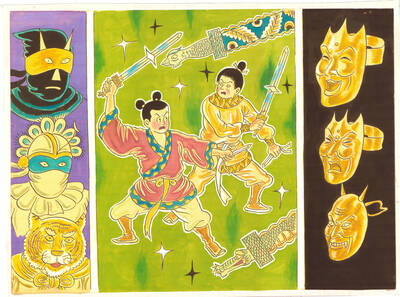
April 22 to April 28 The true identity of the mastermind behind the Demon Gang (魔鬼黨) was undoubtedly on the minds of countless schoolchildren in late 1958. In the days leading up to the big reveal, more than 10,000 guesses were sent to Ta Hwa Publishing Co (大華文化社) for a chance to win prizes. The smash success of the comic series Great Battle Against the Demon Gang (大戰魔鬼黨) came as a surprise to author Yeh Hung-chia (葉宏甲), who had long given up on his dream after being jailed for 10 months in 1947 over political cartoons. Protagonist

Peter Brighton was amazed when he found the giant jackfruit. He had been watching it grow on his farm in far north Queensland, and when it came time to pick it from the tree, it was so heavy it needed two people to do the job. “I was surprised when we cut it off and felt how heavy it was,” he says. “I grabbed it and my wife cut it — couldn’t do it by myself, it took two of us.” Weighing in at 45 kilograms, it is the heaviest jackfruit that Brighton has ever grown on his tropical fruit farm, located


 RSS
RSS