


It is generally known that pregnant women should avoid things like smoking and drinking for the sake of their babies. But watching a puppet performance?
Well, that too, depending on the puppet.

PHOTO COURTESY PUPPETRY ART CENTER OF TAIPEI
The Puppetry Art Center of Taipei, which opened August in the Songshan district of Taipei, traces the history of Chinese puppetry all the way from the Han Dynasty to its present incarnation, stopping everywhere along the way.
In particular, the center is scheduled to hold a special exhibition tomorrow, beginning at
9:55am, that will not only showcase its puppet collection but will also include a host of other activities for children and adults alike.
Puppets have consistently played an important role in Chinese culture, dating back to the Han Dynasty. Like most any form of art, Chinese puppetry has undergone transformations over the years, with puppets assuming roles relevant to the times.
"And just like actors, they can change costumes and become other characters," said Apollo Zhang, a spokesman for the center.
The puppets, which were donated in 1998 to the Taipei City Government by the head of the Taiyuan Arts and Culture center, are indeed a diverse bunch that can be separated into three categories: hand puppets, marionettes and shadow puppets.
The hand puppets have evolved from simple ones with limited mobility to more intricate ones capable of opening their mouths, blinking their eyes and making more complex body movements.
The marionettes, or string puppets, are a bit more complicated to maneuver. Depending on their origin, the marionettes can have more than a dozen strings that, when jiggled the right way, give life to the puppet.
"It's not so easy," said Zhang, smiling while focusing on pulling the strings at one of the areas that allows visitors to toy around with the puppets.
"Many of the people who operate the puppets have studied for at least five years," Zhang said. "Its something that is often passed down from father to son, like that."
Apart from the marionettes cloaked in traditional garb, there were three puppets at the center that stood out. Their history, Zhang said, dates back to the Japanese colonial period in Taiwan. The puppets, dressed in military and police uniforms, used the issues of that time, rather than stories taken from Chinese folklore, as the basis of their performances, Zhang said.
The third type, known as the shadow puppet, is usually made from cow hide, at least in Taiwan, Zhang said. But other animal hides, like pigs and sheep, have been and can be, used as well.
After undergoing a month-long process, the skin turns hard and is stretched thin, allowing a crafter to cut out shapes to create the puppet. The finished product, unlike its hand puppet or marionette counterparts, is two-dimensional.
The performance technique, therefore, is quite different. The shadow puppets are placed behind a thin, illuminated, cloudy screen made out of glass which acts as the stage. The puppeteer then quickly jerks the strings, creating spastic movements similiar to a person who has no control over his or her limbs.
So, what about the pregnant women who shouldn't watch a particular puppet show?
According to Chinese folklore, the puppet, known as kuilei (傀儡), can be harmful to certain people. Next to the puppet exhibit is a large sign listing 10 warnings, among them: women can not appear on the stage with the kuilei; and pregant women who watch a kuilei performance run the risk of giving birth to deformed children.
Fact or Fiction? That depends on who you ask.
Exhibition notes:
Where: Puppetry Art Center of Taipei
(
Telephone: (02) 2528 7955
Hours: 10 am to 5 pm, closed Mondays
Price: NT$100, NT$60 for children
Details: All exhibits are in Chinese. The museum says it plans to have English explanations by October.
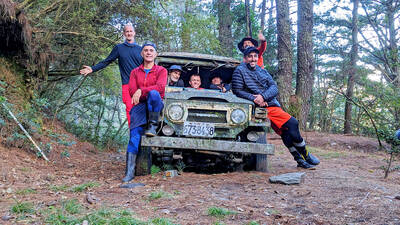
The year was 1991. A Toyota Land Cruiser set out on a 67km journey up the Junda Forest Road (郡大林道) toward an old loggers’ camp, at which point the hikers inside would get out and begin their ascent of Jade Mountain (玉山). Little did they know, they would be the last group of hikers to ever enjoy this shortcut into the mountains. An approaching typhoon soon wiped out the road behind them, trapping the vehicle on the mountain and forever changing the approach to Jade Mountain. THE CONTEMPORARY ROUTE Nowadays, the approach to Jade Mountain from the north side takes an

Last week Joseph Nye, the well-known China scholar, wrote on the Australian Strategic Policy Institute’s website about how war over Taiwan might be averted. He noted that years ago he was on a team that met with then-president Chen Shui-bian (陳水扁), “whose previous ‘unofficial’ visit to the US had caused a crisis in which China fired missiles into the sea and the US deployed carriers off the coast of Taiwan.” Yes, that’s right, mighty Chen caused that crisis all by himself. Neither the US nor the People’s Republic of China (PRC) exercised any agency. Nye then nostalgically invoked the comical specter

Relations between Taiwan and the Czech Republic have flourished in recent years. However, not everyone is pleased about the growing friendship between the two countries. Last month, an incident involving a Chinese diplomat tailing the car of vice president-elect Hsiao Bi-khim (蕭美琴) in Prague, drew public attention to the People’s Republic of China’s (PRC) operations to undermine Taiwan overseas. The trip was not Hsiao’s first visit to the Central European country. It was meant to be low-key, a chance to meet with local academics and politicians, until her police escort noticed a car was tailing her through the Czech capital. The
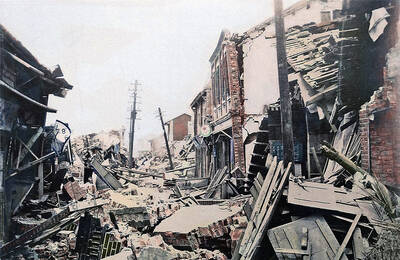
April 15 to April 21 Yang Kui (楊逵) was horrified as he drove past trucks, oxcarts and trolleys loaded with coffins on his way to Tuntzechiao (屯子腳), which he heard had been completely destroyed. The friend he came to check on was safe, but most residents were suffering in the town hit the hardest by the 7.1-magnitude Hsinchu-Taichung Earthquake on April 21, 1935. It remains the deadliest in Taiwan’s recorded history, claiming around 3,300 lives and injuring nearly 12,000. The disaster completely flattened roughly 18,000 houses and damaged countless more. The social activist and


 RSS
RSS