


Controversy surrounded the transformation of the old Taipei Winery Building into an arts center from the word "go."
When artist Tang Huang-chen (湯皇珍) and members of the Golden Bow Theater (金枝演社) decided the abandoned site was a perfect venue for the alternative art scene in 1997, it didn't take long for the authorities to intervene. The first performance, a play called Trojans, was cut short after the local police precinct decided to raid to the center.
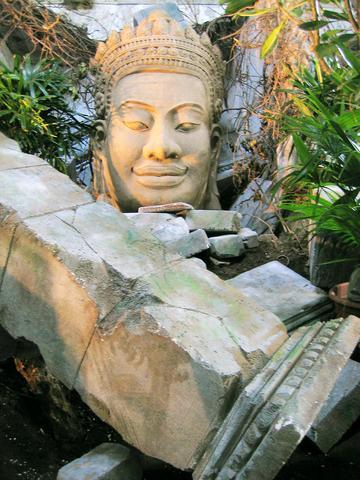
PHOTO: GAVIN PHIPPS, TAIPEI TIMES
Outraged by these actions, large numbers of Taiwan's non-mainstream artists joined forces in an effort to turn the abandoned buildings into a public art space. Two years of demonstrations and petitions finally paid off in 1999 when the government allowed the Association of Culture and Environmental Reform in Taiwan (藝術文化環境改造協會) to manage the site.
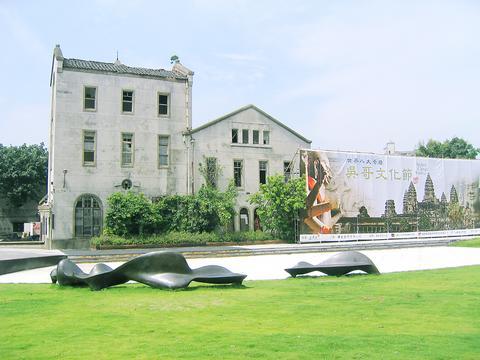
PHOTO: GAVIN PHIPPS, TAIPEI TIMES
After four years the curtain finally came crashing down on the artists' association. In June 2002, local media ran banner headlines about a drug-fueled drum party that had been held at the arts center. And in November last year The Sun Son Theater (身聲演繹社) courted controversy when it staged a play entitled Circle of Love, which included nudity.
Enough was enough, and in December last year the Council for Cultural Affairs (文建會) regained control of the winery and incorporated it into its Creative Taiwan: Creativity and Culture Industry Development Project (文化創意產業發展計畫).
Renaming it the Huashan Cultural and Creative Industry Center (
Since January this year the group has set about creating what many visitors have described as a "much more user-friendly Huashan, with a park-like environment."
Not everyone was happy, however.
While some of the predominantly "alternative" artists who once displayed often dreadful works of art screamed "foul" and alleged that the "new arrangement allows for less creative freedom," it's hard to deny that Huashan today offers visitors an environment that is much more pleasing to both the eye and the palate.
"The contract was pretty open and allowed us to put on whatever exhibitions or performances we thought fitting," said art administrator Liya Wang (王麗雅). "We do have to ensure that the people we book stick to certain guidelines and if we are holding a music event we inform the local police first. But after what happened here in the past, that is hardly surprising."
Late last year, the CCA repaired some of the damaged buildings, replacing broken windows, tore down the wall which once surrounded the area and turned what was a car park and a dump site into a pleasant, grassed public park.
"I think that because there was a wall around the place people thought that it was a private place where the artists could do whatever they liked," Wang said. "We've heard a lot of positive [feedback] and people now feel that the role of the center has changed. Families come here to walk around the park at the weekends and the coffee shop and outdoor seating is always popular. In July and August the center was the busiest I think it's ever been."
This month, the center plays host to its largest exhibition to date, the Beauty of a Thousand Years Angkor Cultural Festival, a mix of genuine artifacts and reproductions of Angkor sculpture and architecture.
Whether or not the center continues to operate is another matter entirely, as the art consultancy's one-year contract is up for renewal next January and it is still not known what the CCA plans for the center.
Regardless of what the CCA chooses to do with the land a slice of Taiwan's wine brewing history will remain affixed to the spot.
Protected by the Taipei City Government Cultural Bureau's "Heritage Sites" program, several of Huashan's buildings will remain on site, including what is now the ceramics center and what was once the plum wine factory and now serves as a visual arts performance center.
In late October of 1873 the government of Japan decided against sending a military expedition to Korea to force that nation to open trade relations. Across the government supporters of the expedition resigned immediately. The spectacle of revolt by disaffected samurai began to loom over Japanese politics. In January of 1874 disaffected samurai attacked a senior minister in Tokyo. A month later, a group of pro-Korea expedition and anti-foreign elements from Saga prefecture in Kyushu revolted, driven in part by high food prices stemming from poor harvests. Their leader, according to Edward Drea’s classic Japan’s Imperial Army, was a samurai

Approaching her mid-30s, Xiong Yidan reckons that most of her friends are on to their second or even third babies. But Xiong has more than a dozen. There is Lucky, the street dog from Bangkok who jumped into a taxi with her and never left. There is Sophie and Ben, sibling geese, who honk from morning to night. Boop and Pan, both goats, are romantically involved. Dumpling the hedgehog enjoys a belly rub from time to time. The list goes on. Xiong nurtures her brood from her 8,000 square meter farm in Chiang Dao, a mountainous district in northern Thailand’s
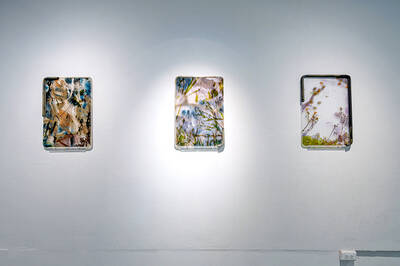
Located down a sideroad in old Wanhua District (萬華區), Waley Art (水谷藝術) has an established reputation for curating some of the more provocative indie art exhibitions in Taipei. And this month is no exception. Beyond the innocuous facade of a shophouse, the full three stories of the gallery space (including the basement) have been taken over by photographs, installation videos and abstract images courtesy of two creatives who hail from the opposite ends of the earth, Taiwan’s Hsu Yi-ting (許懿婷) and Germany’s Benjamin Janzen. “In 2019, I had an art residency in Europe,” Hsu says. “I met Benjamin in the lobby
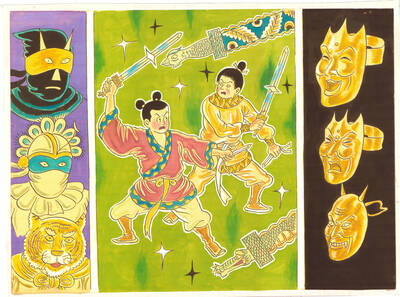
April 22 to April 28 The true identity of the mastermind behind the Demon Gang (魔鬼黨) was undoubtedly on the minds of countless schoolchildren in late 1958. In the days leading up to the big reveal, more than 10,000 guesses were sent to Ta Hwa Publishing Co (大華文化社) for a chance to win prizes. The smash success of the comic series Great Battle Against the Demon Gang (大戰魔鬼黨) came as a surprise to author Yeh Hung-chia (葉宏甲), who had long given up on his dream after being jailed for 10 months in 1947 over political cartoons. Protagonist


 RSS
RSS