


Ilan (宜蘭) is a popular place to visit and spend a few days, but few visitors get to take part in Aboriginal life, so the Tourist Industry Marketing Guidance Group (觀光產業行銷輔導團隊) is organizing trips to give travelers the experience.
While traveling with tour groups is ideal for some, for others the idea crushes romantic notions of roaming the forests of northeastern Taiwan in perfect freedom. After three days and two nights under such circumstances, however, it is difficult to complain, having met some of the warmest and most accepting people in the world and learning about jungle life -- even becoming an honorary member of a native tribe and ... falling in love.
After successive waves of Han migration, the Japanese occupation and Chinese Nationalist (KMT) rule, Aboriginals have been marginalized. Dreadful stereotypes of poverty and alcohol-stricken communities permeate the popular media, but it would seem this does little to prevent the Aboriginals that I met from living life to the full.
Our group stayed at Ya Yun Min Su (雅韻民宿), a quaint bed and breakfast in Da Tong Xiang Gong Suo (大同鄉公所), where the facilities are more than adequate. After coming to terms with the fact that we would not be issued a traditional loincloth, or weapons, we filled each day with nature walks, visits to waterfalls, hot springs, bed and breakfasts, teashop and trinket shops, all within a 20km radius.
The tour begins
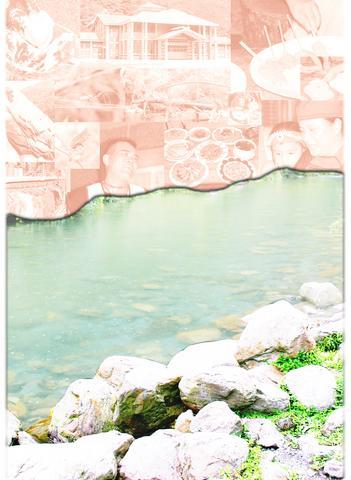
A waterfall, locally known as Pu Bu Yi (瀑布一) or Waterfall one was our first destination. Tourists have got a bad reputation here because of their littering and the Ju Liao Xi river (九寮溪) parking lot was a man-made nightmare of dams and overpopulated public swim holes. They looked refreshing, but were claustrophobic. A 3km trail to a serene riverbed, however, found crystal clear waters in which one could happily spend a lazy afternoon.
Along the hiking trails, Aboriginal guides taught us which plants were edible and warned us about the poisonous varieties. They pointed out the abundance of flora and fauna in the area.
People in Da Tong Xiang Gong Suo eat well, we found. On the first night we had mountain pork and free-range chicken, vegetables ranging from mountain guo mao (過貓) to kong xin cai (空心菜), and local ma gao tea (馬告茶), brewed from the leaves of a mountain tree of the same name. To complement dinner each night, there were countless bottles of Xiao Mi Jiu (小米酒) a fermented rice wine that resembles Smirnoff Ice, but puts the vodka label to shame.
As in any small town, people are on a first-name basis with one another. This is easy enough, as family members all have the same first name. In addition, boys take their second name from their fathers; girls all take their second names from their mothers. While this could easily confuse a visitor, the members of the tribe that arrived during the meal from their white-collar jobs in the area were greeted with toasts and expected to entertain the diners with a song before they could join the feast. Each newcomer sang beautifully and did so without complaint.
It was at one of these dinners that I was to receive my tribal name, Gu Mai. This means worm and I was given the sobriquet for my insect-like performance at the waterfall earlier in the day. After receiving such a "noble" name there was little choice but to toast the tribe's elder and have a song-and-dance.
The tour resumes
Business in the Da Tong area is carried out in a considerably more relaxed manner than you will find in the city. There is no reason to rush to anything or hurry anywhere. During a grueling all-day expedition, one realizes that in everyday city life, time is money. In Da Tong, time is more than this.
On the second day of our visit, we were to find that the surrounding mountains are covered in so many Oolong tea farms that the air has a tea-infused fragrance. Oolong smoothies and frequent tea breaks between dips in various hot springs along the way kept us in a good mood all the way.
The hot springs and featured attractions at various villages in the area provided a relaxing time. In the streets, children played basketball with garbage can hoops. In the forests you could, for a while, feel like the only person on the planet.
The day was pleasant but the lectures about each tree, farm, village and factory did, at times, become exhausting. On the other hand, we learned more in one day than most visitors to the area would learn in a three or four days.
One point that was constantly reiterated throughout the journey was the locals' aversion to change. "We welcome anyone, anytime. This is a completely untouched area that is beautiful and it would be a travesty to see it changed by disrespectful visitors," said Wang Jin-fa (王進發), one of the guides, as we saw a pile of litter along the roadside, left by visitors from the night before.
The people and their culture
In Taiwan there are now officially 12 Aboriginal tribes, who have been living here, reportedly, since 3000BC. Each group has its own dialect and different long-standing traditions.
Today they have found it profitable to mix their traditions and in doing so have created a fusion of customs. Their dances, songs and colors of their clothes have become a heterogeneous hybrid.
The owners of one of the bed-and-breakfast stops, Lai wen-fu (賴文葍) and his wife Zhang Yu-mei (張玉美) said they were not so worried about business. They said their main concern is that people understand them, their culture and their ways. "We often have repeat customers. People come here and love and they will often visit more than once a year," Zhang said.
Aboriginals from the Ta Ya Zu tribe make up the majority of the 700 residents in town. They are well-educated, with a quick wit and a commitment to one another that is thicker than blood. They maintain a fire and passion for life that is reinforced by their appreciation for the finer things in life -- namely eating drinking, singing, dancing and an unyielding respect for all that nature provides.
At the end of my time in the area (which was curtailed due to the arrival of Typhoon Aere) I found a new appreciation for guided tours, in that they create a perfect blend of circumstances for emotional candor -- and in Da Tong I took full advantage. When it comes to falling in love with members of tour groups it is difficult to say for sure whether it is a function of the romantic setting, long days basking in sizzling hot springs and cool waterfalls or late night rice wine binges, but there is an undeniable potential for romance for singles and couples alike.
The bottom line is that if you need a break from your nine to five, watch-worshiping, cellphone dominated lifestyle, there is a place, a short two hours from Taipei that will show you what life's really all about.

Last week Joseph Nye, the well-known China scholar, wrote on the Australian Strategic Policy Institute’s website about how war over Taiwan might be averted. He noted that years ago he was on a team that met with then-president Chen Shui-bian (陳水扁), “whose previous ‘unofficial’ visit to the US had caused a crisis in which China fired missiles into the sea and the US deployed carriers off the coast of Taiwan.” Yes, that’s right, mighty Chen caused that crisis all by himself. Neither the US nor the People’s Republic of China (PRC) exercised any agency. Nye then nostalgically invoked the comical specter

Relations between Taiwan and the Czech Republic have flourished in recent years. However, not everyone is pleased about the growing friendship between the two countries. Last month, an incident involving a Chinese diplomat tailing the car of vice president-elect Hsiao Bi-khim (蕭美琴) in Prague, drew public attention to the People’s Republic of China’s (PRC) operations to undermine Taiwan overseas. The trip was not Hsiao’s first visit to the Central European country. It was meant to be low-key, a chance to meet with local academics and politicians, until her police escort noticed a car was tailing her through the Czech capital. The

April 15 to April 21 Yang Kui (楊逵) was horrified as he drove past trucks, oxcarts and trolleys loaded with coffins on his way to Tuntzechiao (屯子腳), which he heard had been completely destroyed. The friend he came to check on was safe, but most residents were suffering in the town hit the hardest by the 7.1-magnitude Hsinchu-Taichung Earthquake on April 21, 1935. It remains the deadliest in Taiwan’s recorded history, claiming around 3,300 lives and injuring nearly 12,000. The disaster completely flattened roughly 18,000 houses and damaged countless more. The social activist and

Over the course of former President Ma Ying-jeou’s (馬英九) 11-day trip to China that included a meeting with Chinese Communist Party (CCP) leader Xi Jinping (習近平) a surprising number of people commented that the former president was now “irrelevant.” Upon reflection, it became apparent that these comments were coming from pro-Taiwan, pan-green supporters and they were expressing what they hoped was the case, rather than the reality. Ma’s ideology is so pro-China (read: deep blue) and controversial that many in his own Chinese Nationalist Party (KMT) hope he retires quickly, or at least refrains from speaking on some subjects. Regardless


 RSS
RSS