


Fiction.Love Ultra New Vision in Contemporary Art is the grammatically challenged title of the exhibition currently on view at the Museum of Contemporary Art that asks in its press release, "Are comics and animation becoming new art forms?" and strangely enough, doesn't even bother to answer its own question.
A total of 39 artists, mostly from Japan and Taiwan, are included in this show that is heavy on paintings and light on narrative. However, despite its faults (and there are quite a few), the exhibition is definitely a crowd pleaser, where one can roam about the gallery space looking at cutesy and glittery imagery without having to think too much.
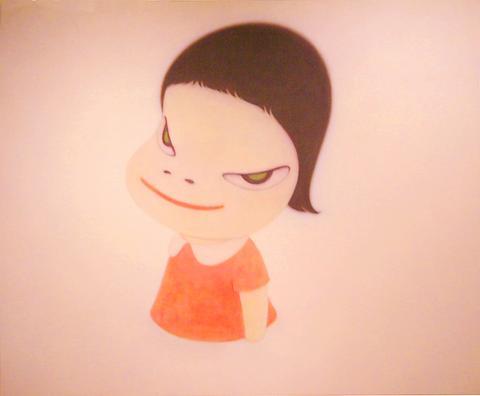
PHOTO COURTESY OF MOCA
There is an unevenness in quality, as museum-level artists are shown next to artists barely one step above student level. However, that unevenness seems to work for itself and gives off a fresh energy, as evidenced by the enjoyment of the high-density audience on opening day.
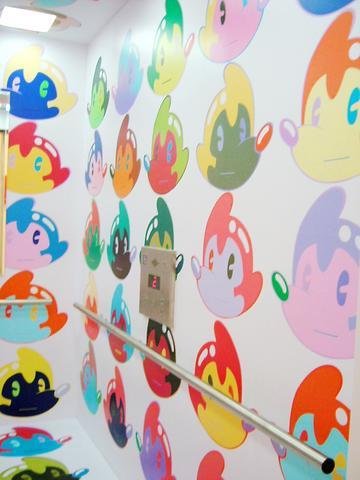
PHOTO COURTESY OF MOCA
Kristy Chu 's (曲家瑞) glass case filled with dolls is entertaining for those who like looking at glass cases filled with dolls. Shouichi Keneda's corporate-logo covered sharks are fun and his thickly impastoed shark paintings look juicy, but he hasn't pushed his imagery convincingly or obsessively enough, making one wonder where will he go with this? How will he further develop his work? South Korean artist Lee Dong-i promises more with his Warhol-inspired elevator papered with brightly colored Atomaus heads; a character he created by combining Astroboy with Mickey Mouse.
On/Megumi, Akiyoshi's neonlit dress channels the spirit of Atsuko Tanaki's famed light-bulb dress of 1956. One can don on the dress and sit alone in a silvery foil chamber for a private viewing experience.
Shintaro Miyaki's repetitive figures of a big-headed pony-tailed parachute-like girl hints at outsider art since it contains an air of creepy obsessiveness to detail. Chiho Aoshima's work is reminiscent of the paintings of pre-pubescent girls by famed institutionalized outsider artist Henry Darger. Aoshima's digital and chromogenic prints of beautiful apricot blossoms suggest Japanese woodcuts and are seductively luscious even when juxtaposed with bleeding heads. Hideaki Kawashima's amoeba-like painted portraits with huge haunting watery eyes are purely sublime and yes, terribly erotic.
A collection of Yoshitomo Nara paintings and drawings is well worth the price of admission. Nara's somber-toned canvases of heavy-lidded children and smiling puppies seem deceptively simple but his innocent-like figures also contain a sinister air, a loss of innocence that triggers deep emotional responses in viewers. Unfortunately though, the two-story wooden shack done up like his studio feels gratuitous, like a shrine to an artistic genius.
And with an exhibition that often alludes to manga's influence on contemporary art, the work of Takashi Murakami is oddly absent here. Perhaps creating designs for Louis Vuitton puts him out of the museum's budget. One artist working in the vein of Murakami is Taiwanese Hung Tunglu (洪東祿), who is poorly represented here with a couple of commercial-oriented sculptures rather than his dynamic lenticulars of Japanese comic figures such as Sailor Moon.
Liu Shih-fen's (劉世芬) premise of a baby born without a brain is haunting and brings a dose of reality, which thus sets up a nice dialogue with Nara's work. Yet, her pink room installation with photos of clouds maudlinly sentimentalizes an otherwise strong idea.
For an exhibition that is promoting art that is influenced by comics and animation, it is extremely befuddling why certain works are included, as they have nothing to do with this premise and the only answer this author can think of she terms "rolodex curating."
In other words, invite the artists in your Rolodex to be in your show. Otherwise, how can one explain the inclusion of Lin Shu-min's (林書民) metaphysical video about life's passages, Lee Ming-wei's (李明維) transformational booth, Yang Fudong's (楊福東) eerily contemplative film Liu Lan and Tsu Su-mei's (謝素梅) video of a puppet cello player? And the offensive juxtaposition of Yang's film with an amateurish installation still has the hair raised on the back of this writer's neck. Ugggghh!
Well, for those who want light-hearted fare and an air-conditioned respite from the heat, the show is worth seeing. There is also an animation program screening 23 short films daily; ah, a great way to be entertained during these dog days of August.
For your information :
What: Fiction.Love Ultra New Vision in Contemporary Art
Where: Museum of Contemporary Art, 39, Changan West Road (台北市長安西路39號), call (02) 2552 3721
When: Until Oct. 31, Tuesday to Sunday, 10am to 6pm
Cost: Admission NT$50
Internet: www.mocataipei.org.tw

In late October of 1873 the government of Japan decided against sending a military expedition to Korea to force that nation to open trade relations. Across the government supporters of the expedition resigned immediately. The spectacle of revolt by disaffected samurai began to loom over Japanese politics. In January of 1874 disaffected samurai attacked a senior minister in Tokyo. A month later, a group of pro-Korea expedition and anti-foreign elements from Saga prefecture in Kyushu revolted, driven in part by high food prices stemming from poor harvests. Their leader, according to Edward Drea’s classic Japan’s Imperial Army, was a samurai

Located down a sideroad in old Wanhua District (萬華區), Waley Art (水谷藝術) has an established reputation for curating some of the more provocative indie art exhibitions in Taipei. And this month is no exception. Beyond the innocuous facade of a shophouse, the full three stories of the gallery space (including the basement) have been taken over by photographs, installation videos and abstract images courtesy of two creatives who hail from the opposite ends of the earth, Taiwan’s Hsu Yi-ting (許懿婷) and Germany’s Benjamin Janzen. “In 2019, I had an art residency in Europe,” Hsu says. “I met Benjamin in the lobby
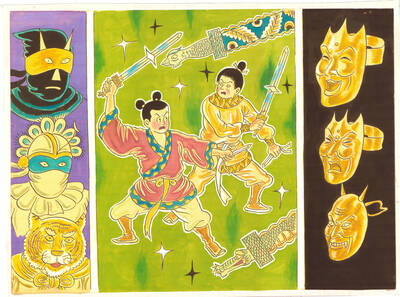
April 22 to April 28 The true identity of the mastermind behind the Demon Gang (魔鬼黨) was undoubtedly on the minds of countless schoolchildren in late 1958. In the days leading up to the big reveal, more than 10,000 guesses were sent to Ta Hwa Publishing Co (大華文化社) for a chance to win prizes. The smash success of the comic series Great Battle Against the Demon Gang (大戰魔鬼黨) came as a surprise to author Yeh Hung-chia (葉宏甲), who had long given up on his dream after being jailed for 10 months in 1947 over political cartoons. Protagonist

Peter Brighton was amazed when he found the giant jackfruit. He had been watching it grow on his farm in far north Queensland, and when it came time to pick it from the tree, it was so heavy it needed two people to do the job. “I was surprised when we cut it off and felt how heavy it was,” he says. “I grabbed it and my wife cut it — couldn’t do it by myself, it took two of us.” Weighing in at 45 kilograms, it is the heaviest jackfruit that Brighton has ever grown on his tropical fruit farm, located


 RSS
RSS