


Right before A Sun-Wu (吳炫三) set fire to more than 20 of his paintings at the opening of his solo exhibition at Sun Yat-sen Memorial Hall last week, a person in the crowd asked him, "Why burn them, why not just keep them in storage."
It was a valid question to which Wu somewhat enigmatically replied, "This is not my art."
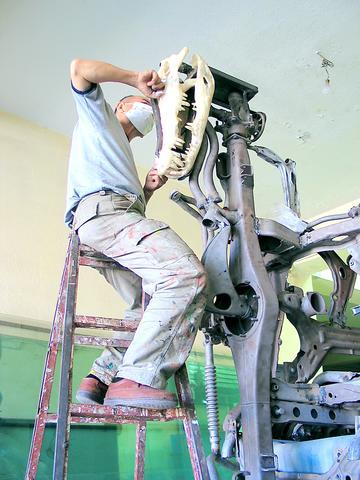
PHOTO COURTESY OF ARTIST
A few days ago over dinner, Wu, who is one of the country's foremost artists, explained his actions in more detail.

"There will always be some things you do when you are younger that you feel are not true representations of your work, and for me, those paintings were not finished."
The pieces had been completed when Wu was an art student. Nearly 30 years later, before undergoing major surgery last year, Wu said he promised himself that if he survived the operation he would "clean up his collection" and do away with earlier works he wasn't satisfied with.
A collection of paintings and sculptures that Wu is pleased with are currently part of a solo exhibition at Sun Yat-sen Memorial Hall. Moving through the gallery, visitors can witness a change in the artist's style, from landscape paintings in the 1960s to his more recent self-labeled "primitive paintings."
It was 10 years of traveling in Africa, Central America, and the South Pacific, that affected his art and attitude the most Wu said.
"Before I went to Africa, I always painted landscapes and I felt bound by painting principles and rules. After I came back form Africa, I didn't care about principles and rules in painting. I stopped painting landscapes and started to paint what I felt inside me."
Wu never had difficulty selling his landscape paintings, but his travel-inspired work was not so well-received at first, he said. But, after a few shows in France and the US, he started getting rave reviews in Europe and Wu's post-travel paintings began to sell in Asia. Now his paintings and sculptures can be seen in galleries and museums around the world.
Walking through the gallery, it's possible to witness a change in Wu's style and technique. During the 1980s he used a lot of bright color and more human-like forms in paintings such as Bone (1981) and African Shep-herd (1984). Then in the mid-to-late 1990s, Wu said he wanted to "go back to the basics."
So, he began using only red, white and black. Around the same time, he started to combine elements of Taoism together with his travel experiences. The result was abstract portrait painting of indigenous peoples using soft, feminine curved lines (yin) and sharp, masculine straight lines (yang), Wu said.
His most recent works contrast tradition with modernity by creating sculptures out of used car parts and animal bones. In addition to mixing Chinese philosophy and religion with his traveling experiences, Wu said nature has always had a great impact on his work. "Nature is my best teacher."
Wu illustrated his statement with an example of his work, The Story of the Bunun Tribe, which uses acrylic on wood.
Asked whether he had been accused of misappropriation of indigenous peoples in his work, Wu said he was once charged with making fun of African people in his paintings.
"Although I am not an Aboriginal, I have always respected and been inspired by the Aboriginals' way of life in Taiwan and wherever I travel," Wu said.
Exhibition notes:
What: Disturbance of the Wild: A-Sun Wu's Solo Exhibition
Where: Sun Yat-sen Memorial Hall (
Telephone: (02) 2758 8008
When: Until Sept. 1, daily from 9am to 5pm.

In late October of 1873 the government of Japan decided against sending a military expedition to Korea to force that nation to open trade relations. Across the government supporters of the expedition resigned immediately. The spectacle of revolt by disaffected samurai began to loom over Japanese politics. In January of 1874 disaffected samurai attacked a senior minister in Tokyo. A month later, a group of pro-Korea expedition and anti-foreign elements from Saga prefecture in Kyushu revolted, driven in part by high food prices stemming from poor harvests. Their leader, according to Edward Drea’s classic Japan’s Imperial Army, was a samurai

The following three paragraphs are just some of what the local Chinese-language press is reporting on breathlessly and following every twist and turn with the eagerness of a soap opera fan. For many English-language readers, it probably comes across as incomprehensibly opaque, so bear with me briefly dear reader: To the surprise of many, former pop singer and Democratic Progressive Party (DPP) ex-lawmaker Yu Tien (余天) of the Taiwan Normal Country Promotion Association (TNCPA) at the last minute dropped out of the running for committee chair of the DPP’s New Taipei City chapter, paving the way for DPP legislator Su
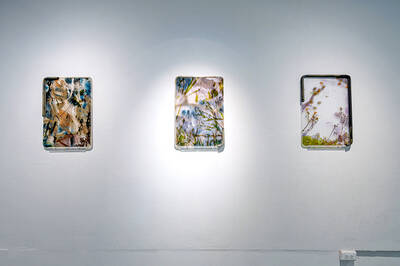
Located down a sideroad in old Wanhua District (萬華區), Waley Art (水谷藝術) has an established reputation for curating some of the more provocative indie art exhibitions in Taipei. And this month is no exception. Beyond the innocuous facade of a shophouse, the full three stories of the gallery space (including the basement) have been taken over by photographs, installation videos and abstract images courtesy of two creatives who hail from the opposite ends of the earth, Taiwan’s Hsu Yi-ting (許懿婷) and Germany’s Benjamin Janzen. “In 2019, I had an art residency in Europe,” Hsu says. “I met Benjamin in the lobby
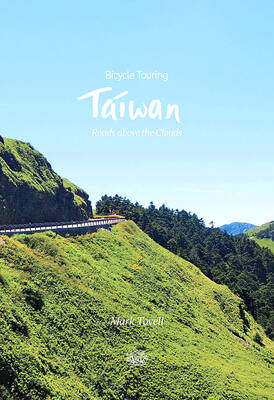
It’s hard to know where to begin with Mark Tovell’s Taiwan: Roads Above the Clouds. Having published a travelogue myself, as well as having contributed to several guidebooks, at first glance Tovell’s book appears to inhabit a middle ground — the kind of hard-to-sell nowheresville publishers detest. Leaf through the pages and you’ll find them suffuse with the purple prose best associated with travel literature: “When the sun is low on a warm, clear morning, and with the heat already rising, we stand at the riverside bike path leading south from Sanxia’s old cobble streets.” Hardly the stuff of your


 RSS
RSS