


This is the second of two linked novels set in Taiwan by a local writer and the sequel to Losing Plum Blossom, issued last year. If your tastes runs to romantic fiction with a strong element of political intrigue, this could be the book for you. This latest installment could even be said to aspire to being a Taiwanese Sex and the City or Gone With the Wind. So, how far does it succeed?
The story of The Black King follows the fortunes of Clarissa, an American widow who, following the death of her husband in Vietnam, has married a Taiwanese orthopedic surgeon. Her central problem is that her marriage has never been consummated because her husband, Ahmed, is gay and has a boyfriend who works alongside him in the same Taipei hospital he works in. Ahmed ("An-men" in Chinese, but Clarissa finds "Ahmed" more romantic), has a Japanese father who now lives in Tokyo but has a dark past as the man responsible for some brutally-run prisoner-of-war camps in Taiwan during World War II.

Clarissa has a wide range of men friends who she meets in Taipei bars, embarking on tentative affairs with more than one of them. There's the good-looking Nathan; an agent of US intelligence services called Sam; Arthur, for whom she is something of a mother-substitute; a Catholic priest called Jack; and several more.
Taipei locations naturally abound, lightly disguised. There are bugged rooms in the "Great Hotel," love trysts in the "Margarita" and "Lilac" hotels, assignations at the "Swine and the Hock" and "Fox and the Flounder" pubs in the twilight zone, a luxurious house on "Central Mountain Road," and so on.
There's plenty of politics here too. Characters are affiliated to either the "China reunification side" or the "Underground Taiwan Independence Movement." Japan believes anything approaching an independent Taiwan would effectively throw the island back under its control, while the US is attempting to rein in pro-independence radicals, while at the same time placing limits on the growth of Chinese power in the Pacific region. And there's a pseudo-priest from Chechnya called Igor who, prior to the novel's opening, has been up to no good among Aborigines in the mountains above Hualien.
In order to assess how successful this novel is, we should ask what kind of book it is. Is it the product of a local Dame Barbara Cartland, queen of British romantic fiction, some sort of parody of that genre, or the far-sighted product of an academic who has also produced a volume of anthropological essays? The fairest answer is probably that it's something of all three, but with more of the first than the others, plus elements of James Bond thrown in.
With its mix of political, inter-racial, and romantic entanglements this is a novel that isn't afraid to tackle big issues. There are
problems, nevertheless. To begin with, the story's dates are hard to get to grips with. Ahmed is presented as having been traumatized by troops during the 228 Incident in 1947. Yet the novel is set in the 21st century -- there are references to the US presence in Afghanistan and Iraq. This would put Ahmed, at his youngest, somewhere in his mid-60s, yet he is depicted as being about to take up a scholarship to further his medical studies in Texas. (Even more problematically, Clarissa is represented as being significantly older than Ahmed.) Furthermore, the tone and details of the novel suggest an older Taipei than today's city. On these grounds my guess is that this is a work that's been on the stocks for some time and has recently been revised for
publication.
There are some minor textual oddities -- phrases like "with his tale between his legs" and "scurrying out into the lobby, she swear she saw ..." Triple exclamation points abound. Phrases such as "that hated Lovencraft beast" and "gay as a goose" recur. (It should be said in passing that neither the author nor her main character anywhere express anti-gay sentiments, though the plot offers many opportunities for them, the nearest thing being some self-loathing outbursts put into the mouth of Ahmed himself).
All this may suggest a world of self-published popular romantic fiction. Yet the book is slightly more sophisticated than this, displaying a knowledge of history, a clear-headed control of plot, and strongly delineated characters, even if their dialogue exchanges are sometimes stereotyped and formulaic.
It's possible this reviewer isn't sufficiently experienced in reading popular novels aimed at a wide readership to make a fair assessment of this sometimes steamy amalgam. There's no doubt the story proceeds with pace and that its characters confront each other with vigor and decisiveness.
If your preference is for books that are cogent, skeptical and ironic, this novel will probably appear gushing, generalizing and over-emotional. It is nevertheless a work that could find a ready audience among English-speaking foreigners in Taiwan. There isn't a boring page, even if there are some embarrassing ones. It's enthusiastic rather than stylish and may raise a few laughs where the author didn't intend them.
Even so, it's a book that readers eager for red-blooded fiction with a local setting may decide they can't afford to ignore. There aren't, after all, that many novelists at work willing to take on Taiwan on the grand scale in quite this unbridled fashion.
The book is available at Caves and Bookman.
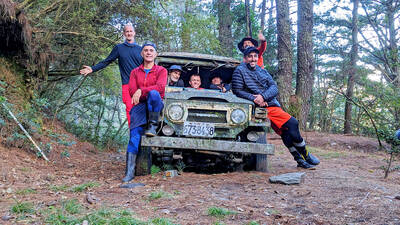
The year was 1991. A Toyota Land Cruiser set out on a 67km journey up the Junda Forest Road (郡大林道) toward an old loggers’ camp, at which point the hikers inside would get out and begin their ascent of Jade Mountain (玉山). Little did they know, they would be the last group of hikers to ever enjoy this shortcut into the mountains. An approaching typhoon soon wiped out the road behind them, trapping the vehicle on the mountain and forever changing the approach to Jade Mountain. THE CONTEMPORARY ROUTE Nowadays, the approach to Jade Mountain from the north side takes an

Last week Joseph Nye, the well-known China scholar, wrote on the Australian Strategic Policy Institute’s website about how war over Taiwan might be averted. He noted that years ago he was on a team that met with then-president Chen Shui-bian (陳水扁), “whose previous ‘unofficial’ visit to the US had caused a crisis in which China fired missiles into the sea and the US deployed carriers off the coast of Taiwan.” Yes, that’s right, mighty Chen caused that crisis all by himself. Neither the US nor the People’s Republic of China (PRC) exercised any agency. Nye then nostalgically invoked the comical specter
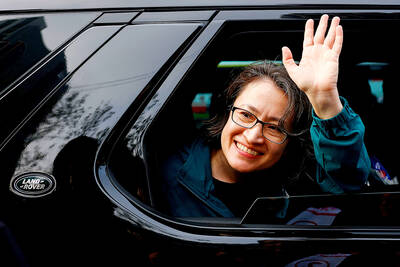
Relations between Taiwan and the Czech Republic have flourished in recent years. However, not everyone is pleased about the growing friendship between the two countries. Last month, an incident involving a Chinese diplomat tailing the car of vice president-elect Hsiao Bi-khim (蕭美琴) in Prague, drew public attention to the People’s Republic of China’s (PRC) operations to undermine Taiwan overseas. The trip was not Hsiao’s first visit to the Central European country. It was meant to be low-key, a chance to meet with local academics and politicians, until her police escort noticed a car was tailing her through the Czech capital. The
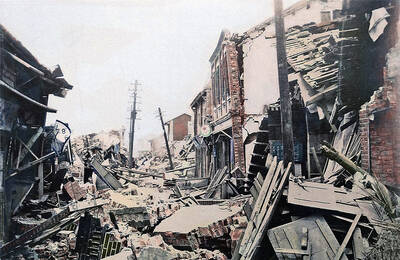
April 15 to April 21 Yang Kui (楊逵) was horrified as he drove past trucks, oxcarts and trolleys loaded with coffins on his way to Tuntzechiao (屯子腳), which he heard had been completely destroyed. The friend he came to check on was safe, but most residents were suffering in the town hit the hardest by the 7.1-magnitude Hsinchu-Taichung Earthquake on April 21, 1935. It remains the deadliest in Taiwan’s recorded history, claiming around 3,300 lives and injuring nearly 12,000. The disaster completely flattened roughly 18,000 houses and damaged countless more. The social activist and


 RSS
RSS