


When 24-year-old Taiwanese violinist Lu Kuan-cheng (盧冠呈) began his bid for a chair in the New York Philharmonic, he did so from behind a screen. One auditor who sat on the other side of that screen, Maestro Lorin Maazel, had no clue as to the identity of the person who'd dazzled him with Dvorak' s Concerto. He'd later comment that he hadn't heard the piece played at audition in many years. Then he'd offer Lu a chair as the youngest member of the Philharmonic and the first Taiwanese to ever earn a seat in the orchestra in its 150-year history.
But while his accomplishment makes him a musical ambassador in the eyes of most, Lu is a cultural refugee of the ROC government. As a Taiwanese male who has recently completed his college education, Lu is compelled to serve two years of military service. Failure to do so makes him akin to an outlaw in Taiwan and, should he return home with his orchestra on a planned tour of Asia next year, he'd surely be greeted at the airport with flowers and flashbulbs, then be promptly detained.
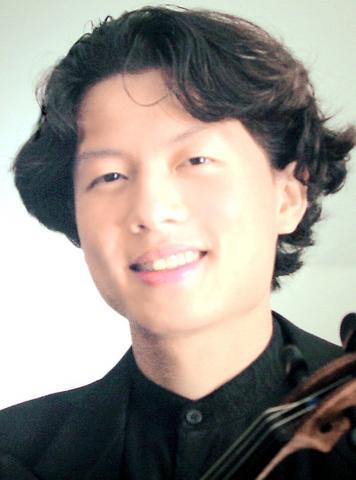
That won't happen anytime soon, however. The Philharmonic's official season begins on the Sept. 20, but it is scheduled to first play in Spain at the end of this month.
And so Lu's days are filled with rehearsals and his mind is filled more with preparations for performance than concern over his future. After all, he's spent the better part of two decades to get where he is.
Lu began studying violin at age six with his father, Lu Tseng-chih, then an elementary school music teacher in the family's native Fengshan Township, Kaohsiung County.
"My father had a lot of students," Lu recalled of his childhood. "I was just one of them. But we were quite serious."
Lu said he would practice an hour or two every day even before beginning his formal education.
"It was quite tough, actually, because they were quite demanding at school academically," he said. "So I would have to go through all the regular courses and testing, but then I also had all the bushiban courses in music theory, English and math -- all that stuff."
His family moved to Taichung when Lu began high school, but he spent only one year there before being uprooted again and transplanted in Michigan, where he'd been accepted to the renowned Interlochen Arts Academy, in itself a serious accomplishment for a young music student.
From there he went to Oberlin, where he'd eventually earn the first chair in the university's chamber orchestra, then on to the Manhattan School of Music for his master's degree.
While still studying for his masters, Lu began auditioning for a chair in a symphony orchestra. First Chicago -- it was a nerve-wracking experience, he said, that taught him the importance of confidence in the audition process -- then San Francisco. Fate played a part in his third major audition, for the New York Philharmonic. Five violinists had retired from the orchestra at the end of the previous season and three chairs remained when Lu auditioned for it in May last year. Over 400 of the world's best violinists auditioned.
Lu played a few minutes of music from behind a large screen erected on the stage of Lincoln Center and impressed the judges enough to earn a slot in the second round. He was given several symphony excerpts and a week's time to study them.
When he returned to Lincoln Center a week later, he was asked to play four or five of the pieces. Lu was no longer behind a screen and the Philharmonic' s conductor, Lorin Maazel, and its music director, Kurt Masur, could now see the person they'd previously only heard. Lu again made the cut. Now, with all but 11 musicians eliminated, the board of auditors could sit with each for a longer time, hear them play more music and ask them questions. It was here that Lu's lesson in confidence paid off.
He was asked to play not four or five of the excerpts he'd been given but all of them. Having rehearsed them voraciously, Lu played for some 25 minutes largely from memory. They also wanted to know what kind of violin he played and were surprised to learn that he'd used his own instrument, an Amati he purchased while still at Oberlin.
"A lot of people will rent a Stradivari or Guarneri from music shops for an audition like this," Lu said. "I wasn't comfortable playing with a violin that was new to me."
Maazel, for his part, was also impressed with Lu's choice of music for the first round.
"Most people don't choose to play Dvorak," Lu said. "Maestro Maazel said he hadn't heard it played in audition in years. I think that may have given me a slight advantage."
Then Maazel, Masur and the other auditors went behind closed doors for three long hours.
Rather than pace the floor, each of the 11 finalists found a room and prepared to play again should they be asked. They weren't. When they emerged from their deliberations, the judges sent home eight of the musicians disappointed and awarded chairs to Lu, his alumna at the Manhattan School of Music, Elizabeth Zeltser, and a third violinist from China (It was also the first time in the orchestra's history that two ethnic Chinese were accepted at the same time. Lu said the symphony has a total of four Chinese musicians. The other three are all from China.)
Zeltser and the Chinese finalist joined the symphony immediately, but Lu opted to finish his master's while concurrently sitting with the orchestra. Though he's since earned his diploma, he says his formal education is far from over. Rather, taking a chair in the symphony has become an extension of his education. "I'm still learning," he said.
Lu first played with the orchestra in September of last year. What was it like to become a member of one of the world's great symphony orchestras?
"Very, very ? It was a brand new experience," he said. "And also such a high standard. But people are very nice. I'm still the youngest. A lot of people are in their 40s and some are in their 70s. I think people treat me as a kid most of the time, but they still regard me as a colleague."
But even as Lu takes his chair in the back row of the Philharmonic's violin section, he must still play from behind another kind of screen, one diplomatic in nature. He has six months remaining on the visa issued him by Taiwan's consular offices in New York and the Philharmonic has promised to help him secure a green card to stay in the US.
While not willing to go on record, officials at the Taiwan Economic and Cultural Office in New York privately express confidence that Lu will be able to continue playing with the Philharmonic rather than having to march back to Taiwan to join the military.
Lu is confident too.
"As long as I don't go to Taiwan, they're not going to come take me back."

Last week Joseph Nye, the well-known China scholar, wrote on the Australian Strategic Policy Institute’s website about how war over Taiwan might be averted. He noted that years ago he was on a team that met with then-president Chen Shui-bian (陳水扁), “whose previous ‘unofficial’ visit to the US had caused a crisis in which China fired missiles into the sea and the US deployed carriers off the coast of Taiwan.” Yes, that’s right, mighty Chen caused that crisis all by himself. Neither the US nor the People’s Republic of China (PRC) exercised any agency. Nye then nostalgically invoked the comical specter
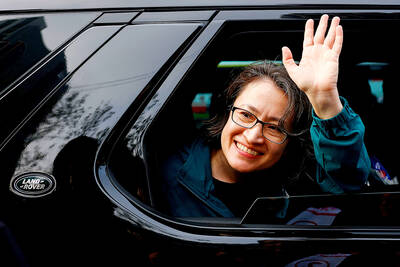
Relations between Taiwan and the Czech Republic have flourished in recent years. However, not everyone is pleased about the growing friendship between the two countries. Last month, an incident involving a Chinese diplomat tailing the car of vice president-elect Hsiao Bi-khim (蕭美琴) in Prague, drew public attention to the People’s Republic of China’s (PRC) operations to undermine Taiwan overseas. The trip was not Hsiao’s first visit to the Central European country. It was meant to be low-key, a chance to meet with local academics and politicians, until her police escort noticed a car was tailing her through the Czech capital. The
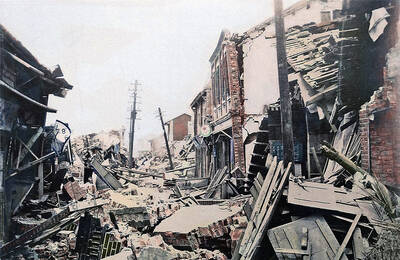
April 15 to April 21 Yang Kui (楊逵) was horrified as he drove past trucks, oxcarts and trolleys loaded with coffins on his way to Tuntzechiao (屯子腳), which he heard had been completely destroyed. The friend he came to check on was safe, but most residents were suffering in the town hit the hardest by the 7.1-magnitude Hsinchu-Taichung Earthquake on April 21, 1935. It remains the deadliest in Taiwan’s recorded history, claiming around 3,300 lives and injuring nearly 12,000. The disaster completely flattened roughly 18,000 houses and damaged countless more. The social activist and

Over the course of former President Ma Ying-jeou’s (馬英九) 11-day trip to China that included a meeting with Chinese Communist Party (CCP) leader Xi Jinping (習近平) a surprising number of people commented that the former president was now “irrelevant.” Upon reflection, it became apparent that these comments were coming from pro-Taiwan, pan-green supporters and they were expressing what they hoped was the case, rather than the reality. Ma’s ideology is so pro-China (read: deep blue) and controversial that many in his own Chinese Nationalist Party (KMT) hope he retires quickly, or at least refrains from speaking on some subjects. Regardless


 RSS
RSS