


It is an ordinary flower shop in a lane near National Taiwan University. Mr. Liu is doing his part-time job here as a clerk. This afternoon he has his usual smile and cordially greets customers in the usual way. "Huan ying guang lin" (Welcome)!"
"I'd like some roses."
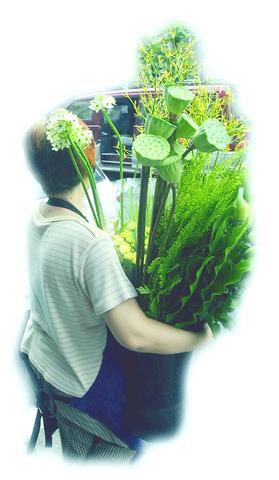
PHOTO: CHIANG YING-YING, TAIPEI TIMES
"Is it for home decoration, or for a present?"
While Liu attends to the customers, his coworkers get on with their work. Some trim the branches of a bonsai, others cut thorns from roses. Others sort out a pile of promotional leaflets. They all look happy in their work and proud to be there, but they're not likely to tell their parents about the place.
The flower shop is also the office of Harmony Home Association (關愛之家協會), a self-help group and half-way house for AIDS patients, or people who are HIV-positive. It was the first institution in Taiwan set up to provide shelter, as well as being a workplace for people with AIDS.
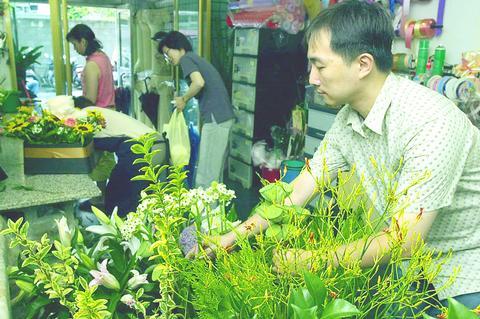
PHOTO: CHIANG YING-YING, TAIPEI TIMES
Nicole Yang (楊婕), who is called Yang Jie (older sister Yang) by workers and volunteers in the flower shop, set up the house 18 years ago to offer job opportunities and a social life for those suffering from the disease, or discrimination against it. "There was simply a need to give them things to do, so that they wouldn't drown in their own feelings of depression, or feelings of isolation," Yang says.

PHOTO: CHIANG YING-YING, TAIPEI TIMES
The flower shop, with less than 10 regular employees (mostly part-time), is able to partly fund two half-way houses for those who are ill (both physically and mentally) with AIDS. In total, Yang offers 25 beds and takes in an average of 750 people per month.
The association was not registered by the government as an AIDS social group until nine months ago, when expenses increased and the income of the flower shop could not make balance. "We did not want government's help," she says.

PHOTO COURTESY OF HARMONY HOME
Getting people with AIDS to regain their sense of self-worth is very important, Yang says. She devoted herself to AIDS work out of passion for a friend, she says, adding she has has no social work experience, or medical background. Eighteen years ago, this friend of hers contracted AIDS, became depressed and an alcoholic.

PHOTO: CHIANG YING-YING, TAIPEI TIMES
"One day when he felt most helpless, we found a bunch of tangled ribbons in my old gallery and I said, `Why don't you sit here and sort out these ribbons?'"
"It helped. He began doing it every day and six months later he resumed his daily work in the business field," Yang says.
Mr. Liu, 35, is a new arrival at the flower shop. He became sick last November and his friends and family turned away from him when they found out that he had AIDS. He lost his job selling handbags in Sanchung, Taipei County. Complications from the disease affected his eyesight, slowed his movement and the speed of his speech.
"Did you know I tried to commit suicide by hanging myself?" he says. "But the branch broke. I guess God did not want me go so soon."
Mr. Liu says he enjoys busy days at the shop, such as school graduation days and Chinese Valentine's Day, because they are the most exciting and help him forget about his own problems. "I'm grateful to Yang Jie, otherwise I'd probably be wandering the streets," he says.
Jacky Teng is a volunteer at the flower shop and is also the association's chairman. He was a hairdresser and used to have his own business with five employees, making NT$300,000 a month. But 10 years ago, a health checkup result found he was HIV-positive. The result was carelessly disclosed by a medical worker and rumors spread around the neighborhood. Fewer customers visited and eventually he had to close down the salon. He later found work as a clerk at a sauna.
"My aim now is try to help as many people as I can. As for the hair salon, I still want to re-open it, but I have not enough money," Teng says. As he talks, someone suddenly shouts, "Somebody come! Chang fainted!"
Outside the flower shop in the lane, a man sprawls on the ground, having spasms. Four workers carry him into the house. Nicole Yang calmly asks the men to lay Chang down on a bed and asks a social worker to call the ambulance. "Oh, by the way, could you ask them not to put on the siren. We don't want to disturb the neighbors," Yang adds.
Even so, the ambulance, accompanied by police, with medical workers in masks, suits and gloves, inevitably attracts attention. Neighbors and passers-by rubberneck, trying to find out what's going on.
Although the health insurance system, which covers expenses for cocktail therapy treatment (costing each patient about NT$20,000, with a sliding scale of subsidy depending on income), AIDS patients are cautious about public attention because of the stigma of the disease.
"From our experience, the biggest problem Taiwan has [for AIDS and HIV-positive people] is social acceptance," Yang says. She tells of a patient ready to return to his hometown and workplace from the half-way house. But relatives and residents lined up to prevent him from entering the village. According to the Positive Rights Association (愛滋感染者權益促進會), discrimination in the workplace is the most common complaint from people with AIDS or who are HIV-positive.
A man lost his job because the nurse called out to him "did you take your AIDS pills, Mr.?" when his colleagues were visiting him in hospital. Last month, an AIDS patient infected, because of a blood transfusion due to hemophilia, was beaten up by two policemen on the street when he refused to show his ID. The police thought he looked skinny and suspicious, "like a drug dealer."
The flower shop and Harmony Home have also suffered from discrimination. After finding out employees of the organization had AIDS, the landlord decided not to renew the lease. Both the flower shop and the association need to move by the end of the month. "It could be big trouble because we have not found a new place," Yang says.
"People obviously have concerns about [AIDS]. If we mention the word they immediately say, `Oh, we've rented the place out, sorry!'" says Rosa Liu, a designer at the flower shop.
Having devoted herself to AIDS work for 18 years, Yang does not give up easily. In fact, she is expanding her care work to China. Harmony Home has set up nine workshops throughout China, and three half-way houses in Guanxi, Guandong and Henan -- each with 15 beds. In Henan, the so-called AIDS village (where 300 people are infected and 100 died in a village of 3,000), she helped set up and financially supports the orphanage/school for AIDS orphans.
For Yang, there is never enough time to finish all the work she has to do. In Taipei, she is planning to set up a laundry, where jobless people with AIDS can work. "In China, apart from more half-way houses and hospice services, we want to follow the example of Project Open Hand to offer meal delivery services," she says.
"But we will not forget the families and friends' here at the flower shop. First of all, we must find a new home soon," Yang says.
The names of the people with AIDS in the article above have been changed to protect their identity.

Last week Joseph Nye, the well-known China scholar, wrote on the Australian Strategic Policy Institute’s website about how war over Taiwan might be averted. He noted that years ago he was on a team that met with then-president Chen Shui-bian (陳水扁), “whose previous ‘unofficial’ visit to the US had caused a crisis in which China fired missiles into the sea and the US deployed carriers off the coast of Taiwan.” Yes, that’s right, mighty Chen caused that crisis all by himself. Neither the US nor the People’s Republic of China (PRC) exercised any agency. Nye then nostalgically invoked the comical specter

Relations between Taiwan and the Czech Republic have flourished in recent years. However, not everyone is pleased about the growing friendship between the two countries. Last month, an incident involving a Chinese diplomat tailing the car of vice president-elect Hsiao Bi-khim (蕭美琴) in Prague, drew public attention to the People’s Republic of China’s (PRC) operations to undermine Taiwan overseas. The trip was not Hsiao’s first visit to the Central European country. It was meant to be low-key, a chance to meet with local academics and politicians, until her police escort noticed a car was tailing her through the Czech capital. The
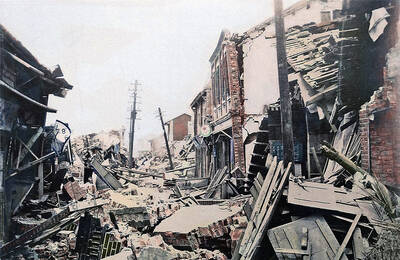
April 15 to April 21 Yang Kui (楊逵) was horrified as he drove past trucks, oxcarts and trolleys loaded with coffins on his way to Tuntzechiao (屯子腳), which he heard had been completely destroyed. The friend he came to check on was safe, but most residents were suffering in the town hit the hardest by the 7.1-magnitude Hsinchu-Taichung Earthquake on April 21, 1935. It remains the deadliest in Taiwan’s recorded history, claiming around 3,300 lives and injuring nearly 12,000. The disaster completely flattened roughly 18,000 houses and damaged countless more. The social activist and

Over the course of former President Ma Ying-jeou’s (馬英九) 11-day trip to China that included a meeting with Chinese Communist Party (CCP) leader Xi Jinping (習近平) a surprising number of people commented that the former president was now “irrelevant.” Upon reflection, it became apparent that these comments were coming from pro-Taiwan, pan-green supporters and they were expressing what they hoped was the case, rather than the reality. Ma’s ideology is so pro-China (read: deep blue) and controversial that many in his own Chinese Nationalist Party (KMT) hope he retires quickly, or at least refrains from speaking on some subjects. Regardless


 RSS
RSS