


The first notes of the serenade slipped through the window, the shutters flew open, and Francesca Bonanni glided out onto the balcony. Looking down at the busy street, she swooned upon seeing her tall, tan and handsome fiance.
The short, plump and somewhat gaudily dressed middle-aged fellow standing beside him seemed to attract less of her attention, even though he was the one singing his heart out.
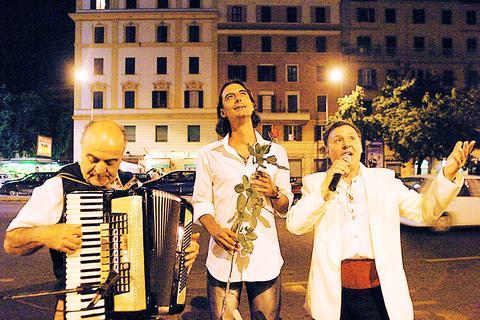
PHOTO: NY TIMES
Since few men have the lungs to belt love songs properly over the city's noisy traffic and up to fourth-story windows, there is a small troupe of professional serenaders that Romans are increasingly hiring to do their courting for them.
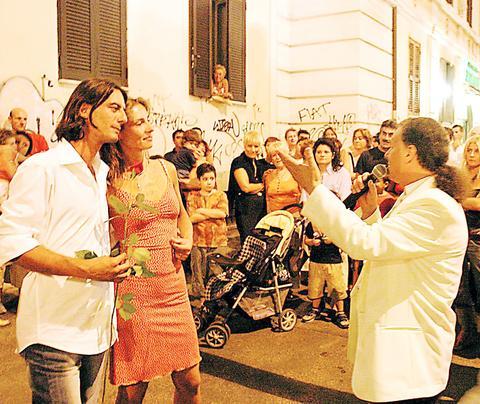
PHOTO: NY TIMES
"If I could sing like him, then I'd be doing his job," explained Enrico Zaffari, the 36-year-old fiance.
He was referring to Ettore Spina, 56, who is a sort of matrimonial salesman traveling from balcony to balcony in a white suit jacket and red cummerbund to help vicariously woo the city's brides-to-be, at US$300 a night and up.
Sure, serenaders opt for tacky wedding singer apparel, use microphones to amplify their velvet voices and favor a sentimental repertory. But there is an overwhelming sweetness to their sappiness that strikes to the very core of the Roman heart.
"Romans are very warm-hearted, emotional people," said Zaffari, who was visibly moved by the roses Bonanni tossed him and the tunes Spina sang on the eve of his wedding day. "It's an important tradition, especially in the real Roman neighborhoods."
Rome's dozen or so serenaders tend to ply their trade in the less picturesque parts of town, where dewy-eyed romanticism is a key ingredient in the more authentic Roman flavor. Spina and his fellow serenaders are being called on so frequently to strum heartstrings here that they long ago gave up the day job.
"There has been a reawakening of sentiment," said Ezio Baiocco, 35, a well-known serenader who says he performs about 65 times a year. "The demand keeps growing."
In the last 10 years, Spina said, business has more than doubled in places like this graffiti-stained apartment building in Piazza Dell'Alberone, where the serenade took place on a recent balmy Friday evening.
It started at 10pm, and as a spotlight was fixed on that yonder window, Zaffari, Spina and his 70-year-old accordion player, Cosimo Villari, took their places on a sliver of cement between two busy streets.
No one seemed to mind the commotion or the fact that the men were flanked by a lingerie advertisement and a bus stop.
"It's going to be a beautiful night," said Spina, who stroked his graying ponytail and sucked in his stomach while an assistant struggled to get him into a tight cummerbund. "All these kids become like my godchildren, and I'm like their godfather."
As a crowd of invited friends, suspicious neighbors and curious onlookers gathered at the corner gelato shop, Spina explained that he had been performing ever since he was a kid accompanying his serenade-singing father.
"I remember the favors even married men would ask my father. `Please play her a song -- we got into a nasty fight,' and things like that."
He said that serenading went back many generations earlier, and that in the 1800s specific songs were written for every destination on the map of the Roman heart. There were songs for courting, songs for anniversaries, songs dedicated to fathers of the bride and songs to ask forgiveness.
"And there were songs to show your disrespect after you'd been dumped," Spina said.
Once the music had started and everyone's eyes turned up to see Bonanni emerging from her apartment with a surprised expression and a pink dress, Spina went into a rendition of Paradise Serenade, crooning, "Wake up, wake up, oh tenderness awake!"
As a large orange bus screeched to a halt behind him, he deftly stepped aside while picking up the slack in his microphone wire.
The accordion player, Villari, remembered a time when such amplification wasn't necessary.
"Now they want all the power and spectacle," he said, admitting, however, that the buzzing scooters and bleating horns present a challenge even when they perform in quieter courtyards.
While many cars rushed by without a pause, a young couple on a scooter stopped to listen, caressing each other under the streetlight. A pedestrian put his cellphone up to the speakers, and neighboring shutters opened to reveal old women with cotton-ball hair looking dreamily down at the young lover and his surrogate singer.
But not everyone was so enamored.
"The music could be more modern," said Laura Gentili, a 29-year-old secretary licking a gelato cone and watching the serenade from the corner. "I mean, traditional love songs are not exactly the top."
"I wouldn't want one," she said. "I mean the days of Romeo and Juliet are over. And what if you walk out there and you're wearing curlers? It would be a tragedy."
But Spina warned against declining a serenade, recalling the "only time in history" when a woman absolutely refused.
"It was the eve of their wedding," he said. "The next day in church, he was the no-show," Spina said, adding that the serenade and subsequent wedding went ahead a week later. "This is a gift that a man makes to a woman. You don't refuse it. You accept, and that's that."

“Taiwan’s Opposition Leader Comes to US With a Message Straight Out of Beijing” read a May 31 headline in the Wall Street Journal. Top US administration officials and members of Congress almost certainly read the WSJ, and if there was a bullet point takeaway that people in Washington should absorb ahead of Chinese Nationalist Party (KMT) Chair Cheng Li-wun’s (鄭麗文) arrival in DC on June 9, that headline is it. The last few columns have discussed this very topic, and the timing is not coincidental. While those top officials likely do not read the Taipei Times, judging by the number

With weighty, anxiety-inducing geopolitical topics dominating the headlines, checking in on the wild and weird state of local politics can take some of the edge off. This November’s elections will determine who will be in charge of fixing potholes in your neighborhood, not the potholes in Taiwan’s complicated geopolitical space. Recently, after an online interview with a Taipei-based journalist, I commented that Taipei journalists never go further than the MRT can take them. He laughed and agreed. Naturally, the Taipei mayoral race is eating up much of the press attention. TAIPEI CITY Democratic Progressive Party (DPP) candidate Puma Shen (沈伯洋) has

Audiences in Leicester, Cardiff, London and Sheffield will this month gather to watch a series of black-and-white Taiwanese-language films made more than 70 years ago. On the surface, these screenings commemorate the seventieth anniversary of taiyupian (台語片) — Taiwanese-language cinema. Yet the significance of these events extends far beyond nostalgia or film history. They represent a remarkable chapter in Taiwan’s ongoing effort to recover, preserve and reinterpret a cultural heritage that was once thought to have largely disappeared. The centerpiece of the program is the Ho Chi-ming (何基明) directed Xue Pinggui and Wang Baochuan (薛平貴與王寶釧), a film produced in 1955 and
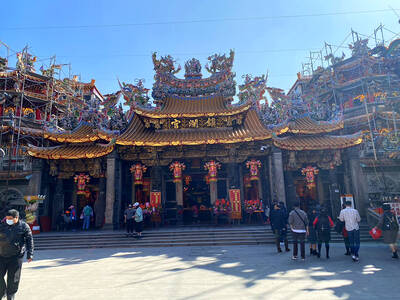
In December of 2008 Lee E-tin (李乙廷), a Miaoli county legislative hopeful, was convicted of vote-buying. Rather than buy votes retail, voter by voter, in the usual manner, Lee had done it wholesale, in a commendably efficient manner: he had visited local temples and made donations to gain their support. Because he did not normally make donations to temples, the court ruled he was attempting to improperly influence voter behavior. The case indicates how important temples are in influencing political life. Both judge and politician appeared to see them in the same way. Beijing sees them that way as well. Democratic Progressive


 RSS
RSS