


Ceramic arts including pottery, stoneware and porcelains have for centuries been the stuff for which China has been celebrated globally. Exported porcelains were given the name China (from Cina in Roman times) to mean ceramics among Europeans.
Back when Mesopotamia and Egypt were firing low-temperature earthenware, the Chinese were firing in proto-porcelains of great density and high ping, having developed the art of kiln making and temperature control early on.
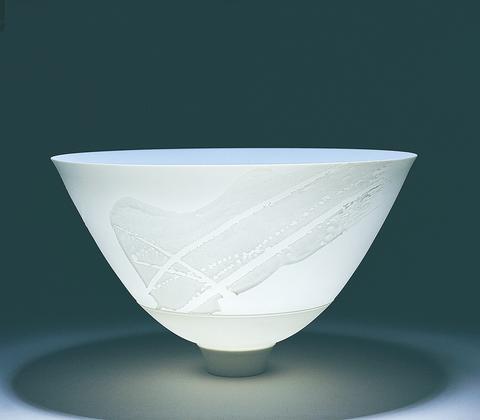
PHOTO COURTESY OF KAOHSIUNG MUSEUM OF FINE ARTS
Chinese potters experimented with lustrous and matt glazes, firing them under atmospheric and reduction kilns affecting the chemical composition of oxides in the glaze, resulting in heavenly jade-like celadons and the equally famous ox-blood reds. They were the first to use kaolin clay for porcelains, so that when thin enough, the walls revealed breathtaking translucency.
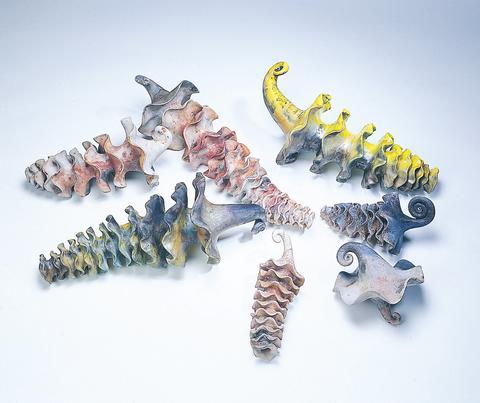
PHOTO COURTESY OF KAOHSIUNG MUSEUM OF FINE ARTS
Ceramics celebrate the most fundamental "Five Elements" of our habitat: a skillful and artistic integration of earth, water and fire, together with metal in the glazes and wood for the firing.
When temperatures rise to incandescence, a look through the peephole will show the clay (earth!) in the act of dissolving, of melting and bubbling or blistering in white heat. It is like witnessing creation itself. These elements bring us close to nature and impart a sense of the sacred, rarely experienced elsewhere.
Chinese potters have for millennia reflected sensitivity to working this malleable, yet enduring medium, striving for more shiny, more polished effects.
Japanese potters, on the other hand, have long preferred naturalness of materials and processes, and have evolved an ethos highlighting firing marks, pits, blisters and irregularities in the clay that may arise in firing, so that Japanese ware, often tactile and dramatic, honors raw materials.
The long pottery traditions of China, Korea and Japan make it appropriate for Taiwan to initiate an international gathering of potters, and indeed the Council for Cultural Affairs (行政院文化建設委員會) has launched Taiwan's first international ceramics biennale, organized by Taipei County Yingge Ceramics Museum (台北縣立鶯歌陶瓷博物館).
Experts have hired seven judges from Europe, America. Japan and Taiwan, who together identified from among nearly 700 submissions from around the world, the 125 winning pieces from 26 countries.
Hereafter huge disappointment sets in. The Grand Prize of NT$1.3 million, the highest ever to be awarded, went to Yoshikawa Masamichi (
Huge (140cm x 78cm) in scale but low slung (20cm in height), the glossy thin-walled compound includes compounds and a proverbial pigsty. Crafted in precision rectilinearity, it typifies Japanese architecture and, ironically, it's glazed in the swooning shimmer of celestial yingqing -- an iron-based reduction pale blue beloved for centuries in Japan.
The work's chief merit is the difficulty in handling kaolin on such a large scale without supports. But otherwise, no advance is evinced in either firing or glazing and worse, there is no feel for the materials in this borrowing of porcelain to imitate lacquered steel.
Second prize was also a massive (110cm x 78cm) ceramic imitation of "fictitious machinery" by American Steven Montgomery.
Again, the elemental ingredients that enliven this genre were denied participation. Once more the strength lay in surmounting technical difficulties when making metallic forms with unsuitable material -- but we miss the inspiration of art.
Effort centers on imitating a broken junk-yard car engine. If this is a current trend, then is it meritorious for artists or juries to follow trends? Whither independence or taste?
Third prize went to Swiss potter Arnold Annen whoseTranslucent Porcelain Bowl invites light to shine through thin walls (1mm to 1.5mm) revealing abstract designs in graduated thickness. This is the anhua technique perfected in Song Dynasty China a millennium back, and is here given a handsome modern look, white on white in a natural asymmetrical balance.
There are a few other works of high originality that extol the qualities and capabilities unique to earth-fired art -- aspects not possible for other media -- but alas, these have been far too few, and not honored.
Exhibition notes:
What: Taiwan's first international ceramics biennale
Where: Kaohsiung Museum of Fine Arts Galleries, 101-103, 80 Meishukuan Road, Kaohsiung (
When: Until Sept. 12, 9am to 5pm (closed Mondays).

In late October of 1873 the government of Japan decided against sending a military expedition to Korea to force that nation to open trade relations. Across the government supporters of the expedition resigned immediately. The spectacle of revolt by disaffected samurai began to loom over Japanese politics. In January of 1874 disaffected samurai attacked a senior minister in Tokyo. A month later, a group of pro-Korea expedition and anti-foreign elements from Saga prefecture in Kyushu revolted, driven in part by high food prices stemming from poor harvests. Their leader, according to Edward Drea’s classic Japan’s Imperial Army, was a samurai
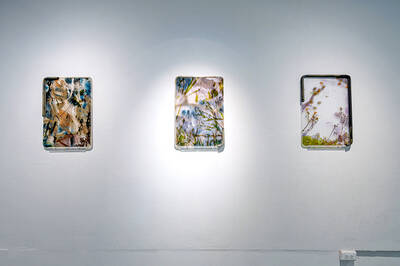
Located down a sideroad in old Wanhua District (萬華區), Waley Art (水谷藝術) has an established reputation for curating some of the more provocative indie art exhibitions in Taipei. And this month is no exception. Beyond the innocuous facade of a shophouse, the full three stories of the gallery space (including the basement) have been taken over by photographs, installation videos and abstract images courtesy of two creatives who hail from the opposite ends of the earth, Taiwan’s Hsu Yi-ting (許懿婷) and Germany’s Benjamin Janzen. “In 2019, I had an art residency in Europe,” Hsu says. “I met Benjamin in the lobby
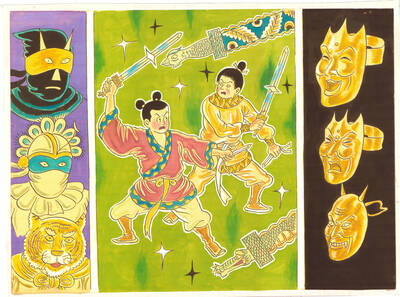
April 22 to April 28 The true identity of the mastermind behind the Demon Gang (魔鬼黨) was undoubtedly on the minds of countless schoolchildren in late 1958. In the days leading up to the big reveal, more than 10,000 guesses were sent to Ta Hwa Publishing Co (大華文化社) for a chance to win prizes. The smash success of the comic series Great Battle Against the Demon Gang (大戰魔鬼黨) came as a surprise to author Yeh Hung-chia (葉宏甲), who had long given up on his dream after being jailed for 10 months in 1947 over political cartoons. Protagonist

The following three paragraphs are just some of what the local Chinese-language press is reporting on breathlessly and following every twist and turn with the eagerness of a soap opera fan. For many English-language readers, it probably comes across as incomprehensibly opaque, so bear with me briefly dear reader: To the surprise of many, former pop singer and Democratic Progressive Party (DPP) ex-lawmaker Yu Tien (余天) of the Taiwan Normal Country Promotion Association (TNCPA) at the last minute dropped out of the running for committee chair of the DPP’s New Taipei City chapter, paving the way for DPP legislator Su


 RSS
RSS