


Alarmed by reports that marijuana is becoming more potent than ever and that children are trying it at younger and younger ages, US officials are changing their drug policies.
Pot is no longer the gentle weed of the 1960s and may pose a greater threat than cocaine or even heroin because so many more people use it. So officials at the National Institutes of Health and at the White House are hoping to shift some of the focus in research and enforcement from "hard" drugs such as cocaine and heroin to marijuana.
While drug use overall is falling among children and teenagers, the officials worry that the children who are trying pot are doing so at ever-younger ages, when their brains and bodies are vulnerable to dangerous side effects.
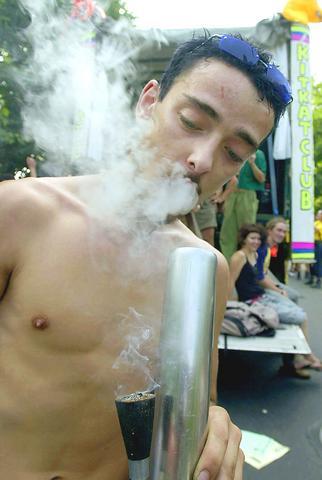
PHOTO: DPA
"Most people have been led to believe that marijuana is a soft drug, not a drug that causes serious problems," said John Walters, head of the White House Office of National Drug Control Policy.
"[But] marijuana today is a much more serious problem than the vast majority of Americans understand. If you told people that one in five of 12- to 17-year-olds who ever used marijuana in their lives need treatment, I don't think people would remotely understand it."
The number of children and teenagers in treatment for marijuana dependence and abuse has jumped 142 percent since 1992, the National Center on Addiction and Substance Abuse at Columbia University reported in April.
According to the report, children and teenagers are three times more likely to be in treatment for marijuana abuse than for alcohol, and six times likelier to be in treatment for marijuana than for all other illegal drugs combined.
And it found the age of youths using marijuana is falling. The teenagers aged 12 to 17 said on average they started trying marijuana at 13-and-a-half. The same survey found that adults aged 18 to 25 had first tried it at 16.
For National Institute on Drug Abuse director Dr Nora Volkow the final straw was a report her institute published in May in the Journal of the American Medical Association showing the steady growth in the potency of cannabis seized in raids.
According to the University of Mississippi's Marijuana Potency Project, average levels of THC, the active ingredient in marijuana, rose steadily from 3.5 percent in 1988 to more than 7 percent last year.
Volkow said many studies have shown the brain has its own so-called endogenous cannabinoids. These molecules are similar in structure to the active ingredients in marijuana and are involved in a range of activities and emotions ranging from eye function to pain regulation and anxiety.
Brain cells have receptors -- molecular doorways -- designed specifically to interact with these cannabinoids.
The cannabinoids in marijuana may use these ready-made doorways into brain cells and this is why they cause a high and reduce pain sensations. But Volkow believes the effects may go beyond the general feeling of well-being that most marijuana users seek.
"I would predict that stronger pot makes the brain less likely to respond to endogenous cannabinoids," Volkow said in an interview. The effects could be especially marked in young brains still growing and learning how to respond to stimuli, she said.
While the research so far is inconclusive, Volkow believes that cannabinoids affect the developing brain and that stronger pot, combined with earlier use, could make children and teenagers anxious, unmotivated or perhaps even psychotic.
As an analogy, Volkow said opiate addicts are more sensitive to pain, as their overuse of drugs have raised the threshold at which the body responds and their own bodies produce fewer natural opiates.
NIDA is seeking proposals from researchers who want to investigate such possibilities for cannabis, she said.
Proponents of legalizing marijuana disagree with the official line. Krissy Oechslin of the Marijuana Policy Project disputes the finding that cannabis products are stronger.
"They make it sound like the THC levels in marijuana were almost nonexistent, but no one would have smoked it then if that was true," she said.
"And there's evidence that the stronger the THC, the less of it a person smokes. I don't want to say it's good for you, but I'll say [more potent marijuana] is less bad for you."
While Walters stresses that drug abusers are patients and not criminals, he hopes to crack down more on producers. And he says, there is a way to go in getting cooperation from local law enforcement officials. "For many in enforcement, marijuana is still `kiddie dope,'" Walters said.
He is quick to stress he does not want to overreact.
"We shouldn't be victims of reefer madness," he said, referring to the 1930s propaganda film Reefer Madness that became a 1970s cult classic for its over-the-top scenes of marijuana turning teenagers into homicidal maniacs.

Last week Joseph Nye, the well-known China scholar, wrote on the Australian Strategic Policy Institute’s website about how war over Taiwan might be averted. He noted that years ago he was on a team that met with then-president Chen Shui-bian (陳水扁), “whose previous ‘unofficial’ visit to the US had caused a crisis in which China fired missiles into the sea and the US deployed carriers off the coast of Taiwan.” Yes, that’s right, mighty Chen caused that crisis all by himself. Neither the US nor the People’s Republic of China (PRC) exercised any agency. Nye then nostalgically invoked the comical specter
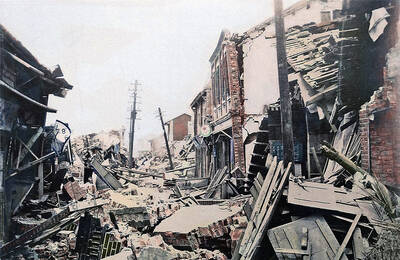
April 15 to April 21 Yang Kui (楊逵) was horrified as he drove past trucks, oxcarts and trolleys loaded with coffins on his way to Tuntzechiao (屯子腳), which he heard had been completely destroyed. The friend he came to check on was safe, but most residents were suffering in the town hit the hardest by the 7.1-magnitude Hsinchu-Taichung Earthquake on April 21, 1935. It remains the deadliest in Taiwan’s recorded history, claiming around 3,300 lives and injuring nearly 12,000. The disaster completely flattened roughly 18,000 houses and damaged countless more. The social activist and

Over the course of former President Ma Ying-jeou’s (馬英九) 11-day trip to China that included a meeting with Chinese Communist Party (CCP) leader Xi Jinping (習近平) a surprising number of people commented that the former president was now “irrelevant.” Upon reflection, it became apparent that these comments were coming from pro-Taiwan, pan-green supporters and they were expressing what they hoped was the case, rather than the reality. Ma’s ideology is so pro-China (read: deep blue) and controversial that many in his own Chinese Nationalist Party (KMT) hope he retires quickly, or at least refrains from speaking on some subjects. Regardless

Approaching her mid-30s, Xiong Yidan reckons that most of her friends are on to their second or even third babies. But Xiong has more than a dozen. There is Lucky, the street dog from Bangkok who jumped into a taxi with her and never left. There is Sophie and Ben, sibling geese, who honk from morning to night. Boop and Pan, both goats, are romantically involved. Dumpling the hedgehog enjoys a belly rub from time to time. The list goes on. Xiong nurtures her brood from her 8,000 square meter farm in Chiang Dao, a mountainous district in northern Thailand’s


 RSS
RSS