


Australia is shaken by about 200 tremors each year, but most register only about 3 on the Richter scale and usually occur in the outback, scaring a few birds and kangaroos.
But scientists say a major earthquake could strike Australia's largest city Sydney, population 4.5 million, and even a moderate quake could cause devastation and death.
The strongest quake on record in Australia registered about 6.9 on the Richter scale, matching the strength of Japan's Kobe earthquake in January 1995 that killed more than 6,400 people.

PHOTO: REUTERS
"Large earthquakes have occurred in sparsely populated areas. You can't discount that possibility, that a large earthquake might occur in the Sydney area," said Phil Cummins, head of the earthquake hazard team at government agency Geoscience Australia.
In fact, every five years or so a potentially disastrous earthquake of 6.0 or more on the Richter scale rocks Australia and a quake as high as 7 is expected to occur every 100 years.
And scientists say the larger quakes are more likely to hit the edges of the Australian continent where the vast majority of the population lives.
Australia's most damaging earthquake, a moderate 5.6 on the Richter scale, occurred in December 1989. The quake struck the coastal coal-mining city of Newcastle, killing 13 people, injuring 130.
Total estimated losses were US$4 billion, including uninsured losses, damage to infrastructure and community disruption, according to Emergency Management Australia, a government disaster management body.
Newcastle, with a population of more than 300,000, is about 140km north of Sydney.
CATASTROPHE GAME
Earthquakes, bushfires, cyclones and floods have the potential to cause havoc in Australia and the largest exposure to most of these risks is Sydney, given its status as the country's center of commerce and large population.
In the world of earthquakes, risk analysts play what they call "the catastrophe game" to figure out the odds of a quake hitting a city like Sydney.
There is only a small chance of a major earthquake striking Australia's eastern seaboard. But, as the Newcastle quake showed, they can happen and can cause extensive damage.
Regulators, particularly after the massive losses caused by the Sept. 11 attacks on the US, require Australia's insurers to buy a high level of cover.
"[Germany's] Munich Reinsurance were here almost a year ago. They cover the major disasters in the region. That was one of their major scenarios, a large earthquake in Sydney. That was one of their major concerns," Cummins said.
Insurance Australia Group Ltd, the country's largest insurer, has cover for earthquake losses of up to A$3 billion (US$2 billion) for this year. That figure includes coverage for quakes in nearby New Zealand, where the much greater likelihood of earthquake damage is also covered by a state-funded disaster insurer.
"Insurers have to buy cover to a level that means there is no more than a 1-in-250 chance of it being insufficient. You can assume that the risk is believed to be no more than this (US$2 billion)," an IAG company spokesperson said.
GUESSING GAME
The frequency of earthquakes is lower in Australia than in its Asia-Pacific neighbors because the continent sits on the Indo-Australian tectonic plate, rather than on a volatile edge.
Earthquakes are most common where different tectonic plates meet, for example in earthquake-prone New Zealand to the southeast, which straddles the Indo-Australian and Pacific Plates.
Intraplate earthquakes, like those in Australia and continental North America, are less common and do not follow a pattern. They can also feel more violent, because intraplate earthquakes generally occur closer to the earth's surface.
When a large earthquake occurs within 10km of the Earth's surface, the fault may rupture through the rocks that make up the Earth's surface and open up a long jagged rent.
Australia has had five such fault breakages in the past 30 years, more than any other country.
All five are in remote areas away from major population centers.
Hidden thrust faults pose hazards to buildings, roads, railways and pipelines which no-one can truly calculate. And just like Kobe, an Australian earthquake is likely to have a shallow epicenter, ensuring maximum damage.
In August 1994, an earthquake of about 5.6 on the Richter scale rattled Sydney and the east coast but it lasted for only about 10 seconds. Still, the tremor was felt over a 300km stretch from Wollongong to the south to Sydney and Newcastle in the north.

In late October of 1873 the government of Japan decided against sending a military expedition to Korea to force that nation to open trade relations. Across the government supporters of the expedition resigned immediately. The spectacle of revolt by disaffected samurai began to loom over Japanese politics. In January of 1874 disaffected samurai attacked a senior minister in Tokyo. A month later, a group of pro-Korea expedition and anti-foreign elements from Saga prefecture in Kyushu revolted, driven in part by high food prices stemming from poor harvests. Their leader, according to Edward Drea’s classic Japan’s Imperial Army, was a samurai

Located down a sideroad in old Wanhua District (萬華區), Waley Art (水谷藝術) has an established reputation for curating some of the more provocative indie art exhibitions in Taipei. And this month is no exception. Beyond the innocuous facade of a shophouse, the full three stories of the gallery space (including the basement) have been taken over by photographs, installation videos and abstract images courtesy of two creatives who hail from the opposite ends of the earth, Taiwan’s Hsu Yi-ting (許懿婷) and Germany’s Benjamin Janzen. “In 2019, I had an art residency in Europe,” Hsu says. “I met Benjamin in the lobby
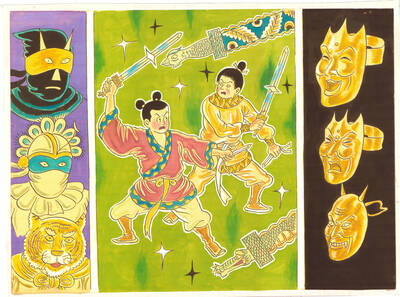
April 22 to April 28 The true identity of the mastermind behind the Demon Gang (魔鬼黨) was undoubtedly on the minds of countless schoolchildren in late 1958. In the days leading up to the big reveal, more than 10,000 guesses were sent to Ta Hwa Publishing Co (大華文化社) for a chance to win prizes. The smash success of the comic series Great Battle Against the Demon Gang (大戰魔鬼黨) came as a surprise to author Yeh Hung-chia (葉宏甲), who had long given up on his dream after being jailed for 10 months in 1947 over political cartoons. Protagonist

A fossil jawbone found by a British girl and her father on a beach in Somerset, England belongs to a gigantic marine reptile dating to 202 million years ago that appears to have been among the largest animals ever on Earth. Researchers said on Wednesday the bone, called a surangular, was from a type of ocean-going reptile called an ichthyosaur. Based on its dimensions compared to the same bone in closely related ichthyosaurs, the researchers estimated that the Triassic Period creature, which they named Ichthyotitan severnensis, was between 22-26 meters long. That would make it perhaps the largest-known marine reptile and would


 RSS
RSS