


If postmodernism is the mix of high and low culture, swallowing in one gulp past and present, tradition and newness, and all different media, then Taiwan's new generation of artists have certainly caught on to the world's most fashionable movement.
Unfortunately, in the 2004 Taipei Arts Award exhibit at the Taipei Fine Arts Museum (TFAM), they also seem to be lacking aesthetic depth, a common malaise in contemporary art. Concepts that merit perhaps a wry grin on the part of the viewer replace truly moving experiences, with a few notable exceptions. Video or projection installations creating simple tricks of light or animation stretch the limits of utter inanity.
Nevertheless, the exhibit manages to construct a certain thematic flow, reinforcing weaknesses by suggestive juxtapositions.

PHOTOS COURTESY OF TFAM
The striking gold background and black frame of Li Hsuan-chih's
Further in, Wu Yong-chieh's
Hua's series creates a wackier cartoon world while squeezing in a jab at traditional Chinese scroll painting. Four vertical toiles make a complete set, like any good quartet of ink paintings, but instead feature devious-looking "saints" of four different natures. All four share a face and fiery halo, including a thin but greedy looking Santa Claus and a grinning Buddha clutching jewels. Mismatched scenes and all manners of multi-cultural costumes come together for a collaged postmodern effect. The artist makes a smirking nod to the artifice of his creation with the presence of a stage curtain, stage lights and sets hung on strings.

The theme of self-reflexivity comes to full fruition when it reaches works by Lai Chih-sheng
The blandness of New Rainbow is made somewhat more interesting by Lai's display, Time Wall-Space Body. Rocks presented on a white canvas seem to be dotted as a part of their painted texture, until the viewer walks closer to the open cube space set up by the artist. On a white bench, as if a painting itself, lies an actual rock, dotted with the same brushstrokes. The wall behind the canvas is also covered with dots, connecting the display space, to the painted space, to the real space which is itself painted.
Sheu's contribution, Being There, broods on the nature of space more cognitively. A set of photographs shows empty urban spaces onto which their English dictionary definitions have been projected as if acknowledging the impossibility of fixed communication between artist and viewer. The light effects are haunting, but the series is more thrilling when it is almost too successful at searching for new definitions.
Perhaps the best aesthetic achievement is Narrative, an oil painting series by award-winner Chiou Jyian-ren
Exhibition note:
WHAT: Taipei Arts Award
WHERE: Taipei Fine Arts Museum, 181 Zhongshan N Rd. Sec 3, Taipei
WHEN: Through Sept. 19. Open Tuesday to Sunday.
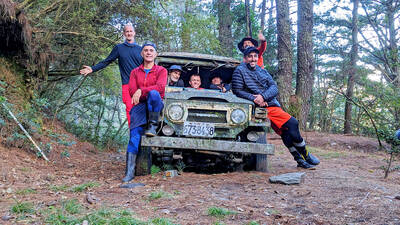
The year was 1991. A Toyota Land Cruiser set out on a 67km journey up the Junda Forest Road (郡大林道) toward an old loggers’ camp, at which point the hikers inside would get out and begin their ascent of Jade Mountain (玉山). Little did they know, they would be the last group of hikers to ever enjoy this shortcut into the mountains. An approaching typhoon soon wiped out the road behind them, trapping the vehicle on the mountain and forever changing the approach to Jade Mountain. THE CONTEMPORARY ROUTE Nowadays, the approach to Jade Mountain from the north side takes an
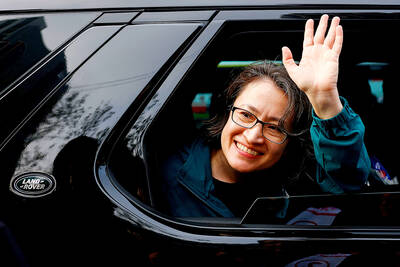
Relations between Taiwan and the Czech Republic have flourished in recent years. However, not everyone is pleased about the growing friendship between the two countries. Last month, an incident involving a Chinese diplomat tailing the car of vice president-elect Hsiao Bi-khim (蕭美琴) in Prague, drew public attention to the People’s Republic of China’s (PRC) operations to undermine Taiwan overseas. The trip was not Hsiao’s first visit to the Central European country. It was meant to be low-key, a chance to meet with local academics and politicians, until her police escort noticed a car was tailing her through the Czech capital. The
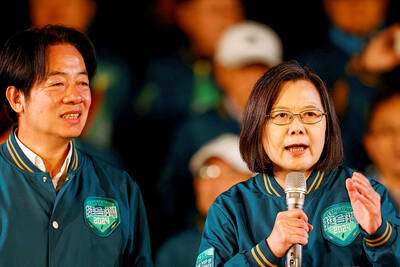
Last week Joseph Nye, the well-known China scholar, wrote on the Australian Strategic Policy Institute’s website about how war over Taiwan might be averted. He noted that years ago he was on a team that met with then-president Chen Shui-bian (陳水扁), “whose previous ‘unofficial’ visit to the US had caused a crisis in which China fired missiles into the sea and the US deployed carriers off the coast of Taiwan.” Yes, that’s right, mighty Chen caused that crisis all by himself. Neither the US nor the People’s Republic of China (PRC) exercised any agency. Nye then nostalgically invoked the comical specter
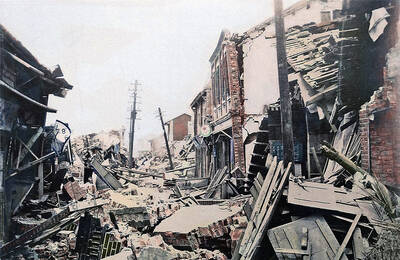
April 15 to April 21 Yang Kui (楊逵) was horrified as he drove past trucks, oxcarts and trolleys loaded with coffins on his way to Tuntzechiao (屯子腳), which he heard had been completely destroyed. The friend he came to check on was safe, but most residents were suffering in the town hit the hardest by the 7.1-magnitude Hsinchu-Taichung Earthquake on April 21, 1935. It remains the deadliest in Taiwan’s recorded history, claiming around 3,300 lives and injuring nearly 12,000. The disaster completely flattened roughly 18,000 houses and damaged countless more. The social activist and


 RSS
RSS