


Ewald-Heinrich von Kleist had a vision of eternal damnation as he was taken in for questioning at Gestapo headquarters in Berlin over the attempt to kill Adolf Hitler on July 20, 1944.
"I thought of the lines from the Divine Comedy: `Abandon hope, all ye who enter here,'" Kleist said, referring to the inscription over the gates to hell described in Dante's medieval opus.
Sixty years ago, Kleist was a 22-year-old army lieutenant and part of the largely military conspiracy which carried out a bomb attack on Hitler and attempted a coup d'etat in Berlin.
The bomb killed four but Hitler emerged almost unscathed, dooming the coup to failure and ushering in brutal reprisals and the final, bloodiest phase of World War II.
"We had to try something," said Kleist, whose forceful and energetic manner belie his 82 years. "The things being done by those criminals in Germany's name were simply appalling."
The plot's driving force was the aristocrat Colonel Claus von Stauffenberg, a man deeply opposed to the Nazis' treatment of the Jews, who planted the bomb in a briefcase under a table close to Hitler in his "Wolf's Lair" headquarters in modern Poland.
Of an estimated 40 assassination attempts, only Stauffenberg and the solo bombing of a Munich beer hall in 1939 by a Swabian joiner Georg Elser came close to claiming the Fuehrer's life.
But for the intervention of fate, Kleist might have killed Hitler himself. In early 1944, he had agreed with Stauffenberg to carry out a suicide bombing on the Nazi leader as he inspected new uniforms, but the inspection was cancelled at short notice.
While most Germans remained loyal to Hitler through almost six years of warfare and genocide, the plotters hoped that removing him and installing a new government could save Germany and end the war.
Kleist was always skeptical.
"We were too few," he said. "But it was a question of attitudes, and how criminal and in need of change the state seemed to you. And then you had to ask yourself how far you were willing to go -- even if that meant things could get nasty."
LONG LIVE OUR SACRED GERMANY!
Sitting inside the "Bendlerblock," the former Wehrmacht headquarters and nerve center of the coup bid, Kleist, one of the last surviving plotters, is quick to play down his bravery.
"It was no great achievement on my part," he said. "Once you've made a decision, fear can play no role."
The July plot was codenamed "Operation Valkyrie", originally an emergency government plan for suppressing internal unrest, but reconceived by the plotters as a pretext for putting down a would-be attempt by disgruntled Nazi leaders to seize power.
Kleist and the other conspirators, who included several top generals, succeeded in sealing off the government quarter in Berlin and arresting 1,200 SS and Gestapo members in Paris.
But defective planning, a lack of support and moments of crucial hesitation proved decisive and the rebellion foundered.
As darkness fell, Hitler regained the initiative. Soon after midnight, the now captive Stauffenberg was shot by firing squad, reportedly dying with the shout: "Long live our sacred Germany!"
Arrested, interrogated by the Gestapo and then interned for months in a concentration camp, Kleist was eventually released and sent back to the front where he survived the war.
He does not talk about how he escaped death, but admits his debt to comrades who refused to betray him under torture.
"Of course it helped me. Some talked, and as a result some people were unnecessarily sent to the gallows," he said.
The purge that followed the uprising claimed around 140 lives, among them that of Kleist's father, who had long been an opponent of the Nazis. Executions dragged on until just weeks before the war ended, with the Third Reich already in freefall.
In total, some 5,500 conspirators and political opponents were rounded up and interned after the abortive putsch.
EITHER TRAITORS OR COLLABORATORS
Long a divisive topic, July 20 is now seen as a day Germany can be proud of, one which proved there were Germans in positions of high authority ready to risk their lives to end the tyranny that plunged the country into its darkest hour.
"The history of July 20 is one of the few things that makes the history of the Third Reich bearable," Hartmann von der Tann, editor-in-chief of the German public broadcaster ARD, said recently.
It was not always so, according to Christian Hartmann from the Institute for Contemporary History in Munich.
"For years after the war [the plotters] were regarded as betrayers of the Fatherland," Hartmann said.
Later generations of leftist students dismissed them as collaborators with a fascist regime, he added.
"Now, though, I think they've become a fixed part of the German consciousness," Hartmann said. "But it did take a while."
A recent nationwide poll by ZDF television on the "best German" of all time featured a number of prominent resistance fighters in its top 50, including Stauffenberg.
The plot's 60th anniversary has coincided with a surge in media interest in the subject in Germany and the release of the first new feature films on the events in almost 50 years.
Kleist, who became a publisher after the war, is loath to dwell on the past and gives few interviews about the conspiracy.
"The matter's closed for me now. There's nothing more that can be changed about it," Kleist said. "I pay much more attention to the future than I do to the past."

In late October of 1873 the government of Japan decided against sending a military expedition to Korea to force that nation to open trade relations. Across the government supporters of the expedition resigned immediately. The spectacle of revolt by disaffected samurai began to loom over Japanese politics. In January of 1874 disaffected samurai attacked a senior minister in Tokyo. A month later, a group of pro-Korea expedition and anti-foreign elements from Saga prefecture in Kyushu revolted, driven in part by high food prices stemming from poor harvests. Their leader, according to Edward Drea’s classic Japan’s Imperial Army, was a samurai

Located down a sideroad in old Wanhua District (萬華區), Waley Art (水谷藝術) has an established reputation for curating some of the more provocative indie art exhibitions in Taipei. And this month is no exception. Beyond the innocuous facade of a shophouse, the full three stories of the gallery space (including the basement) have been taken over by photographs, installation videos and abstract images courtesy of two creatives who hail from the opposite ends of the earth, Taiwan’s Hsu Yi-ting (許懿婷) and Germany’s Benjamin Janzen. “In 2019, I had an art residency in Europe,” Hsu says. “I met Benjamin in the lobby
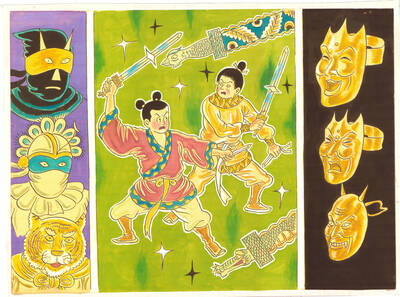
April 22 to April 28 The true identity of the mastermind behind the Demon Gang (魔鬼黨) was undoubtedly on the minds of countless schoolchildren in late 1958. In the days leading up to the big reveal, more than 10,000 guesses were sent to Ta Hwa Publishing Co (大華文化社) for a chance to win prizes. The smash success of the comic series Great Battle Against the Demon Gang (大戰魔鬼黨) came as a surprise to author Yeh Hung-chia (葉宏甲), who had long given up on his dream after being jailed for 10 months in 1947 over political cartoons. Protagonist

A fossil jawbone found by a British girl and her father on a beach in Somerset, England belongs to a gigantic marine reptile dating to 202 million years ago that appears to have been among the largest animals ever on Earth. Researchers said on Wednesday the bone, called a surangular, was from a type of ocean-going reptile called an ichthyosaur. Based on its dimensions compared to the same bone in closely related ichthyosaurs, the researchers estimated that the Triassic Period creature, which they named Ichthyotitan severnensis, was between 22-26 meters long. That would make it perhaps the largest-known marine reptile and would


 RSS
RSS