


Western society has denounced racism, sexism and anti-Semitism, mobilized against ageism and genderism, anguished over postcolonialism and nihilism, taken arms against Marxism, totalitarianism and absolutism, and trashed, at various conferences and cocktail parties, liberalism and conservatism.
Is it possible there is yet another ism to mobilize against?
Robert Fuller, a boyishly earnest 67-year-old who has spent most of his life in academia, thinks so, and he calls it "rankism;" the bullying behavior of people who think they are superior. The manifesto? Nobodies of the world unite! -- against mean bosses, disdainful doctors, power-hungry politicians, belittling soccer coaches and arrogant professors.
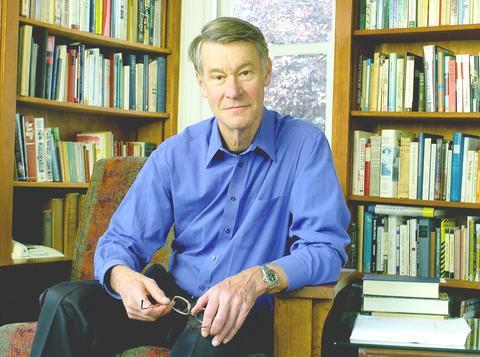
PHOTO: NY TIMES
"I wanted a nasty word for the crime, an unpleasant word, a stinky word," he said, referring to his choice of the word rankism. "Language is incredibly important in making political change. I always go back to that word sexism and how it became the catalyst for a movement."
Fuller wants nothing less than moral as well as behavioral accountability from the people in charge, whether of governments, companies, patients, employees or students. And he pitches his quixotic notion in a book, a Web site (breakingranks .net), in radio interviews and in lectures at universities and business gatherings that could be considered breeding farms for somebodies.
"The theory has the potential to explain many things we just ignore as a given," said Camilo Azcarate, Princeton University's ombudsman, who recently attended one of Fuller's lectures and bought several copies of his book to give to friends. "Democracy and education should concentrate on creating virtuous citizens. This is exactly the kind of discussion we need to have."
not a movement yet
Fuller began postulating these theories on the Internet several years ago, and then brought them together last year in a book called Somebodies and Nobodies (New Society Publishers), published recently in paperback. He can't answer how, exactly, his lofty ideas might translate into political or legal action. "I don't see the form the movement will take," he confessed in an interview at his home in Berkeley. "But I don't feel too bad about it because Betty Friedan told me she didn't have any idea there would be a women's movement when she wrote The Feminine Mystique. You need five years of consciousness-raising before you find the handle."
Friedan provided a blurb for his book. Other supporting blurbers include Bill Moyers, the political scientist Frances Fukuyama and the author Studs Terkel. So far the book has sold 33,000 copies (including bulk sales); and his Web site totals 2,000 to 3,000 visitors a week, his Web master, Melanie Hart, said.
Fuller's appeal nonetheless eludes some critics. In one of the few reviews of Somebodies and Nobodies, Clay Evans, books editor of The Daily Camera newspaper in Boulder, Colorado, was dismissive. Fuller's concepts, he wrote, "were old when Jesus was making fishers of men."
But with others, he has struck a chord. Among the 2,000 people who had downloaded a working manuscript of his were Mary Lou and Ann Richardson, two sisters living in Roanoke, Virginia. They were so inspired by that early version that they eventually met with Fuller after the book was published. The women, Ann Richardson said, had been taking care of an aging mother with Parkinson's disease and were distressed by how people's treatment of her changed after she lost her ability to speak.
The sisters began their own Dignitarian Foundation, described on its Web site (dignitarians.org) as "an organization dedicated to promoting and protecting the intrinsic right to human dignity."
fast track to academia
This was not the role Fuller seemed destined to fulfill. Designated a math and science whiz kid, he entered Oberlin College at age 15, expecting to follow the path of his father, Calvin Fuller, a physicist at Bell Laboratories in New Jersey who was co-inventor of the solar cell. After Oberlin, Fuller accumulated credentials with breathtaking speed. By 18 he was enrolled in graduate school at Princeton. At 33 he was named president of Oberlin.
In between he learned about politics at the Ecole Normale Supeieure in Paris and economics at the University of Chicago, helped write a significant physics text -- Mathematics of Classical and Quantum Physics -- taught at Columbia University, did a fellowship at Wesleyan University and was dean of faculty at Trinity College in Hartford.
His peripatetic intellectual ambitions coincided with an era of social upheaval. Fuller left for Oberlin as an undergraduate in 1952, thinking Dwight Eisenhower was the perfect next president. By the time he returned to Oberlin as its president in 1970, he was ready to lead the college through the revolutions of the period -- making changes in admissions policies for African-American students, abolishing course requirements, ending parietal hours.
Then, after 22 years on the academic fast track, he quit -- at age 37. He left Oberlin and his first wife, with whom he had had two children, and traveled around the world for three months. Then he settled in Berkeley where, he said, "I sat still for two years, read 200 books and completely re-educated myself." Among other things, he began to realize his role model may have been his mother, Willmine Works Fuller. "She wasn't very concerned about social justice, but if someone tried to step on her toes, watch out," Fuller said, recalling a protest his mother organized against putting an airport near his hometown of Chatham, New Jersey.
academic turns activist
He became obsessed with the nuclear arms race between the US and the Soviet Union. "The bomb makes nobodies of all of us, that's how I put it now," he said. With a new wife, and eventually two more children in tow (a third wife would come still later) he began traveling through the Soviet Union, paying for the expeditions by giving speeches and raising money from philanthropists. Calling himself a citizen diplomat, he helped arrange televised discussions between Soviet and American scientists via satellite links.
In 1987, Fuller found a crucial advocate for his expensive self-discovery -- Robert Cabot, a novelist and diplomat, but also heir to a family fortune. They traveled together to the Soviet Union, Afghanistan and China and together wrote a few articles. Cabot put money into some of Fuller's citizen-diplomacy projects, which always struggled for financing.
One day Cabot decided to become Fuller's patron. For 15 years he paid him to think -- and to travel, expenses paid. No rankism there: Cabot included pension payments, which kicked in two years ago when Fuller turned 65.
How does Cabot feel about the way his money has been spent? "I am immensely gratified," he said. "I think we are witnessing an extreme abuse of rankism in Washington, right now. Our policy in the Middle East is rankism."
rankism's many guises
Fuller acknowledges that rankism is harder to pin down than other more apparent forms of discrimination -- sex, race and disability. "We try to sniff how much power each of us has by asking: `What do you do? Where did you go to school? Who's your husband?'" said Fuller.
"It's like trying to find out if someone's gay or not, if they're a threat to us or if we can get away with abusing or exploiting them."
Fuller isn't calling for an end to hierarchy, but neither is he simply asking for mere politeness. Controversially, he would get rid of faculty tenure at universities, which he calls "an outdated sacrosanct privilege of a few somebodies held at the expense of many nobodies."
Fuller doesn't rouse his audiences with smooth patter and startling revelations of abuse he's suffered. But his reflective, old-fashioned professorial approach to his sometimes glib, populist theories has been taken in some quarters as a refreshing whiff of sincerity in a skeptical age.
When he spoke at Mount Holyoke College last September, Andrea Ayvazian, dean of religious life, was surprised to see how mixed the audience was: students, faculty members, administrators, staff members and campus workers. "Bob's analysis freed people who considered themselves low in the hierarchy to tell their stories," said Ayvazian, who was a student of Fuller's 30 years earlier. "I saw this had struck a chord in unpredictable circles."

In late October of 1873 the government of Japan decided against sending a military expedition to Korea to force that nation to open trade relations. Across the government supporters of the expedition resigned immediately. The spectacle of revolt by disaffected samurai began to loom over Japanese politics. In January of 1874 disaffected samurai attacked a senior minister in Tokyo. A month later, a group of pro-Korea expedition and anti-foreign elements from Saga prefecture in Kyushu revolted, driven in part by high food prices stemming from poor harvests. Their leader, according to Edward Drea’s classic Japan’s Imperial Army, was a samurai

The following three paragraphs are just some of what the local Chinese-language press is reporting on breathlessly and following every twist and turn with the eagerness of a soap opera fan. For many English-language readers, it probably comes across as incomprehensibly opaque, so bear with me briefly dear reader: To the surprise of many, former pop singer and Democratic Progressive Party (DPP) ex-lawmaker Yu Tien (余天) of the Taiwan Normal Country Promotion Association (TNCPA) at the last minute dropped out of the running for committee chair of the DPP’s New Taipei City chapter, paving the way for DPP legislator Su

It’s hard to know where to begin with Mark Tovell’s Taiwan: Roads Above the Clouds. Having published a travelogue myself, as well as having contributed to several guidebooks, at first glance Tovell’s book appears to inhabit a middle ground — the kind of hard-to-sell nowheresville publishers detest. Leaf through the pages and you’ll find them suffuse with the purple prose best associated with travel literature: “When the sun is low on a warm, clear morning, and with the heat already rising, we stand at the riverside bike path leading south from Sanxia’s old cobble streets.” Hardly the stuff of your

Located down a sideroad in old Wanhua District (萬華區), Waley Art (水谷藝術) has an established reputation for curating some of the more provocative indie art exhibitions in Taipei. And this month is no exception. Beyond the innocuous facade of a shophouse, the full three stories of the gallery space (including the basement) have been taken over by photographs, installation videos and abstract images courtesy of two creatives who hail from the opposite ends of the earth, Taiwan’s Hsu Yi-ting (許懿婷) and Germany’s Benjamin Janzen. “In 2019, I had an art residency in Europe,” Hsu says. “I met Benjamin in the lobby


 RSS
RSS