


Taipei's first performance by the Beijing People's Art Theater (北京人民藝術劇院) production of Lao She's (老舍) Tea House (茶館) came to an end last night. Tickets did not sell as well as Andrew Lloyd Webber's Cats but with eight performances packing in over 70 percent capacity, the show put in a more-than-respectable box office for New Aspect (新象文化基金會), which brought the show to Taiwan.
Rumors that ticket sales were down due to an unofficial boycott of a production from China proved unfounded, but the audience on the evening this reviewer saw the performance certainly lacked respect, quite apart from an unforgivable number of cellphone interludes.
Tea House was first performed in 1958, but it has weathered the years surprisingly well -- far better than the works of Cao Yu (
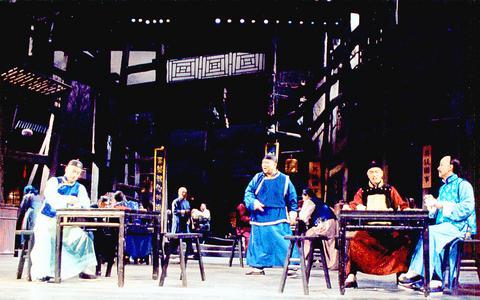
PHOTO COURTESY OF NEW ASPECT
In Western terms, Tea House is a relatively conventional production focusing on the life that passes through a Beijing teahouse. There are three acts, each of which covers a slice of life spanning half a century -- the end of the Qing empire, the period of unrest after the death of Yuan Shi-kai (
At the center of this vast production is the character of the teahouse proprietor Wang Li-fa, played by Liang Guan-hua (
While the cast is uniformly strong, Liang's talent overwhelms, bringing enormous subtlety of expression to this massive work. Given the melodramatic nature of the play, Liang performed miracles of understatement.
The fact that the whole cast was performing without the aid of attached microphones puts the show in a league well beyond that of all Taiwan's large-format theater simply in terms of thespian skill, especially as they were able to overcome the well-known acoustic limitations of the Sun Yat-sen Memorial Hall.
Technically Tea House should have been a work of ensemble theater, and Liang was ably supported by co-stars Pu Cunxin (
Tea House, as the major theatrical event of the summer, is an obvious benchmark for Taiwan's theater establishement. The comparison that comes to mind most readily is Wedding Memories (
Lao She, despite his many, many faults as a playwright, not least that he sold most of his soul to the communist powers-that-be, still reaches out for universal themes.
It can only be hoped that given the poverty of dramatic productions in Taiwan, more such "conventional" theater productions can be brought over from China. While some of the ideas expressed might not be regarded as edifying, the skills and, above all, the knowledge and appreciation of ensemble theater might eventually reach Taiwan.
In late October of 1873 the government of Japan decided against sending a military expedition to Korea to force that nation to open trade relations. Across the government supporters of the expedition resigned immediately. The spectacle of revolt by disaffected samurai began to loom over Japanese politics. In January of 1874 disaffected samurai attacked a senior minister in Tokyo. A month later, a group of pro-Korea expedition and anti-foreign elements from Saga prefecture in Kyushu revolted, driven in part by high food prices stemming from poor harvests. Their leader, according to Edward Drea’s classic Japan’s Imperial Army, was a samurai

The following three paragraphs are just some of what the local Chinese-language press is reporting on breathlessly and following every twist and turn with the eagerness of a soap opera fan. For many English-language readers, it probably comes across as incomprehensibly opaque, so bear with me briefly dear reader: To the surprise of many, former pop singer and Democratic Progressive Party (DPP) ex-lawmaker Yu Tien (余天) of the Taiwan Normal Country Promotion Association (TNCPA) at the last minute dropped out of the running for committee chair of the DPP’s New Taipei City chapter, paving the way for DPP legislator Su
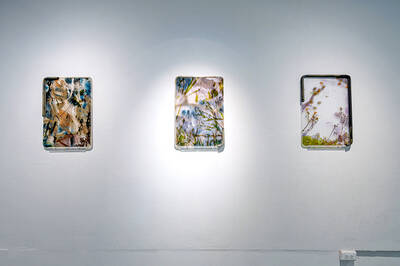
Located down a sideroad in old Wanhua District (萬華區), Waley Art (水谷藝術) has an established reputation for curating some of the more provocative indie art exhibitions in Taipei. And this month is no exception. Beyond the innocuous facade of a shophouse, the full three stories of the gallery space (including the basement) have been taken over by photographs, installation videos and abstract images courtesy of two creatives who hail from the opposite ends of the earth, Taiwan’s Hsu Yi-ting (許懿婷) and Germany’s Benjamin Janzen. “In 2019, I had an art residency in Europe,” Hsu says. “I met Benjamin in the lobby
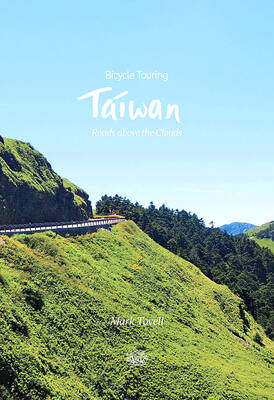
It’s hard to know where to begin with Mark Tovell’s Taiwan: Roads Above the Clouds. Having published a travelogue myself, as well as having contributed to several guidebooks, at first glance Tovell’s book appears to inhabit a middle ground — the kind of hard-to-sell nowheresville publishers detest. Leaf through the pages and you’ll find them suffuse with the purple prose best associated with travel literature: “When the sun is low on a warm, clear morning, and with the heat already rising, we stand at the riverside bike path leading south from Sanxia’s old cobble streets.” Hardly the stuff of your


 RSS
RSS