


After more than 100 years as an outlandish vision, the idea of a space elevator reaching 100,000km into the heavens is, well, inching toward credence.
Scientists are meeting in Washington this week to discuss the real potential for a project whose single most enthusiastic promoter, Bradley Edwards, has the backing of the National Aeronautics and Space Administration's (NASA) Institute for Advanced Concepts and other respected space outfits.
Edwards, a physicist, is convinced that an umbilical cord connecting a platform in the Pacific Ocean to goings-on in outer space will be a reality in 10 to 15 years, and a growing battery of the scientific community thinks so, too. Dozens of scientists are presenting their research at the conference.
"I'm convinced that the space elevator is practical and doable," he told the Internet service space.com. "In 12 years, we could be launching tonnes of payload every three days, at just a little over a couple hundred dollars a pound."
Yesterday, the third annual gathering of scientists and economists were brainstorming the idea and were to conclude their business at a hotel located appropriately enough just a stone's throw from the Air and Space Museum on Washington's green park-like mall.
The elevator calls for a ribbon-like cable, spun like rope from a new marvel of modern science, the carbon nanotube, to provide the "highway" that would be used to transport building materials and engine parts into outer space and transmit energy back to Earth from solar panels mounted along its length.
extraterrestrials
Poorer countries would be able to place satellites into orbit. Satellites already orbiting could be repaired and not always replaced with new ones. Even extraterrestrial settlements and space observatories would become possible, Edwards says.
"In 15 years we could have a dozen cables running full steam putting 50 tonnes in space every day ... including upper middle class individuals wanting a joyride into space," Edwards told space.com.
Edwards estimates that building the project would cost US$8 billion, but would reduce transport costs from the US$10,000 to US$40,000 it now costs to send 0.5kg into space to about US$100. The price would fall because expensive and dangerous rocket launches would become a thing of the past.
The idea flabbergasts with boldness: Build a huge platform about 1,600km west of the Galapagos Islands to serve as the anchor; spin 100,000km of tough ribbon from the carbon nanotubes; start sending payloads into space along the rope.
Much of the success depends on the nanotubes, which are tiny tubes of rolled up sheets of carbon hexagons about 10,000 times thinner than a human hair but 100 times stronger than steel. First developed in 1991, carbon nanotubes are just now being produced in enough quantity to serve industry, not just research.
rope to the stars
The bands would be held taut by the Earth's gravity on one end and the centrifugal force generated by the rotating planet on the other.
Edwards has a definite schedule: The first flat "rope" would be only 5cm broad and thinner than a piece of paper. Over the following two and a half years, the band would be spun to 1m wide, making it stable enough to transport 14 tonnes at a time.
The space dreamer even has a solution for propelling the space elevator. Because solar cells are not efficient enough, and nuclear technology is too heavy, he has hit upon the idea of a large laser to push the payloads into space.
Such a high-tech rope would, of course, have to cope with natural enemies such as storms, meteorites, space junk, electromagnetic fields and atmospheric erosion. But Edwards believes technology can solve all those problems.
The project has so far attracted US$500,000 in funding from NASA and the promise of US$2.5 million from the US Congress.
The idea of a space cable is traced to the Russian space pioneer Konstantin Ziolkowsky, who along with Robert Goddard and Hermann Oberth is regarded as the intellectual father of space travel.
Ziolkowsky began as a science fiction writer in the late 1800s, but later laid down some of the fundaments of rocket propulsion that are still used today.
Symbolic of how far the idea has progressed, this week's conference is deliberating how best to educate the public about it, whether there are health effects from the carbon nanotubes and the problems posed by man-made satellites and orbital debris to the nanotube cable.

Last week Joseph Nye, the well-known China scholar, wrote on the Australian Strategic Policy Institute’s website about how war over Taiwan might be averted. He noted that years ago he was on a team that met with then-president Chen Shui-bian (陳水扁), “whose previous ‘unofficial’ visit to the US had caused a crisis in which China fired missiles into the sea and the US deployed carriers off the coast of Taiwan.” Yes, that’s right, mighty Chen caused that crisis all by himself. Neither the US nor the People’s Republic of China (PRC) exercised any agency. Nye then nostalgically invoked the comical specter
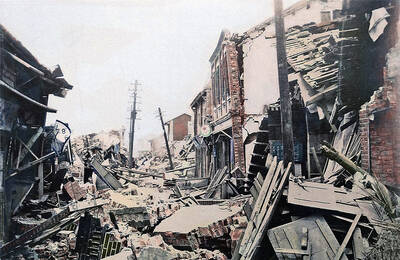
April 15 to April 21 Yang Kui (楊逵) was horrified as he drove past trucks, oxcarts and trolleys loaded with coffins on his way to Tuntzechiao (屯子腳), which he heard had been completely destroyed. The friend he came to check on was safe, but most residents were suffering in the town hit the hardest by the 7.1-magnitude Hsinchu-Taichung Earthquake on April 21, 1935. It remains the deadliest in Taiwan’s recorded history, claiming around 3,300 lives and injuring nearly 12,000. The disaster completely flattened roughly 18,000 houses and damaged countless more. The social activist and

Over the course of former President Ma Ying-jeou’s (馬英九) 11-day trip to China that included a meeting with Chinese Communist Party (CCP) leader Xi Jinping (習近平) a surprising number of people commented that the former president was now “irrelevant.” Upon reflection, it became apparent that these comments were coming from pro-Taiwan, pan-green supporters and they were expressing what they hoped was the case, rather than the reality. Ma’s ideology is so pro-China (read: deep blue) and controversial that many in his own Chinese Nationalist Party (KMT) hope he retires quickly, or at least refrains from speaking on some subjects. Regardless

Approaching her mid-30s, Xiong Yidan reckons that most of her friends are on to their second or even third babies. But Xiong has more than a dozen. There is Lucky, the street dog from Bangkok who jumped into a taxi with her and never left. There is Sophie and Ben, sibling geese, who honk from morning to night. Boop and Pan, both goats, are romantically involved. Dumpling the hedgehog enjoys a belly rub from time to time. The list goes on. Xiong nurtures her brood from her 8,000 square meter farm in Chiang Dao, a mountainous district in northern Thailand’s


 RSS
RSS