


The mythical homeland of Mexico's Aztecs -- an island known as Aztlan -- has eluded historians for centuries, and the quest to find it has become shrouded in political spin and scholarly speculation.
Like the lost Atlantis and Camelot, Aztlan may or may not have existed, but fervent believers have sought it from the desert of Utah to a mangrove swamp in western Mexico.
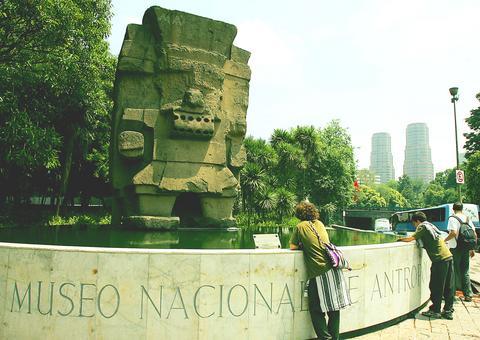
PHOTO: REUTERS
Academics agree that the Aztecs, a warlike tribe with a passion for human sacrifice, wandered the badlands of central Mexico for years before founding what is now Mexico City around 1325 and then forging the greatest empire of the ancient Americas.
But the original habitat of the people whose history and symbols are still invoked by modern Mexico remains a mystery.
Aztec legend says little about Aztlan, apart from that it was a small island on a lake inhabited by herons north of Mexico City. If it is ever found, archaeologists do not expect to discover much in the way of treasure or ruins there.
The small western state of Nayarit, long neglected by the federal government, declared itself the "cradle of the Mexicans" in the early 1990s based on an old theory that the marshy island of Mexcaltitan was in fact Aztlan.
Little stirs on the mosquito-infested islet which nestles in a salt water lagoon on the Pacific coast.
An expected tourism boom to the state has mostly failed to materialize and the islanders still scratch a living from fishing for shrimp and lobsters.
"No serious archeological study has ever been done in Mexcaltitan," said Jesus Jauregui, an expert in western Mexico at the National Institute of Anthropology and History.
"Aztlan is a mythical place, not an historical one," he said.
SPEAKING in TONGUEs
Try telling that to the growing number of Mexican immigrants in the US for whom the idea that Aztlan was in Utah or Colorado has become a matter of doctrine.
"Mexican Americans are very interested in it because it gives them identity as an ethnic group," said Armando Solorzano, ethnic studies professor at the University of Utah.
He said that if the Aztecs indeed came from what is now the western US, as some linguistic studies suggest, then the millions of mostly illegal Mexican migrants there could argue that they are not just undocumented workers but descendants of the original inhabitants who have come home.
"With this massive wave of immigration from Mexico now, the immigrants are saying, `We are returning to Aztlan,' so there is a lot of political misunderstanding and conflict," Solorzano said.
Many Mexicans still resent the US taking much of the US Southwest in the 1846 to 1848 Mexican-American war.
Perhaps the best clue to the origins of the Aztecs is the language.
The Aztec tongue is widely recognized by linguists as being part of the Uto-Aztecan family and related to the language of the Ute Indians of Utah as well as the Hopi and Comanche.
The discovery in recent years of a cave painting in Sego Canyon, Utah that appears to be a deity also seen on a famous Aztec stone calendar boosts the theory of a former Aztec presence in the US, Solorzano said.
Seven caves found on Antelope Island in Utah may also tie in with an Aztec story that the tribe passed through a place of seven caves, the fabled Chicomoztoc, he said.
But all this does not prove that Aztlan was in the southwest US, only that the Aztecs may have spent time there on their wanderings before departing for Mexico City some 2,736km to the south.
"This is one point of departure. Nayarit might be another one. Some people say they also migrated from California," Solorzano said. "There is another belief that the Aztecs came from Florida," he said.
Mexcaltitan, home to 1,800 people in a mangrove swamp, is now losing ground to US claims to be the Aztecs' homeland.
Even the curator of the island's tiny museum acknowledges that the local version of the Aztlan story may be fiction.
ISLAND HOME
"The issue of where the mythical Aztlan is has been thrashed about a lot. They haven't located it definitively," said curator Lilia Apocada.
The island was first tapped as Aztlan by a 19th century Mexican historian and given credence by National Geographic magazine in a 1968 article.
Mexcaltitan's tiny museum houses some pre-Hispanic pottery but no evidence that it was the place from where the Aztecs took their first step into the history books.
Locals are more concerned about shrimp fishing and preparations for the annual festival when the island's population triples for a few days of dancing and heavy drinking at the end of June.
"They say the Aztecs passed through here. Well, I didn't see them," said fish gutter Abelardo Ramos, 38.
The doors of houses are often left open in Mexcaltitan, unlike in crime-ridden areas of Mexico, and families laze in hammocks, eating seafood or drinking cold beer.
"Whether it is the real Aztlan or not, people enjoy this place anyway," said museum curator Apocada.
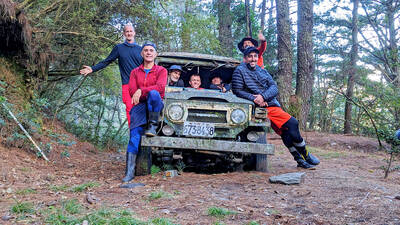
The year was 1991. A Toyota Land Cruiser set out on a 67km journey up the Junda Forest Road (郡大林道) toward an old loggers’ camp, at which point the hikers inside would get out and begin their ascent of Jade Mountain (玉山). Little did they know, they would be the last group of hikers to ever enjoy this shortcut into the mountains. An approaching typhoon soon wiped out the road behind them, trapping the vehicle on the mountain and forever changing the approach to Jade Mountain. THE CONTEMPORARY ROUTE Nowadays, the approach to Jade Mountain from the north side takes an

Relations between Taiwan and the Czech Republic have flourished in recent years. However, not everyone is pleased about the growing friendship between the two countries. Last month, an incident involving a Chinese diplomat tailing the car of vice president-elect Hsiao Bi-khim (蕭美琴) in Prague, drew public attention to the People’s Republic of China’s (PRC) operations to undermine Taiwan overseas. The trip was not Hsiao’s first visit to the Central European country. It was meant to be low-key, a chance to meet with local academics and politicians, until her police escort noticed a car was tailing her through the Czech capital. The

Last week Joseph Nye, the well-known China scholar, wrote on the Australian Strategic Policy Institute’s website about how war over Taiwan might be averted. He noted that years ago he was on a team that met with then-president Chen Shui-bian (陳水扁), “whose previous ‘unofficial’ visit to the US had caused a crisis in which China fired missiles into the sea and the US deployed carriers off the coast of Taiwan.” Yes, that’s right, mighty Chen caused that crisis all by himself. Neither the US nor the People’s Republic of China (PRC) exercised any agency. Nye then nostalgically invoked the comical specter

April 15 to April 21 Yang Kui (楊逵) was horrified as he drove past trucks, oxcarts and trolleys loaded with coffins on his way to Tuntzechiao (屯子腳), which he heard had been completely destroyed. The friend he came to check on was safe, but most residents were suffering in the town hit the hardest by the 7.1-magnitude Hsinchu-Taichung Earthquake on April 21, 1935. It remains the deadliest in Taiwan’s recorded history, claiming around 3,300 lives and injuring nearly 12,000. The disaster completely flattened roughly 18,000 houses and damaged countless more. The social activist and


 RSS
RSS