


In the opening scenes of the most daring film to come out of Singapore this year, a young man accosts the head of the board of censors in a supermarket and declares he is her biggest fan.
"I know every film you have ever cut in the history of Singapore," he enthuses, before reeling off the names of 24 movies and 99 cuts made and thanking her for "shielding us from the evils of arts".
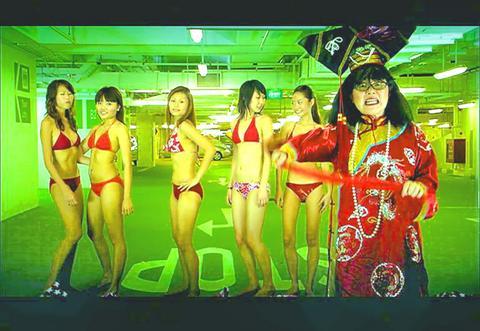
PHOTO: AFP
The sarcasm-drenched 13-minute film Cut was made without a permit by one of Singapore's few controversial filmmakers, 27-year-old drama teacher Royston Tan.
Speaking to foreign reporters recently, Tan said the movie, which has recorded tens of thousands of downloads from a local Web site, was made out of frustration at the Singapore government's famous "nanny state" mentality.
It followed 27 cuts being made to his highly acclaimed feature film last year about Singapore's gang culture, 15, which he said the government censored heavily because gang chants and other aspects were deemed a threat to national security.
"Trying to enact censorship out of paranoia does more harm than good. Censorship closes the door on debate," Tan said, offering a much more subdued reflection of the issue than his main character in Cut.
"Being our nanny, you are exposed to all the uncensored and controversial scenes. What I would really like to know [is] who looks after your welfare?" the besotted young man in Cut asks the censorship chief.
"How do you resist the evil temptations to be a call girl when you watch the uncut version of Chicago, a drug addict when you watch the uncut Trainspotting, a lesbian when you watch Boys don't cry?"
Tan's release of Cut came at a sensitive time for the Singapore government, which has been trying to project a more open-minded approach after years of international headlines ridiculing the city-state.
Laws banning things such as oral sex between consenting adults, the sale of Cosmopolitan magazine and chewing gum have proved wonderful fodder for correspondents and editors looking for quirky stories.
Over the past year, the government has modified the oral sex law to allow the act between men and women, has announced gays are allowed to work in the civil service, has introduced reverse bungee jumping, let certain bars stay open 24 hours a day and said people can chew gum, albeit on a restricted basis.
Deputy Prime Minister Lee Hsien Loong, who will take over as the nation's leader this year, acknowledged in January that the "nanny state" approach was having some negative impacts on Singaporean society.
"If we want a more participatory citizenry, the government will have [to[ cut the apron strings and leave more matters to the private and people sectors," Lee said in an address to international businessmen.
But Tan and another prominent social campaigner, gay rights activist Alex Au, believe the government's efforts are little more than window dressing.
"Every announced loosening-up has been followed by waffle and scaling back, if not altogether contradicted by subsequent decisions, as the gay example indicates," Au told foreign reporters in a separate forum.
Au's People Like Us group, which represents Singapore's gay and lesbian community, has been trying to be registered as a society since 1996.
Homosexuality is still illegal and the most recent effort by Au's group for registration failed in March.
In its rejection, the government said allowing People Like Us to form as a society would be "contrary to the national interest."
Au said this attitude reflected a still-deeply entrenched conservatism within Singapore's government. The People's Action Party has ruled the majority Chinese population since the nation's independence in 1965.
"My opinion is that this so-called liberalization... is really driven by economics -- to attract and retain talent -- and not by any belief in the lasting though intangible value of a liberal political culture," Au said.
And despite Lee saying he was in favor of weakening "nanny's" role, he told parliament in April he was still much more comfortable with Singapore's social attitudes remaining 20 years behind those of the US and Britain.
"If you are absolutely up at the leading edge in matters of social change, you are never quite sure whether the leading edge has taken a wrong turn, needs to back-track and make a U-turn," he said.

Last week Joseph Nye, the well-known China scholar, wrote on the Australian Strategic Policy Institute’s website about how war over Taiwan might be averted. He noted that years ago he was on a team that met with then-president Chen Shui-bian (陳水扁), “whose previous ‘unofficial’ visit to the US had caused a crisis in which China fired missiles into the sea and the US deployed carriers off the coast of Taiwan.” Yes, that’s right, mighty Chen caused that crisis all by himself. Neither the US nor the People’s Republic of China (PRC) exercised any agency. Nye then nostalgically invoked the comical specter

April 15 to April 21 Yang Kui (楊逵) was horrified as he drove past trucks, oxcarts and trolleys loaded with coffins on his way to Tuntzechiao (屯子腳), which he heard had been completely destroyed. The friend he came to check on was safe, but most residents were suffering in the town hit the hardest by the 7.1-magnitude Hsinchu-Taichung Earthquake on April 21, 1935. It remains the deadliest in Taiwan’s recorded history, claiming around 3,300 lives and injuring nearly 12,000. The disaster completely flattened roughly 18,000 houses and damaged countless more. The social activist and

Over the course of former President Ma Ying-jeou’s (馬英九) 11-day trip to China that included a meeting with Chinese Communist Party (CCP) leader Xi Jinping (習近平) a surprising number of people commented that the former president was now “irrelevant.” Upon reflection, it became apparent that these comments were coming from pro-Taiwan, pan-green supporters and they were expressing what they hoped was the case, rather than the reality. Ma’s ideology is so pro-China (read: deep blue) and controversial that many in his own Chinese Nationalist Party (KMT) hope he retires quickly, or at least refrains from speaking on some subjects. Regardless

Approaching her mid-30s, Xiong Yidan reckons that most of her friends are on to their second or even third babies. But Xiong has more than a dozen. There is Lucky, the street dog from Bangkok who jumped into a taxi with her and never left. There is Sophie and Ben, sibling geese, who honk from morning to night. Boop and Pan, both goats, are romantically involved. Dumpling the hedgehog enjoys a belly rub from time to time. The list goes on. Xiong nurtures her brood from her 8,000 square meter farm in Chiang Dao, a mountainous district in northern Thailand’s


 RSS
RSS