


Sunny Wang's
Now, together with just under a dozen young glass artists in Taiwan, Wang and her gang are trying to create a new wave of public awareness about glass as a medium for modern artistic
creation.
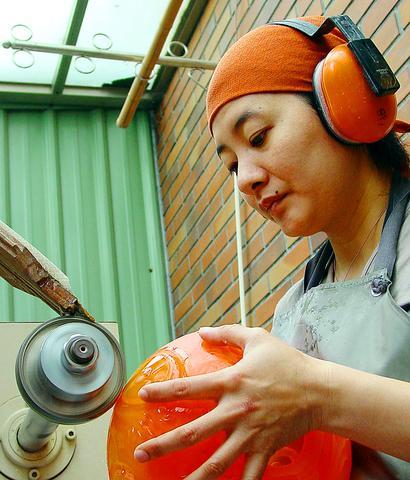
PHOTO COURTESY OF SUNNY WANG
Ever since Heinrich Wang
Wang worked at a glassware factory in Hsinchu
As a full-time glass artist and university lecturer, Wang applies various glass techniques to show different types of beauty exhibited by glass artifacts. In her exhibition at Page One in Taipei, titled Contemporary Art Glass of Taiwan she displays her talent to the fullest extent.
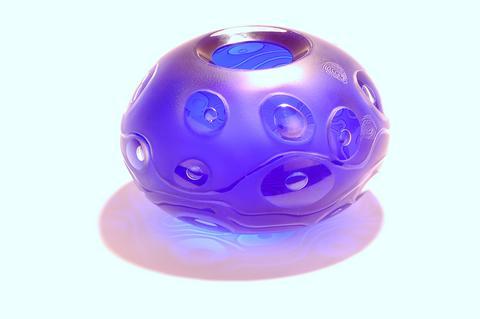
PHOTO COURTESY OF SUNNY WANG
In her earliest series, Cell, she employed the lost-wax-casting method. Because of the spherical sculpturability of the casting method, the cells appear as three dimensional and rich in form. As the cells were enlarged and transformed, light was able to pass naturally through them and the effect promoted a seeming dialogue between the light and the glass.
Wang explained her philosophy behind these works thus: "The cell is the basic building block of life. Its purity and beauty are fascinating. The cell is special because it extends life."
Through this series, which represented the essence of life, she sought to encourage tactile appreciation of her art by asking people to touch the works -- the opposite approach to most other artists working in glass. This is the reason why she engraved fingerprints in some of her works, to provide an additional tactile element.
Her use and choice of Chinese characters in another series of her glassworks were, perhaps, inspired by the simplicity and silence that she felt practicing Chinese calligraphy. Contrary to traditional Chinese calligraphy, however, the legibility of Chinese characters in her works was not the focus. She sought to present a sense of primitiveness or origin through each symbolic image that her created character represents.
As Nigel Lendon, deputy director of Australian National University, commented: "The artist is not using drawing to plan the relationship between line and form, but is in the process discovering the character of the line, imagining how it will finally find itself wrapped around the curvature of the vessel, and interacting with the character-drawing it meets on the other side."
These characters revealed the artist's experience and passion for life, through lines and images engraved on her works. This series has been exhibited in the US, Italy, Australia, Japan and Hong Kong.
A more recent series of works, entitled Love is the materialization of a concept that the artist has contemplated for two years. As she pointed out, in this series linear beauty is shown through the characteristics, lines and thickness of the glass. The techniques and vocabulary used are very different from those employed in her earlier works. She hopes to further develop her ideas in this series for wider spaces, as installation art.
As for this exhibition, Wang's glass artifacts are infused with life, wisdom and artistic possibility. There is a presence of maturity and understanding. Each piece is to be experienced, and requires time for exploration. Take your time and enjoy looking at the form and color of her ingenious glass works.
Exhibition notes:
What: Sunny Wang's Glass Exhibition.
Where: Page One, Taipei 101 Mall, Taipei (
When: June 19 to July 25.
Time: 11a.m. to 10pm.
Phone: (02) 8101 8282 X 6622.

In late October of 1873 the government of Japan decided against sending a military expedition to Korea to force that nation to open trade relations. Across the government supporters of the expedition resigned immediately. The spectacle of revolt by disaffected samurai began to loom over Japanese politics. In January of 1874 disaffected samurai attacked a senior minister in Tokyo. A month later, a group of pro-Korea expedition and anti-foreign elements from Saga prefecture in Kyushu revolted, driven in part by high food prices stemming from poor harvests. Their leader, according to Edward Drea’s classic Japan’s Imperial Army, was a samurai

Located down a sideroad in old Wanhua District (萬華區), Waley Art (水谷藝術) has an established reputation for curating some of the more provocative indie art exhibitions in Taipei. And this month is no exception. Beyond the innocuous facade of a shophouse, the full three stories of the gallery space (including the basement) have been taken over by photographs, installation videos and abstract images courtesy of two creatives who hail from the opposite ends of the earth, Taiwan’s Hsu Yi-ting (許懿婷) and Germany’s Benjamin Janzen. “In 2019, I had an art residency in Europe,” Hsu says. “I met Benjamin in the lobby
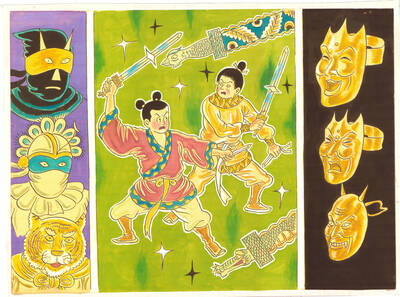
April 22 to April 28 The true identity of the mastermind behind the Demon Gang (魔鬼黨) was undoubtedly on the minds of countless schoolchildren in late 1958. In the days leading up to the big reveal, more than 10,000 guesses were sent to Ta Hwa Publishing Co (大華文化社) for a chance to win prizes. The smash success of the comic series Great Battle Against the Demon Gang (大戰魔鬼黨) came as a surprise to author Yeh Hung-chia (葉宏甲), who had long given up on his dream after being jailed for 10 months in 1947 over political cartoons. Protagonist

The following three paragraphs are just some of what the local Chinese-language press is reporting on breathlessly and following every twist and turn with the eagerness of a soap opera fan. For many English-language readers, it probably comes across as incomprehensibly opaque, so bear with me briefly dear reader: To the surprise of many, former pop singer and Democratic Progressive Party (DPP) ex-lawmaker Yu Tien (余天) of the Taiwan Normal Country Promotion Association (TNCPA) at the last minute dropped out of the running for committee chair of the DPP’s New Taipei City chapter, paving the way for DPP legislator Su


 RSS
RSS