


Gregory Schopen is a remarkable phenomenon by any standard. First, he's a specialist in a very restricted field, the academic world of Indian Buddhist studies. He writes books, such as this new one, on the remote topic of monasticism in India during what the Christian West calls the first millennium. Second, he's that field's dominating personality, and has seemingly lifted it out of an ethos characterized by disputes in obscure periodicals over archaeological sites and ancient rule-books into the light of a humane and resplendent day. But thirdly, and in many ways most importantly, he's an example of that exceptionally rare species -- an academic who writes not only lucidly but also eloquently, charmingly, and very often wittily.
There are no longer significant numbers of Buddhists in India. The faith at some point moved outwards as if by centrifugal force from its place of origin to Sri Lanka, Tibet, Japan, Korea and the pan-Chinese world. But at one time there were Buddhist monasteries all over the sub-continent, and these, together with those in what is now Sri Lanka, are the subject of Professor Schopen's enquiring gaze.
If Schopen is a big fish in a rather small pond, this doesn't prevent him dominating it with the style of a generous-hearted pontiff. He may of necessity deal with such things as broken walls, coins, re-used pots and stray inscriptions, but he surveys his field with nothing less than a full-throated ease.
The popular image of the Buddhist monk, he writes, is of a "lone ascetic who has renounced all social ties and property to wander or live in the forest, preoccupied with meditation and the heroic quest for ... enlightenment." As the title of this book shows, however, there was much else to be considered, and it's this business side of Indian monastic life that comes under scrutiny, along with matters such as death ("a lively issue"), nuns, the measurement of time, and parallels with the world of medieval Christian monasticism -- Ireland is the most westerly point that gets a mention.
Among the things that Schopen is at pains to point out are that Buddhist monks of the period continued to hold their own private property, that their institutions maintained important contacts with the rich donors to whom they owed so much, and the monastic life in general was ordered in ways that took a careful account of money.
As for Schopen's pervasive sense of humor, there are many examples to choose from. Right at the start there's a Dedication "to the taxpayers and working men and women of Indiana, Texas and California whose labor paid for my scholarly leisure." Then there are the acknowledgements -- one of a colleague most of whose personal library "is made up of books checked out of the university library for the next two hundred years," another of "the only monk I know who looks really good in a three-piece suit." Skip to the index and you'll find, under "Bull-shit," the following note: "There should, perhaps, be many more entries here."
But Schopen's scholarly pre-eminence and stylish sense of humor are related. He has a stylist's lightness of touch and an ever-present wit precisely because he is so eminent. After all, he has worked so hard on what was presumably at first recalcitrant and humorless material (though he does claim to see a certain droll humor in monastic regulations). His style is clear because he's such a complete master of his subject, in the same way that the style of the jargon-purveyors who dominate the humanities departments of so many universities is convoluted and inaccessible precisely because they are not masters of their subjects, and are hiding behind a briefly-fashionable terminology in order to conceal their own lack of true learning.
Schopen is a professor at the University of California, Los Angeles, and also does much work in Austin, Texas. Both places are lucky to have him. He's a major scholar because he masters the smallest details of his sources, then stands back and imagines the big picture. By asking good questions he comes up with interesting answers. The sunny serenity that characterizes Schopen's work shouldn't disguise his originality. He's described by his peers as having revolutionized the study of Indian Buddhism, and although it isn't possible for a general reviewer to confirm this, his standing is clearly very high.
There's a welcome touch of an older school of academic about him as well, something of the now legendary JRR Tolkien when he was professor of nordic philology at Oxford, and of other scholars turned imaginative writers such as Robert Graves. Maybe Schopen, too, will take to writing fiction one day -- he clearly reads such books as he comments that the traditional view of the Buddhist monk quoted above has "found its way even into modern European novels."
But it's his urbanity and wit that stay with you. You can easily imagine his colleagues doubling up with laughter as the celebrated scholar once again knocks over the academic proprieties -- at the moment, for instance, when he breezily ends the final chapter, originally published as an article in a learned journal, as follows [Professor Bechert is a rival expert in the field]: "Again, our text suggests that for the Indian Mulasarvastivadin tradition the writing down of Buddhist texts was simply not -- unlike Professor Bechert's sixty-fifth birthday -- a major event. We send our congratulations!"

In late October of 1873 the government of Japan decided against sending a military expedition to Korea to force that nation to open trade relations. Across the government supporters of the expedition resigned immediately. The spectacle of revolt by disaffected samurai began to loom over Japanese politics. In January of 1874 disaffected samurai attacked a senior minister in Tokyo. A month later, a group of pro-Korea expedition and anti-foreign elements from Saga prefecture in Kyushu revolted, driven in part by high food prices stemming from poor harvests. Their leader, according to Edward Drea’s classic Japan’s Imperial Army, was a samurai

Approaching her mid-30s, Xiong Yidan reckons that most of her friends are on to their second or even third babies. But Xiong has more than a dozen. There is Lucky, the street dog from Bangkok who jumped into a taxi with her and never left. There is Sophie and Ben, sibling geese, who honk from morning to night. Boop and Pan, both goats, are romantically involved. Dumpling the hedgehog enjoys a belly rub from time to time. The list goes on. Xiong nurtures her brood from her 8,000 square meter farm in Chiang Dao, a mountainous district in northern Thailand’s

Located down a sideroad in old Wanhua District (萬華區), Waley Art (水谷藝術) has an established reputation for curating some of the more provocative indie art exhibitions in Taipei. And this month is no exception. Beyond the innocuous facade of a shophouse, the full three stories of the gallery space (including the basement) have been taken over by photographs, installation videos and abstract images courtesy of two creatives who hail from the opposite ends of the earth, Taiwan’s Hsu Yi-ting (許懿婷) and Germany’s Benjamin Janzen. “In 2019, I had an art residency in Europe,” Hsu says. “I met Benjamin in the lobby
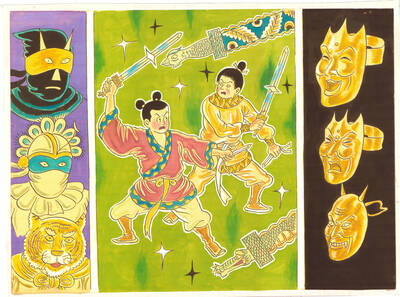
April 22 to April 28 The true identity of the mastermind behind the Demon Gang (魔鬼黨) was undoubtedly on the minds of countless schoolchildren in late 1958. In the days leading up to the big reveal, more than 10,000 guesses were sent to Ta Hwa Publishing Co (大華文化社) for a chance to win prizes. The smash success of the comic series Great Battle Against the Demon Gang (大戰魔鬼黨) came as a surprise to author Yeh Hung-chia (葉宏甲), who had long given up on his dream after being jailed for 10 months in 1947 over political cartoons. Protagonist


 RSS
RSS