


The air was jaundice-yellow under a sky like bruised flesh when Todd Thorn and his three vanloads of tornado-chasers lurched to a stop by the side of the road in the wheat fields of north Kansas one evening at the end of May.
Danielle Elvery of England was one of the first to pile out. She stooped and gathered up a hailstone the size of a yo-yo.
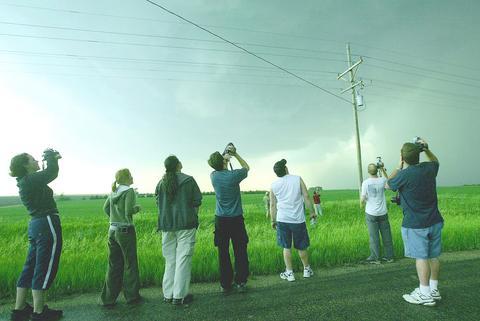
PHOTO: NY TIMES
"It's almost there," Thorn said, scanning the smoking clouds. "It's going to be a huge tornado. It's going to be a monster."
This is high season in Tornado Alley, the swath of the Great Plains from Texas to North Dakota where heat, moisture and shearing winds create just the right brew for the whirling funnel storms that are one of nature's most terrifying spectacles. In late May, a swarm of twisters ravaged the region, one record-size tornado leaving a path of destruction 4km wide near the southeastern Nebraska town of Hallam.
With a tornado warning, most people in the Midwest head the other way or hunker down, as anyone who has seen The Wizard of Oz knows. But lately growing ranks of aficionados come barreling in, the vanguard of a booming mini-industry of storm-chasers whose passion translates into tourism dollars gratefully harvested by small-town motels and restaurants. Sometimes, too, they help sound the alarm and assist victims.
"More people are curious to see Mother Nature's wrath," said Mike Theiss, 26, a film archivist who founded Cyclone Tours with another career storm-chaser and film partner, Jim Leonard, in Miami last year. In the latest Midwest storms, they said they rescued a couple and their baby whose house was collapsed by a tornado in Jamestown, Kansas, north of here.
Since the success of the 1996 film Twister, about a dozen outfits with names like Cloud Nine, Silver Lining, Tempest, F5 Tornado Safari, Twister Sisters and Thorn's Storm Chasing Adventure Tours have sprung up to cater to those eager to get as close as reasonable -- and sometimes dangerously closer -- to a fearsome storm, paying thousands of dollars for the thrill. Thorn's latest group of 16 included some from Britain and one from Papua New Guinea.
`Like great sex'
"Seeing a tornadic storm is like great sex," said Charles A. Doswell III, senior research scientist for the Cooperative Institute for Mesoscale Meteorological Studies at the University of Oklahoma in Norman, and a 30-year storm-chaser affiliated with Tempest Tours. "You never get enough and it never lasts long enough."
So on many stormy evenings, the country roads slicing through the farmlands of the Texas Panhandle, Oklahoma, Kansas, Nebraska and beyond are lined with vans sprouting electronic gear and the pickup trucks and cars of avid hobbyists and the idly curious, as well as police, fire and rescue vehicles. At times, there are so many cars that drivers carelessly staring at the sky can be a greater risk than the storms themselves.
"You get people who aren't paying full attention to the road," said Harold Brooks, a research meteorologist with the National Severe Storms Laboratory in Norman, the leading tornado research center.
Groups like Thorn's, which rely on vans equipped with Doppler radar, global positioning systems and access to the Weather Channel, and those like Theiss' that stress experience and local knowledge to read the sky and forecast, as he said, "the old fashioned way -- the real way," generally approach tornadoes from their southeast side, away from the most violent spin, and try to stay out of reach of the fierce winds and flying debris. The companies say no fatalities have resulted, but storm-chasers have been struck by lightning and suffered other injuries.
With all the scientific study, the why and how of tornadoes -- "our atmosphere's most savage creature," in the words of Texas Weather (University of Texas Press, 1994) -- are far from understood. The book describes tornadoes as products of large, intense thunderstorms that grow in an excessively unstable atmosphere roiled by cold air from the Rockies meeting warm and wet air from the Gulf of Mexico.
Energized flows of moist air surge upward into the base of a thunderhead, or supercell, and, like ice-skaters who spin faster when they pull in their arms, the drafts accelerate as they enter the column propelled from different sides. At some point, they can evolve into a twisting funnel that suspends itself beneath the base of the cloud and reaches to the ground with incredible force.
But danger is not the appeal, tornado-chasers insist -- the beauty is. "This is pushing all the buttons I have," said Jock McGinty, 36, a district manager for Coca-Cola in Papua New Guinea, as he stood in a field near Yuma, in north-central Kansas, excitedly pointing his video camera at swirling gray thunderclouds that held the imminent promise of tornadoes. Moments like this, McGinty said, amply justified the fee of US$2,800, not counting food and plane fare, to join Thorn's 10-day expedition out of Oklahoma City.
Adrenaline rush
Standing under a column of streaming water that could at any time throw off a tornado, he said, "puts everything in perspective." John Larew, a fire and rescue volunteer who drives a van for the company, said "the adrenaline rush is one of the biggest things."
"You're going, `Whoa! This is great.' You can see the funnel coming down and see dust swirling up and you ask, `Are they going to connect?'"
Doswell of the storm study institute, a partner with the National Oceanic and Atmospheric Administration, said the appeal of a tornado was its paradoxical fragility. "You get a chance to see something spectacular, rare and awesome," he said. "The next day it's gone: It's just air -- air and condensed water."
After three decades of chasing storms on his own, Doswell, 58, attached his expertise to Tempest Tours. "Chasing is an expensive hobby," he explained, noting that lodging, food, gas and tolls could run him US$1,000 a week.
It can also be hard work. There is no telling where a storm-chasing tour may lead. On one day in May, Larew said, they covered more than 1,200km. One 10-day trip, he said, wound through 13 states, from Minnesota to Louisiana. And sightings are far from guaranteed. Last year was particularly disappointing. "You couldn't buy a cloud," he said.
One of Thorn's clients, Ed Freudenberg, 59, a public relations consultant from Los Angeles, said that in three years of touring with the company he had yet to break what he called his "tornado virginity."
"We don't have weather in LA," he said glumly.
A sighting
Novices on the Thorn's trip included a Los Angeles car dealer, Ariel Rosso, who brought along a portable DVD player to watch Twister; two 18-year-old students from Cambridge, England, Samantha Millard and Amanda Sipson; and, Nick De Mouilpied, a 42-year-old grocery manager from Guernsey, England.
The tour started uneventfully, so much so that one couple, Elvery and Michael Hall, both 29, from Crawley, England, near Gatwick Airport, vowed that if they saw a tornado they would get married.
A few days later, on one banner night between Nelson and Hastings, in south-central Nebraska, they witnessed not one twister but 14. "It was a good sign," Elvery said later. "We got engaged."
But then, after Freudenberg and others joined the tour, another tornado drought set in. The group spent long afternoons in dispiriting sunshine hanging around gas stations waiting for thunderclouds to materialize. Thorn, 40, an engineer from Oregon who founded his company in 1998, was cautious. "The storms are still having trouble getting organized," he said.
Finally, weather reports on a small screen on the van's dashboard turned promising, with the warning: "Hail and tornadoes as bad as it's going to get this year."
Tracking an approaching storm on radar, Thorn aimed the motorcade toward Beloit, in north-central Kansas. Suddenly, near Asherville, the blackening sky loosed a barrage of large hailstones that hammered the van with the racket of marbles in a tin pan. "Turn around!" he commanded.
They backtracked out of the bombardment and stopped near Scottsville to watch the clouds writhing. It was almost time, Thorn said. "This could be it," he said.
In the distance a grayish wisp snaked down like a wizard's beard and elongated into a funnel cloud heading to earth. Below it, the earth seemed to explode.
"It's on the ground, it touched down!" Thorn shouted. "You lost your virginity, Ed."
A curtain of rain swept in. "Go! Go!" ordered Thorn, shooing everyone into the vans to keep up with the moving storm.
They stopped again a few kilometers away near Yuma under black clouds that unfolded slowly like a crab nebula. Ropey tendrils snaked earthward. "It's doing it. It's doing it," Thorn said.
Suddenly the whirling clouds seemed overhead and the wind was roaring like an oncoming train. After days of chasing tornadoes, a tornado was chasing them. Everyone tore for the vans, which started moving even before the doors closed.
From the trail of split trees and downed branches, a tornado seemed to have passed close by.
"That's the first time I felt the wind of one," Thorn said.
One of the drivers checked some readings and said, matter-of-factly, "149 mile (240km) an hour shear, just where we were."
Thorn began making calls on a cell phone looking for a motel in Salina. "I need 18 rooms," he said, waiting for the inevitable question before repeating, "Yes, 18."
In late October of 1873 the government of Japan decided against sending a military expedition to Korea to force that nation to open trade relations. Across the government supporters of the expedition resigned immediately. The spectacle of revolt by disaffected samurai began to loom over Japanese politics. In January of 1874 disaffected samurai attacked a senior minister in Tokyo. A month later, a group of pro-Korea expedition and anti-foreign elements from Saga prefecture in Kyushu revolted, driven in part by high food prices stemming from poor harvests. Their leader, according to Edward Drea’s classic Japan’s Imperial Army, was a samurai

Approaching her mid-30s, Xiong Yidan reckons that most of her friends are on to their second or even third babies. But Xiong has more than a dozen. There is Lucky, the street dog from Bangkok who jumped into a taxi with her and never left. There is Sophie and Ben, sibling geese, who honk from morning to night. Boop and Pan, both goats, are romantically involved. Dumpling the hedgehog enjoys a belly rub from time to time. The list goes on. Xiong nurtures her brood from her 8,000 square meter farm in Chiang Dao, a mountainous district in northern Thailand’s

Located down a sideroad in old Wanhua District (萬華區), Waley Art (水谷藝術) has an established reputation for curating some of the more provocative indie art exhibitions in Taipei. And this month is no exception. Beyond the innocuous facade of a shophouse, the full three stories of the gallery space (including the basement) have been taken over by photographs, installation videos and abstract images courtesy of two creatives who hail from the opposite ends of the earth, Taiwan’s Hsu Yi-ting (許懿婷) and Germany’s Benjamin Janzen. “In 2019, I had an art residency in Europe,” Hsu says. “I met Benjamin in the lobby

April 22 to April 28 The true identity of the mastermind behind the Demon Gang (魔鬼黨) was undoubtedly on the minds of countless schoolchildren in late 1958. In the days leading up to the big reveal, more than 10,000 guesses were sent to Ta Hwa Publishing Co (大華文化社) for a chance to win prizes. The smash success of the comic series Great Battle Against the Demon Gang (大戰魔鬼黨) came as a surprise to author Yeh Hung-chia (葉宏甲), who had long given up on his dream after being jailed for 10 months in 1947 over political cartoons. Protagonist


 RSS
RSS