


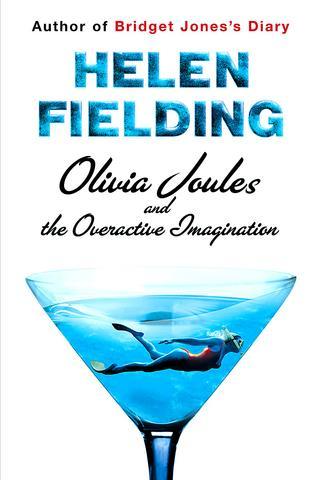
Just when it seems there cannot, and should not, be room for one more breezy, boss-bashing, boyfriend-stalking chick-lit novel, Olivia Joules and the Overactive Imagination is challenging the collective conscious.
If Joules' name is unfamiliar, her creator's is surely not: She is Helen Fielding, the British novelist who eight years ago unleashed the publishing equivalent of a tsunami with Bridget Jones's Diary.
That slim ode to lovelorn British singletons of the 1990s became the Da Vinci Code of its day, selling more than 10 million copies in 35 countries. It was made into the hit 2001 film starring Renee Zellweger, who will reprise her role as the pudgy, witty English heroine in the film adaptation of the book's best-selling sequel, Bridget Jones: The Edge of Reason, this fall.
It also transformed its author, then 39, from a little-known freelance journalist into a global
publishing franchise and a role model for legions of aspiring young women who went on to create the chick-lit genre, examples of which continue to flood bookstores almost weekly.
In fact, in 1997 when the paperback edition of Bridget Jones's Diary had reigned on best-seller lists in England for more than a year, Fielding grew so weary of being asked if she was the model for her man-crazy, perpetually dieting, alcohol-units-consuming, cigarette-smoking protagonist that she pondered taking what Bridget would call v. drastic action.
"At one point I was going to put a sign around my neck that said, `No, I am not Bridget Jones,' just so I could quietly snooze," said Fielding, as she alternately sipped a cappuccino and a strawberry-banana iced drink in the Sunset Strip coffeehouse that has doubled as her office since she moved to Los Angeles five years ago. "Bridget wasn't me," she added pointedly. "She was an exaggeration of bits of me."
Now comes Olivia Joules, named for a character who, although still loosely modeled on its author, might best be described as the anti-Bridget. Instead of a low-level publicist mooning over boyfriends at boozy London dinner parties, Olivia is a self-made, self-confident, globe-trotting style writer turned international spy, who quaffs martinis while hunting operatives of al-Qaeda in Miami, Africa, Los Angeles and the Caribbean.
Fielding readily concedes she has abandoned Jane Austen -- whose novel Pride and Prejudice was famously the model for Bridget Jones's Diary -- for Ian Fleming's James Bond.
"The summer after Sept. 11, I got a DVD package of all the James Bond movies and just watched them," said Fielding, who is known among her friends as an experienced and adventurous traveler. "I found myself thinking, `What if?' and `How would I cope?' if I were in a similar situation."
Fielding's post-9/11, Jane Bond-like heroine is the result of that marathon viewing session, the study of several how-to-write-a-thriller handbooks and dramatic changes in her own life. "Olivia is what Bridget would be if she made peace with herself," she said, "if she stopped worrying about her weight and what people expected of her, but just made the decision to get on with things."
Whether the character will define her times as powerfully as Bridget Jones did, sending the navel-gazing genre in a new direction, remains to be seen. When Olivia Joules was published in Britain in November, it hit the best-seller list for 10 weeks, but reviews were mixed. Some critics complained that Olivia and her adventures were too far removed from the kind of closely observed realism and, as one critic put it, "miserable edge" that helped make Bridget such an appealing character.
A few reviews suggested that Fielding's success and subsequent move to America might be to blame for her difficulty creating a character as compelling as Bridget. Fielding has certainly undergone a transformation in the years since Bridget Jones. This Yorkshire-born, Oxford-educated former journalist now owns a large house with a pool and a view in a chic neighborhood in the Hollywood Hills, a home she shares with her fiance, Kevin Curran, a writer for The Simpsons, and their four-month-old son, Dashiell. Her circle of friends includes the actress Carrie Fisher and the comedian Tracey Ullman.
"I always had the idea that if you were a successful writer you would live in the South of France, and to me, LA is like that -- only with shopping," said Fielding, who made the decision to buy her house here "impulsively," while in town to write the Bridget Jones screenplay. "I just really liked Los Angeles," she added. "Of course, I was living at the Four Seasons, so perhaps that skewed my perspective."
Sitting in the west Hollywood coffee shop where she wrote much of Olivia Joules, Fielding, now 46, seemed less the publishing phenomenon than a woman rooted in everyday life, a new mother struggling to balance caring for her son with a coming book tour and trip back to Yorkshire to visit her mother. Tiffany diamonds twinkled at her ear lobes, and her engagement ring was impressive, but Fielding was dressed simply in black corduroys, black clogs and a worn, suede shirt.
Fielding is planning a sequel to Olivia Joules. "Some people have said, `Oh, it's all just copycat publishing,' but when I was writing Bridget there was an entire group of women who had all this confusion about who you were supposed to be as women, and they were not being represented in fiction," Fielding said. "My feeling now is that there will be more books with women looking outward rather than inward, women who are not just worrying about the size of their thighs but looking out at the world.
"Not that you won't still be worrying about the size of your thighs," she added with a laugh. "But it won't be to the exclusion of everything else."

In late October of 1873 the government of Japan decided against sending a military expedition to Korea to force that nation to open trade relations. Across the government supporters of the expedition resigned immediately. The spectacle of revolt by disaffected samurai began to loom over Japanese politics. In January of 1874 disaffected samurai attacked a senior minister in Tokyo. A month later, a group of pro-Korea expedition and anti-foreign elements from Saga prefecture in Kyushu revolted, driven in part by high food prices stemming from poor harvests. Their leader, according to Edward Drea’s classic Japan’s Imperial Army, was a samurai

Located down a sideroad in old Wanhua District (萬華區), Waley Art (水谷藝術) has an established reputation for curating some of the more provocative indie art exhibitions in Taipei. And this month is no exception. Beyond the innocuous facade of a shophouse, the full three stories of the gallery space (including the basement) have been taken over by photographs, installation videos and abstract images courtesy of two creatives who hail from the opposite ends of the earth, Taiwan’s Hsu Yi-ting (許懿婷) and Germany’s Benjamin Janzen. “In 2019, I had an art residency in Europe,” Hsu says. “I met Benjamin in the lobby

April 22 to April 28 The true identity of the mastermind behind the Demon Gang (魔鬼黨) was undoubtedly on the minds of countless schoolchildren in late 1958. In the days leading up to the big reveal, more than 10,000 guesses were sent to Ta Hwa Publishing Co (大華文化社) for a chance to win prizes. The smash success of the comic series Great Battle Against the Demon Gang (大戰魔鬼黨) came as a surprise to author Yeh Hung-chia (葉宏甲), who had long given up on his dream after being jailed for 10 months in 1947 over political cartoons. Protagonist

A fossil jawbone found by a British girl and her father on a beach in Somerset, England belongs to a gigantic marine reptile dating to 202 million years ago that appears to have been among the largest animals ever on Earth. Researchers said on Wednesday the bone, called a surangular, was from a type of ocean-going reptile called an ichthyosaur. Based on its dimensions compared to the same bone in closely related ichthyosaurs, the researchers estimated that the Triassic Period creature, which they named Ichthyotitan severnensis, was between 22-26 meters long. That would make it perhaps the largest-known marine reptile and would


 RSS
RSS