


Lauren was enjoying an evening out with a girlfriend at a nightclub in Sydney, Australia's biggest city, when she started to feel dizzy and disoriented.
A man who had been sitting at a table next to her was quick to help get her outside for some fresh air, where he tried to bundle her into a car full of his friends.
"Luckily my friend was there and stopped them because I was totally immobilized. I couldn't walk, couldn't talk and was spinning out," said Lauren, 21, a receptionist.
Police and medics were called -- but there was no sign of the men in the car. It was clear Lauren was the victim of a drink spiker who had slipped drugs into her vodka and orange.
"I was lucky. Who knows what would have happened if they had got me into that car," said Lauren, who has gone public with her story as campaigns appear across Australia about drink spiking.
New figures show that spiking drinks with a range of drugs is on the increase in Australian nightclubs and pubs, with women the most common victims, targeted by sexual predators.
New research by the Australian Institute of Criminology has found up to 4,500 people in Australia had their drinks spiked last year with about 40 percent of them sexually assaulted.
"This is the first national study on drink spiking and first figures but anecdotal evidence points to a rise in incidence," said institute spokeswoman Leanne Huddy, adding the full study was expected to be released by the government later this year.
LETHAL COCKTAIL
While authorities in Britain and the US have battled the problem of people doctoring drinks with drugs for several years, the phenomenon has only emerged as a problem in Australia since 2000, with a surge in reported incidents.
Australian Federal Police (AFP) said the trend in Australia was fueled by an increase in availability of prescription and illicit drugs, with up to 100 substances now believed used to spike drinks in what are deemed "drug-assisted sexual assaults."
Police in Australia's six states and two territories have begun to launch television, print and poster campaigns warning people to be on the alert for drink spikers.
These campaigns aim to raise public awareness -- and highlight the legal ramifications for anyone caught in the act.
The penalties for drink spiking in Australia vary from up to 25 years jail for using stupefying drugs to commit an indictable offence such as rape, to two years jail for administering or supplying a prohibited or controlled substance.
Authorities in the state of Victoria are pushing ahead with legal changes to make drink spiking a serious crime after an accidental death from spiking this year.
Isabel Kenton, 21, from the Victorian state capital of Melbourne, died in March, apparently after friends spiked her drink for a prank in a pub.
But police say it is impossible to accurately assess the extent of the problem as so many attacks go unreported.
HARD TO PROVE
Di McLeod, coordinator of a Sexual Assault Support Service on the Gold Coast on Australia's east coast, said lots of women contacted counseling services after falling victim to a drink spiker but did not want to report the incident to the police.
They were embarrassed by what had happened and uncertain going to the police would make any difference as drugs used to spike drinks can be out of the system within 12 hours.
Without forensic evidence, it is very hard for police to prove what has happened and, as a result, very few people in Australia have been convicted for drink spiking.
"Usually the women have no clear memory of what happened, which makes a police investigation even harder," McLeod said.
"But you assume the worst. You don't know how many people have been involved and you don't know whether photos or videos have been taken and you're up on the Internet."
Successful prosecutions remain few and far between.
One of Australia's few successful convictions was against flight attendant John Robertson who was caught when police found photographic negatives of several naked, unconscious female flight-crew members during a raid on his Gold Coast home.
The raid followed several complaints about Robertson -- but no forensic evidence -- and he was jailed for six years in 1996.
One victim, a fellow cabin crew member, told the court she blacked out in a hotel after drinking some hot chocolate made by Robertson. She awoke 12 hours later, wearing only her underpants.
The surge in drink spiking in Australia has mirrored similar trends in the US and Britain where on-the-spot tests are now sold to check drinks.
In Australia a matchbox sized kit called Drink Checker was launched this month with a dropper and testing pad to check for the most common date rate drugs, GBH, Rohypnol and Ketamine.
"This can give people reassurance their drink has not been tampered with," said spokesman for Drink Checker, Sunil Lodhia.

Last week Joseph Nye, the well-known China scholar, wrote on the Australian Strategic Policy Institute’s website about how war over Taiwan might be averted. He noted that years ago he was on a team that met with then-president Chen Shui-bian (陳水扁), “whose previous ‘unofficial’ visit to the US had caused a crisis in which China fired missiles into the sea and the US deployed carriers off the coast of Taiwan.” Yes, that’s right, mighty Chen caused that crisis all by himself. Neither the US nor the People’s Republic of China (PRC) exercised any agency. Nye then nostalgically invoked the comical specter

Relations between Taiwan and the Czech Republic have flourished in recent years. However, not everyone is pleased about the growing friendship between the two countries. Last month, an incident involving a Chinese diplomat tailing the car of vice president-elect Hsiao Bi-khim (蕭美琴) in Prague, drew public attention to the People’s Republic of China’s (PRC) operations to undermine Taiwan overseas. The trip was not Hsiao’s first visit to the Central European country. It was meant to be low-key, a chance to meet with local academics and politicians, until her police escort noticed a car was tailing her through the Czech capital. The
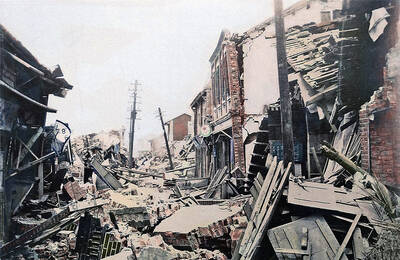
April 15 to April 21 Yang Kui (楊逵) was horrified as he drove past trucks, oxcarts and trolleys loaded with coffins on his way to Tuntzechiao (屯子腳), which he heard had been completely destroyed. The friend he came to check on was safe, but most residents were suffering in the town hit the hardest by the 7.1-magnitude Hsinchu-Taichung Earthquake on April 21, 1935. It remains the deadliest in Taiwan’s recorded history, claiming around 3,300 lives and injuring nearly 12,000. The disaster completely flattened roughly 18,000 houses and damaged countless more. The social activist and

Over the course of former President Ma Ying-jeou’s (馬英九) 11-day trip to China that included a meeting with Chinese Communist Party (CCP) leader Xi Jinping (習近平) a surprising number of people commented that the former president was now “irrelevant.” Upon reflection, it became apparent that these comments were coming from pro-Taiwan, pan-green supporters and they were expressing what they hoped was the case, rather than the reality. Ma’s ideology is so pro-China (read: deep blue) and controversial that many in his own Chinese Nationalist Party (KMT) hope he retires quickly, or at least refrains from speaking on some subjects. Regardless


 RSS
RSS