


Bhutan, the Himalayan kingdom the size of Switzerland with no McDonalds, no ATM machines, no traffic lights, and until five years ago no TV, is for many people a species of Shangri-La. It's as spiritual as Tibet, but without its political problems. The only hurdle for prospective travelers is the relatively high price of a visit -- a deliberate tactic set in place to limit tourism and preserve the nation's culture.
The Blessings of Bhutan is the modest work of an American couple from the banks of the McKenzie River in Oregon (which they claim resembles Bhutan, if only scenically) who have been going there since 1996, latterly to help set up a desk-top publishing company. It looks at many aspects of the country, from archery to -- rather surprisingly -- sexuality.
Bhutan is ranked 130th in the UN Development Program's ratings, close to Haiti and Bangladesh. Most visitors rate it almost infinitely higher, however, and the measure they use is one let fall by the country's king in 1987 -- "Gross National Happiness." This is no joking contrast with Gross National Product, but a serious measure of how any place might be assessed -- not by per capita income, the number of concrete roads, dams and parking lots, but by the simple quality of life. This most observers believe Bhutan's is enviably high.
Gross National Happiness -- and it's an official criterion of the Bhutanese government -- is measured by the levels of environmental protection, cultural promotion, good governance and -- the only item shared with the UN's criteria -- economic development. Clearly this last is not encouraged if it results in a decline of any of the other three.
Despite a burgeoning interest in Tantric Buddhism in the US and elsewhere, Bhutanese sexual norms are markedly different from those in the West, both more modest and more extrovert. At the country's only college, for instance, dating is forbidden, yet genital images are painted on the walls of many houses in what these authors dub sacred paint. The country appears to combine a culture of marriage and mischievous sexual play. But the former is easily dissolved by either partner, a simple fine may be payable for marital infidelity, and having more than one wife or husband is legal. Rape, however, can result in a prison sentence.
What is so attractive about this system, at least as described in this book, is that it lacks any over-reaction to sexual events, any pent-up anger, or culture of jealousy and consequent punishment -- both elements that have grown up in the West as part of the Judeo-Christian tradition. Instead, it's relaxed and practical. Erotic joking is common, seemingly, with no sense of such things being "obscene." As has often been remarked, puritanism and pornography are two faces of the same coin. Bhutan has neither -- though it does nowadays have the Internet.
Archery is more than the national sport -- it's the focus for a great part of the country's social life. While the strong men draw the bow, parties of observers gather round to sing love songs, dance the local dances, and light-heartedly insult their opponents. The target is tiny, a mere 1m-tall and 28cm wide, and placed at a distance of an astonishing 140m. To hit it at all is a cause for celebration. When Russ Carpenter, clearly not in his first youth, hit it both times on his first two attempts, his feat quickly became legendary.
But most people don't travel to places like Bhutan for the sports -- they go because, at one level or another, they seek enlightenment. And the Carpenters have a secret that lies at the heart of their short book -- that the main benefit they acquired from getting to know the country was mental, a relaxation and re-adjustment of the mind.
There is much here about the life of monks, some of it similar to things readers will be familiar with from books about Tibet. More interesting, though, is what the authors have to say about the country's modern values, not to mention its future.
Bhutan, which its inhabitants like to describe as Asia's only under-populated state, does worry these authors in some matters. TV, allowed since 1999, is now very popular, and most popular of all are so-called professional wrestling programs. This taste is viewed, surely rightly, as seriously degrading to the traditional culture in which no sentient being may be harmed (arrows, unlike in Oregon, are never shot at living beings). Secondly, education is still largely by rote, with the result that logical thought is, so the authors claim, rare. No doubt as a result of this, reading isn't, they report, a popular pastime.
This would be a book to read before taking a trip to the landlocked kingdom. Two travel guides recommended by the authors are Bhutan by Francoise Pommaret (Contemporary Books) and Stan Armington's Lonely Planet Bhutan. Pommaret is a local specialist who began living in Bhutan in 1981, while Armington is a mountaineering expert and also author of Lonely Planet's Trekking in the Nepal Himalaya.
Nevertheless, the Carpenters openly adore Bhutan. As countries go, it is obviously one of a kind. Because its principles offer a system that could, if widely adopted, help save the world from its current slide towards ecological and social disaster, the preservation of its way of life and all that this entails is surely of real and serious importance.

In late October of 1873 the government of Japan decided against sending a military expedition to Korea to force that nation to open trade relations. Across the government supporters of the expedition resigned immediately. The spectacle of revolt by disaffected samurai began to loom over Japanese politics. In January of 1874 disaffected samurai attacked a senior minister in Tokyo. A month later, a group of pro-Korea expedition and anti-foreign elements from Saga prefecture in Kyushu revolted, driven in part by high food prices stemming from poor harvests. Their leader, according to Edward Drea’s classic Japan’s Imperial Army, was a samurai
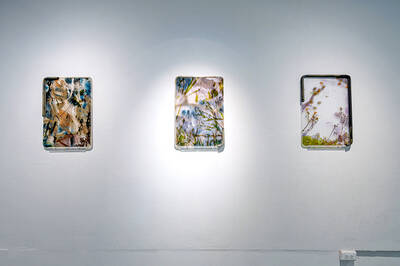
Located down a sideroad in old Wanhua District (萬華區), Waley Art (水谷藝術) has an established reputation for curating some of the more provocative indie art exhibitions in Taipei. And this month is no exception. Beyond the innocuous facade of a shophouse, the full three stories of the gallery space (including the basement) have been taken over by photographs, installation videos and abstract images courtesy of two creatives who hail from the opposite ends of the earth, Taiwan’s Hsu Yi-ting (許懿婷) and Germany’s Benjamin Janzen. “In 2019, I had an art residency in Europe,” Hsu says. “I met Benjamin in the lobby
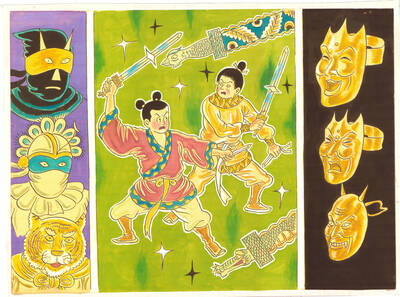
April 22 to April 28 The true identity of the mastermind behind the Demon Gang (魔鬼黨) was undoubtedly on the minds of countless schoolchildren in late 1958. In the days leading up to the big reveal, more than 10,000 guesses were sent to Ta Hwa Publishing Co (大華文化社) for a chance to win prizes. The smash success of the comic series Great Battle Against the Demon Gang (大戰魔鬼黨) came as a surprise to author Yeh Hung-chia (葉宏甲), who had long given up on his dream after being jailed for 10 months in 1947 over political cartoons. Protagonist

Peter Brighton was amazed when he found the giant jackfruit. He had been watching it grow on his farm in far north Queensland, and when it came time to pick it from the tree, it was so heavy it needed two people to do the job. “I was surprised when we cut it off and felt how heavy it was,” he says. “I grabbed it and my wife cut it — couldn’t do it by myself, it took two of us.” Weighing in at 45 kilograms, it is the heaviest jackfruit that Brighton has ever grown on his tropical fruit farm, located


 RSS
RSS