


Spring, Summer, Fall, Winter .... and Spring is an exquisitely simple movie. Written and directed by Kim Ki-duk, it was filmed at a single location -- a remote and picturesque mountain lake in a South Korean wilderness preserve -- and it concentrates on the relationship between a Buddhist monk and his young protege, characters whose names are never spoken. But like William Blake's Songs of Innocence and Experience, the film's lyrical plainness is the sign of a profound and sophisticated artistic sensibility. In five sharp, concise vignettes that correspond to the seasons of the title, Kim manages to isolate something essential about human nature and at the same time, even more astonishingly, to comprehend the scope of human experience.
The subject of "Spring" is spiritual discipline, which the older monk distills into a set of lessons that are, like the film, self-evident and enigmatic. They also reflect aspects of Buddhism not always sufficiently appreciated in the West, often witty and occasionally harsh.
In the first chapter the child monk, indulging a boyish taste for cruelty to animals, ties rocks around the bodies of a fish, a frog and a snake and laughs as they struggle to move. That night the older monk ties a stone to the boy, saying he will remove it when the animals are free. There is an element of slapstick in this punishment, as well as a severe and uncompromising notion of responsibility. If any of the animals have died, the teacher tells his pupil, "you will carry this stone in your heart for the rest of your life."
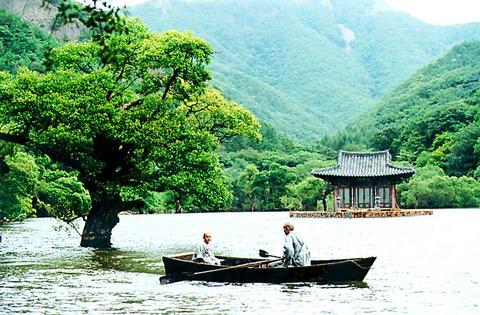
PHOTO COURTESY OF HWA JAAN
Animals figure in other chapters: a cat's tail is used as a calligraphy brush, and there is a quizzical rooster and a deadpan turtle. They are emblems of the natural world, Aesopian metaphors offering silent commentary on the foibles of humanity.
The master and his protege live in extreme isolation; their small wooden house, on a raft in the middle of the lake, is the only habitation for kilometers around. But emissaries from the outside world occasionally reach them. In "Summer" they are joined by a young woman seeking treatment for an unspecified disease. (The style of her clothes is one of the few indications that the film takes place in modern times.) She and the younger monk, who since "Spring" has become a man, slip into a love affair that marks his fall from innocence into experience. "Lust," his tolerant mentor warns, "awakens the desire to possess, which ends in the intent to murder."
When the mentor is proved right in "Autumn," the proof may at first seem melodramatic and literal minded. For all its hushed, philosophical mood, Kim's film has moments of intense, theatrical
feeling. To illustrate the ideals of harmony and peace, a certain amount of discord and dissonance must be endured. The music sometimes tests the limits of such endurance; it sounds better suited to accompany the sinking of the Titanic than the progress of the monk's creaky rowboat.
But the story, effortlessly joining the cycle of the seasons to the larger rhythms of the life cycle, has a beguiling perfection. Along the way there are numerous surprises, and you are never sure, as one chapter gives way to the next, how many changes will have taken place. But by the end -- when you are back at spring, with a young acolyte and a gray-haired master -- the film takes on the heft and gravity of one of the smooth stone Buddhas that decorate the old monk's house. It seems less a modern work of art than a solid, ancient object that has always been there, waiting to be found.

In late October of 1873 the government of Japan decided against sending a military expedition to Korea to force that nation to open trade relations. Across the government supporters of the expedition resigned immediately. The spectacle of revolt by disaffected samurai began to loom over Japanese politics. In January of 1874 disaffected samurai attacked a senior minister in Tokyo. A month later, a group of pro-Korea expedition and anti-foreign elements from Saga prefecture in Kyushu revolted, driven in part by high food prices stemming from poor harvests. Their leader, according to Edward Drea’s classic Japan’s Imperial Army, was a samurai

The following three paragraphs are just some of what the local Chinese-language press is reporting on breathlessly and following every twist and turn with the eagerness of a soap opera fan. For many English-language readers, it probably comes across as incomprehensibly opaque, so bear with me briefly dear reader: To the surprise of many, former pop singer and Democratic Progressive Party (DPP) ex-lawmaker Yu Tien (余天) of the Taiwan Normal Country Promotion Association (TNCPA) at the last minute dropped out of the running for committee chair of the DPP’s New Taipei City chapter, paving the way for DPP legislator Su

Located down a sideroad in old Wanhua District (萬華區), Waley Art (水谷藝術) has an established reputation for curating some of the more provocative indie art exhibitions in Taipei. And this month is no exception. Beyond the innocuous facade of a shophouse, the full three stories of the gallery space (including the basement) have been taken over by photographs, installation videos and abstract images courtesy of two creatives who hail from the opposite ends of the earth, Taiwan’s Hsu Yi-ting (許懿婷) and Germany’s Benjamin Janzen. “In 2019, I had an art residency in Europe,” Hsu says. “I met Benjamin in the lobby

April 22 to April 28 The true identity of the mastermind behind the Demon Gang (魔鬼黨) was undoubtedly on the minds of countless schoolchildren in late 1958. In the days leading up to the big reveal, more than 10,000 guesses were sent to Ta Hwa Publishing Co (大華文化社) for a chance to win prizes. The smash success of the comic series Great Battle Against the Demon Gang (大戰魔鬼黨) came as a surprise to author Yeh Hung-chia (葉宏甲), who had long given up on his dream after being jailed for 10 months in 1947 over political cartoons. Protagonist


 RSS
RSS