


A strange sight greets the many visitors to the sleepy French hamlet of Sainte-Mere-Eglise in Normandy -- a forlorn figure dangling from an old-fashioned white parachute caught on the steeple of the village church.
The figure is not, as may first appear, a hapless parachutist blown off-course, but is actually a model -- a memorial of sorts, one of hundreds that dot this particular corner of rural France, a place where the hand of history has left its mark.
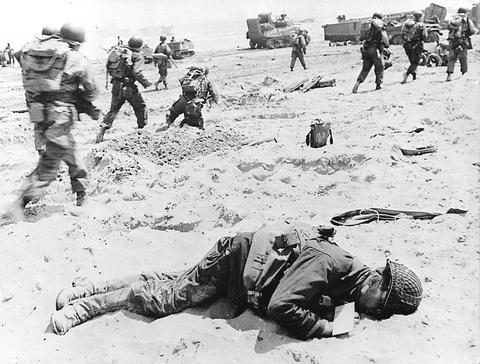
PHOTO: DPA
The dangling model, decked out in full uniform, represents US private John Steele, who in the early morning hours of June 6, 1944, was one of hundreds of US soldiers parachuted deep behind enemy lines to pave the way for the D-Day landings.
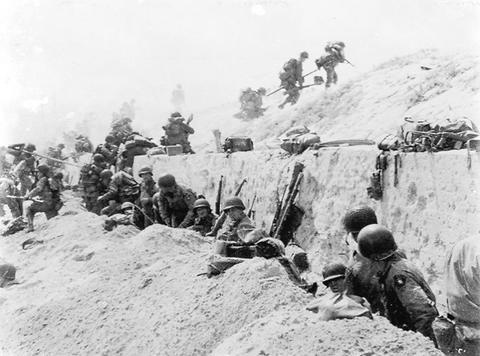
PHOTO: REUTERS
Steele's parachute snagged on the church steeple. Unable to free himself, the soldier played dead for hours in order to avoid the attentions of German gunners in the church tower.
Only when daylight came was he cut down by enemy troops and imprisoned. His story -- later immortalized in the 1962 film The Longest Day -- is just one of countless tales to emerge from that fateful day six decades ago -- one of the most significant military operations in history and the turning point of World War II.
For many of the thousands of visitors and veterans who flock to Normandy yearly to swop such tales, to relive and to reflect, Sainte-Mere-Eglise and its curious memorial is the beginning of the story of D-Day.
As the years pass however, the numbers of visitors who can remember the day itself dwindles. Eventually, no more D-Day veterans will visit the village.
"This will probably be the last year that we can celebrate one of the `big'
anniversaries together with the veterans," says mayor Marc Lefevre wistfully, amid preparations for the 60th anniversary of the landings.
"Already the 80-year-olds are frail, and easily tired," he adds. "We see from year to year that more and more family members are coming."
In the village museum dedicated to the airborne landings, 57-year-old Franck aids his 80-year-old veteran father. The two have made the journey from Pennsylvania and are in Europe for two weeks. It is Franck's first time here.
"I'm trying to experience this unbelievable adventure with him ... to get some kind of impression of what he went through back then," he says.
Bill Coleman, also 80, was one of those who made the landing on Omaha Beach -- and survived. Thousands of his US and British colleagues, many as young as 18, weren't so lucky.
To this day, nobody knows exactly how many died on Omaha beach as heavily laden, under constant machine-gun fire, and whipped by wind and waves, thousands of Allied troops struggled from the landing vessels onto solid ground.
"The beach was just littered with bodies," says Coleman today. "Sometimes you would just run over them without touching the sand."
German bunkers situated on high escarpments overlooking the beach gave gunners a free line of sight to the sands below. Slaughter ensued, before the allies gained the upper hand, with many mown down before they even left the landing vessels. Casualty rates at other landing points not overlooked by high ground -- Utah, Gold, Juno and Sword beaches -- were lower.
Today the carnage of that day, the blood spilled and lives lost on Omaha beach, is but a memory. A page in the history books. A display in the museum. On the beach itself, red plaques denote points of interest. Visitors wander about, stopping to read, stooping to remember.
On the lush green slopes leading from the beach to the higher vantage points h
uddled together, many of them weekend homes owned by well-heeled city folk from Paris or Rouen.
Above the houses the concrete bunkers have easily weathered the intervening six decades, and will weather many more. A stiff breeze blowing through the gun slots whistles eerily, and flaps the row of flags in pride of place in front of the small museum at the end of the beach.
The Union Jack is there. So is the Stars and Stripes. As are the Maple Leaf of Canada and the blue standard of the EU. A little away sits an armored vehicle, squat and watchful. This place is guarded. Feelings run deep.
Bill Coleman is easy to spot in the crowd of visitors trickling through the museum, his distinctive red hat emblazoned with the word "veteran." In many ways the spry octogenarian is the past come to life.
"I give talks in schools and so on," he explains. "I try to ensure that the things that happened here are not forgotten."

In late October of 1873 the government of Japan decided against sending a military expedition to Korea to force that nation to open trade relations. Across the government supporters of the expedition resigned immediately. The spectacle of revolt by disaffected samurai began to loom over Japanese politics. In January of 1874 disaffected samurai attacked a senior minister in Tokyo. A month later, a group of pro-Korea expedition and anti-foreign elements from Saga prefecture in Kyushu revolted, driven in part by high food prices stemming from poor harvests. Their leader, according to Edward Drea’s classic Japan’s Imperial Army, was a samurai

Approaching her mid-30s, Xiong Yidan reckons that most of her friends are on to their second or even third babies. But Xiong has more than a dozen. There is Lucky, the street dog from Bangkok who jumped into a taxi with her and never left. There is Sophie and Ben, sibling geese, who honk from morning to night. Boop and Pan, both goats, are romantically involved. Dumpling the hedgehog enjoys a belly rub from time to time. The list goes on. Xiong nurtures her brood from her 8,000 square meter farm in Chiang Dao, a mountainous district in northern Thailand’s

Located down a sideroad in old Wanhua District (萬華區), Waley Art (水谷藝術) has an established reputation for curating some of the more provocative indie art exhibitions in Taipei. And this month is no exception. Beyond the innocuous facade of a shophouse, the full three stories of the gallery space (including the basement) have been taken over by photographs, installation videos and abstract images courtesy of two creatives who hail from the opposite ends of the earth, Taiwan’s Hsu Yi-ting (許懿婷) and Germany’s Benjamin Janzen. “In 2019, I had an art residency in Europe,” Hsu says. “I met Benjamin in the lobby
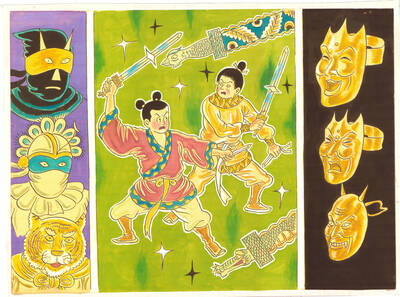
April 22 to April 28 The true identity of the mastermind behind the Demon Gang (魔鬼黨) was undoubtedly on the minds of countless schoolchildren in late 1958. In the days leading up to the big reveal, more than 10,000 guesses were sent to Ta Hwa Publishing Co (大華文化社) for a chance to win prizes. The smash success of the comic series Great Battle Against the Demon Gang (大戰魔鬼黨) came as a surprise to author Yeh Hung-chia (葉宏甲), who had long given up on his dream after being jailed for 10 months in 1947 over political cartoons. Protagonist


 RSS
RSS