


"I never got to be an emperor and I never lived like one," joked Peng Yong-chuan (
The 75-year-old Hakka farmer born in Hsinchu, who settled in Hualien County, is almost single-handedly responsible for preserving Yoshino No. 1 (
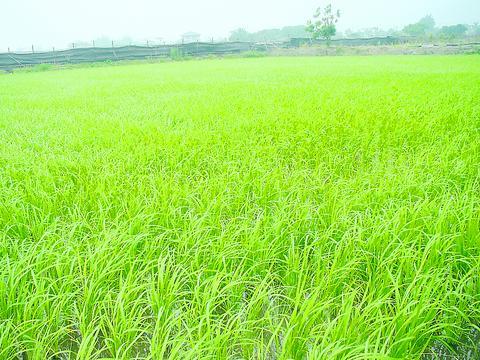
Also known as "Japanese Emperor's rice" (
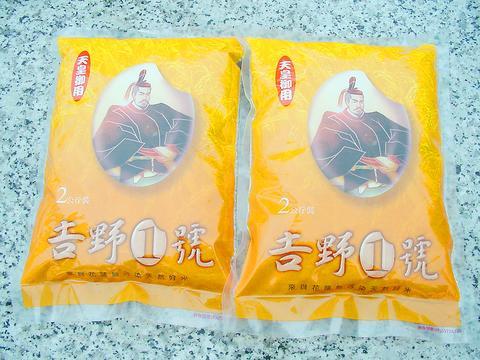
Yoshino No. 1, unlike other rice varieties, is said to have an appealing smell and unique taste when it's properly prepared. It has a sweet flavor that stays on the palate even after a lot of chewing. Its grains are rounder and plumper than other varieties and are crystal clear, with a white, heart-shaped dot in the middle. Japanese growers claimed the shape of the dot was similar to the sun rising on the nation's white flag and thus cherished the rice even more.
Cultivating the rice, however, is extremely labor-intensive and too much or too little wind, rain or fertilizer destroys the crop. Also, without proper care, the length of the stem easily exceeds 110cm before ears of rice develop. There is a critical point where the stem can no longer support the weight of the ears of rice and bends over. If this happens the rice changes in taste and is fit only for chicken feed. It is essential, then, that the crop is picked at the right time. Too early and the rice is not ready, too late and it's over ripe.
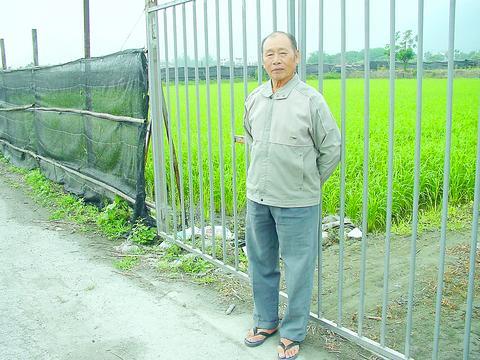
Birds like the rice so much, according to agriculture official Chen Ming-te (
As a result of the difficulty of growing the rice and the departure of the Japanese after World War II, production of Yoshino No. 1 stopped because the cost of growing it was higher than the returns.
It wasn't until 1969, when Peng retired from his hospital job after 20 years and started helping his in-laws cultivate a large piece of farmland, that Japanese emperor's rice would be cultivated again. Peng recalled stories told by his primary school teacher in Hualien about the quality of the rice and was inspired to try growing it himself.
He was lucky enough to obtain some seeds of the long-forgotten rice from an old colleague working in the Farming Reform Field (
Originally, Yoshino No. 1 was invented by Aoki Shigelu (青木繁氏) in 1926 and was first known as "Aoki rice" (青木米). In 1909, the Japanese government's policy of managed emigration to relieve domestic population pressures, meant that "immigration villages" were set up in Hualien. Immigrants from Tokushima Ken and Kagawan Ken in Shikoku Prefecture started to cultivate paddy rice in what used to be known as Chijiaochuang. Now known as Chian township village, it was then named after some of the immigrants' hometown of Yoshinokawa.
Among the new settlers, Shigelu was an agriculture researcher and developed a new variety of rice by crossing a Japanese rice plant Kikuchi Mai (
The year after it was developed, the new breed of rice was presented to Emperor Hirohito as a tribute and was given its official name, Yoshino No. 1. Two hectares of rice fields at the back of Taohsing Primary School, in Chian, were then designated for the exclusive production of the rice. The field was looked after by a group of agricultural researchers and specialists and was guarded closely by local township officials. One of their major duties was to scare birds away from the field.
Peng told this reporter a story which he said he had never told anyone before. He said when the rice was harvested, Japanese officials would pick a dozen or so local young Japanese girls to pick and package the rice. These young girls were required to take a bath and change into new clothes prior to performing their duties, as a token of their respect for the emperor. They would peel off the husks on the rice, by hand, one by one. No Taiwanese girls were chosen for the job, perhaps because of security concerns.
A traditional Japanese ceremony would be held to bless the rice and to plead for special blessings from the emperor. The handpicked 10kg or so of Yoshino No. 1 rice was then shipped from Hualien to its final destination -- the Emperor's Palace in Tokyo. Whatever was left over was then presented to the Japanese Colonial Governor's Palace in Taipei.
According to Kang Mu-shu (
Now, more farmers in Hualien are eager to plant the rice because demand is steadily increasing, and since it can only be produced in Chian, its selling price is much higher than other varieties. Normally, 60kg of rice sells for about NT$1,000. Yoshino No. 1 sells for nearly double that.
Without Peng's dedicated efforts Yoshino No. 1 could have vanished into history for good. Not only has Peng brought fame and trade to his hometown, he has also saved a part of Taiwan's cultural heritage.
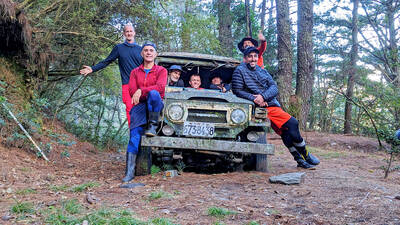
The year was 1991. A Toyota Land Cruiser set out on a 67km journey up the Junda Forest Road (郡大林道) toward an old loggers’ camp, at which point the hikers inside would get out and begin their ascent of Jade Mountain (玉山). Little did they know, they would be the last group of hikers to ever enjoy this shortcut into the mountains. An approaching typhoon soon wiped out the road behind them, trapping the vehicle on the mountain and forever changing the approach to Jade Mountain. THE CONTEMPORARY ROUTE Nowadays, the approach to Jade Mountain from the north side takes an

Last week Joseph Nye, the well-known China scholar, wrote on the Australian Strategic Policy Institute’s website about how war over Taiwan might be averted. He noted that years ago he was on a team that met with then-president Chen Shui-bian (陳水扁), “whose previous ‘unofficial’ visit to the US had caused a crisis in which China fired missiles into the sea and the US deployed carriers off the coast of Taiwan.” Yes, that’s right, mighty Chen caused that crisis all by himself. Neither the US nor the People’s Republic of China (PRC) exercised any agency. Nye then nostalgically invoked the comical specter
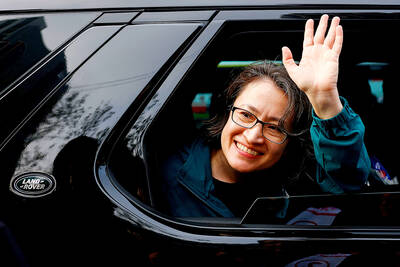
Relations between Taiwan and the Czech Republic have flourished in recent years. However, not everyone is pleased about the growing friendship between the two countries. Last month, an incident involving a Chinese diplomat tailing the car of vice president-elect Hsiao Bi-khim (蕭美琴) in Prague, drew public attention to the People’s Republic of China’s (PRC) operations to undermine Taiwan overseas. The trip was not Hsiao’s first visit to the Central European country. It was meant to be low-key, a chance to meet with local academics and politicians, until her police escort noticed a car was tailing her through the Czech capital. The
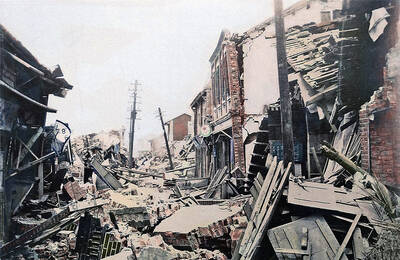
April 15 to April 21 Yang Kui (楊逵) was horrified as he drove past trucks, oxcarts and trolleys loaded with coffins on his way to Tuntzechiao (屯子腳), which he heard had been completely destroyed. The friend he came to check on was safe, but most residents were suffering in the town hit the hardest by the 7.1-magnitude Hsinchu-Taichung Earthquake on April 21, 1935. It remains the deadliest in Taiwan’s recorded history, claiming around 3,300 lives and injuring nearly 12,000. The disaster completely flattened roughly 18,000 houses and damaged countless more. The social activist and


 RSS
RSS