


Maxine Hong Kingston is currently the living author most-widely taught in American universities. She rocketed to fame in 1976 with The Woman Warrior, a book now simultaneously prescribed by university departments and read for pleasure by ordinary readers -- quite some achievement.
Four years later Hong Kingston published another work, China Men, dealing with the lives of the males in her family. This had comparatively little success. Male problems didn't have the same sort of appeal that those of women had, apparently. So whereas there is today a massive bibliography of books and learned articles analyzing The Woman Warrior, its successor has received scant attention. This imbalance Hong Kong academic Maureen Sabine seeks to redress.
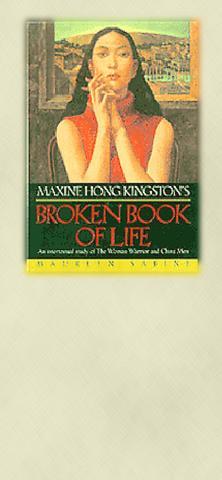
Her main strategy is to note that the two books were originally one vast manuscript. Either Hong Kingston or her publishers considered this too unwieldy, however, so the book was broken into two. This is why Sabine calls her book Maxine Hong Kingston's Broken Book of Life. The two books were originally one, and to understand either properly we should see them as two faces of the same coin. In practical terms this means giving China Men its due.
Is this maneuver in effect an affront to feminism? Of course Sabine doesn't think so. Not only is she a woman herself, but her first book, Feminine Engendered Faith (Macmillan, 1992), looked at the 17th-century English poets John Donne and Richard Crashaw from a female's perspective.
In addition, she is herself something of a woman warrior. She bases her analysis of Hong Kingston on her own brand of feminist, mytho-poetic Catholicism, sharply at odds with the varieties of Marxist-based radicalism at the moment dominant in the Western academy. Few other critics are mining Sabine's particular seam, but it could become a powerful viewpoint as the cycle of change moves away, as inevitably it will, from current preoccupations.
Sabine is not slow to point out that Hong Kingston's title China Men contains a veiled reference to the words "Chinaman" and "Chinamen," nowadays considered racist terms. It's important to keep a sense of historical perspective, however, and remember that the words weren't always insulting. As recently as 1939, the Irish poet W.B.Yeats used them in his poem Lapis Lazuli, and in an immensely complimentary context, with three carved Chinese figures emblematic of the very philosophic tranquillity and wisdom the whole poem sets out to praise.
As for other literary figures, Sabine brings in Lewis Carroll, Virginia Woolf, Walt Whitman, A.S.Byatt, Andrew Marvell, Gerard Manley Hopkins, Doris Lessing and more. She is, in other words, interested in literature, in contrast to the subversive zealots who are primarily interested in using it as target practice for their socio-political strategies.
This is not to say that Sabine isn't concerned with winkling out the psychoanalytic significancies that lurk below the surface of even the most serene imaginative works. Thus Sigmund Freud features prominently in this book -- slightly strangely as he is more often encountered as part of the reigning Marx-Freud-Derrida trinity.
The Oedipus Complex is central to Freud's view of human life, and incest is at the heart of the Oedipus story as told by Sophocles. For both Freud and Sophocles, the family is a squirming nest of terrible secrets, and Maureen Sabine honors Hong Kingston by adding her to this select company. Incest between father and daughter, Sabine argues, may be an unmentioned and unmentionable ingredient in Kingston's narrative. She adds it to that dark trinity of Chinese taboos -- suicide, menstruation, and the trauma of childbirth.
This book is presented as an intertextual study, and intertextuality -- the reading of one text in the light of another one -- is also incestuous in that it involves an illicit connection between things closely related. Maxine Hong Kingston's Broken Book of Life, therefore, is no simple-minded tract, but instead something that seeks to finger its way deep into the female Chinese subconscious, energetically brushing away the neatly raked top-soil to establish the exact nature of the secret root system beneath.
This kind of investigation is in the tradition of Camille Paglia, a writer of genius and the most brilliant literary critic the US has ever produced. Far from perceiving women as the same as men in all important particulars (something Marxist feminists are keen to insist on), Paglia sees them instead as profoundly different, and much closer to savage nature than the calculating, cerebral male.
With her interests in mother goddesses and mystery religions, Sabine is a feminist with a difference. It's a mark of Hong Kingston's stature that she can absorb even this kind of darkly chthonic analysis into her capacious embrace.

In late October of 1873 the government of Japan decided against sending a military expedition to Korea to force that nation to open trade relations. Across the government supporters of the expedition resigned immediately. The spectacle of revolt by disaffected samurai began to loom over Japanese politics. In January of 1874 disaffected samurai attacked a senior minister in Tokyo. A month later, a group of pro-Korea expedition and anti-foreign elements from Saga prefecture in Kyushu revolted, driven in part by high food prices stemming from poor harvests. Their leader, according to Edward Drea’s classic Japan’s Imperial Army, was a samurai

Located down a sideroad in old Wanhua District (萬華區), Waley Art (水谷藝術) has an established reputation for curating some of the more provocative indie art exhibitions in Taipei. And this month is no exception. Beyond the innocuous facade of a shophouse, the full three stories of the gallery space (including the basement) have been taken over by photographs, installation videos and abstract images courtesy of two creatives who hail from the opposite ends of the earth, Taiwan’s Hsu Yi-ting (許懿婷) and Germany’s Benjamin Janzen. “In 2019, I had an art residency in Europe,” Hsu says. “I met Benjamin in the lobby
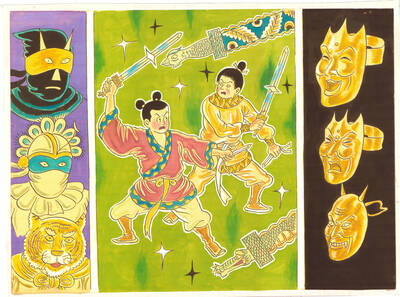
April 22 to April 28 The true identity of the mastermind behind the Demon Gang (魔鬼黨) was undoubtedly on the minds of countless schoolchildren in late 1958. In the days leading up to the big reveal, more than 10,000 guesses were sent to Ta Hwa Publishing Co (大華文化社) for a chance to win prizes. The smash success of the comic series Great Battle Against the Demon Gang (大戰魔鬼黨) came as a surprise to author Yeh Hung-chia (葉宏甲), who had long given up on his dream after being jailed for 10 months in 1947 over political cartoons. Protagonist

A fossil jawbone found by a British girl and her father on a beach in Somerset, England belongs to a gigantic marine reptile dating to 202 million years ago that appears to have been among the largest animals ever on Earth. Researchers said on Wednesday the bone, called a surangular, was from a type of ocean-going reptile called an ichthyosaur. Based on its dimensions compared to the same bone in closely related ichthyosaurs, the researchers estimated that the Triassic Period creature, which they named Ichthyotitan severnensis, was between 22-26 meters long. That would make it perhaps the largest-known marine reptile and would


 RSS
RSS