


Andy Wang is a modern-day warrior with a mission. The 26-year-old has returned to his home country from California, where he grew up, to do what he does best: teach people how to fight and win.
And though the Taipei Brazilian Jiujitsu Academy at which he teaches has been in business only a month, he and his students are already putting the skills they've acquired to test in the nation's first-ever international Brazilian jiujitsu
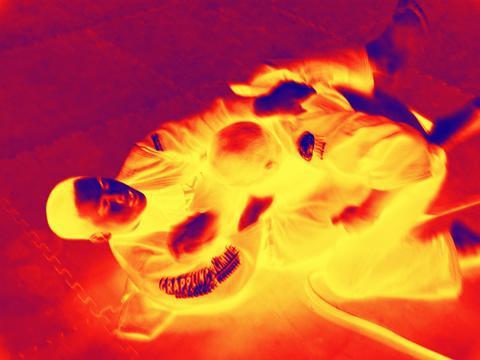
PHOTO: DAVID MOMPHARD, TAIPEI TIMES
tournament.

PHOTO: DAVID MOMPHARD, TAIPEI TIMES
The grappling gets under way today at the Core Pacific Living Mall, when teams from the US, Korea, the Philippines, Thailand, Singapore, Hong Kong and Taiwan meet on the mat.
While Wang has been studying jiujitsu for the past eight years, his desire to pass on what he's learned to others is more recent.

PHOTO: DAVID MOMPHARD, TAIPEI TIMES
"There was a world fighting competition in 1998 and the Chinese Olympic judo team was invited to compete," Wang says. "They'd never trained in jiujitsu and they were all beaten ... Afterward I heard people saying `the Chinese suck.' I don't want to ever again hear someone say that Chinese or Taiwanese people suck."

PHOTO: DAVID MOMPHARD, TAIPEI TIMES
seeking a master
To that end, he returned to Taiwan after answering an ad searching for a teacher at a new academy in Taipei. Sean McCormack, who placed the ad and is general manager of the academy, had been involved with a jiujitsu club for several months prior to the founding of the academy. He says that when word got out that Wang might sign on as instructor, the burgeoning academy quickly got off the ground.
"When Andy responded to the ad, we immediately felt like it was a good fit," McCormack says. "But then people I'd never met found out and called us saying `You guys have Andy Wang coming to teach?' Now even more people are wanting to know what Brazilian jiujitsu is about."
It's about winning a fight. Jiujitsu was exported from its native Japan in the early 20th century on the broad shoulders of Mitsuyo Maeda. He was said to have taken on 1,000
challengers in several countries, including the US where, legend has it, he fought the toughest wrestler at West Point military academy.
Though just 152cm and 72kg, Maeda bested the hulking wrestler. He allegedly never lost a judo-style competition and was defeated only twice in professional wrestling matches.
In his later life, as an immigrant to Brazil, Maeda passed on his skills to eager Brazilian boys, most notably Carlos Gracie and his brothers, who would adapt what they learned and transform it into what's now known as Brazilian or Gracie jiujitsu.
Brazilian jiujitsu practitioners prefer taking an opponent to the ground and relying on arm-locks, leg-locks, striking and chokeholds to force their opponent to "tap-out" or submit. The strategy takes away the advantage of anyone with superior striking abilities and can mitigate the advantage of larger, stronger opponents.
"The first advantage of Brazilian jiujitsu is being able to put yourself in a position where your opponent is weak and you're strong," Wang says. Though about Maeda's height, Wang is by no means a small guy and recalls growing up in a tough neighborhood in LA.
"When I was 16, I walked in to what I thought was a doughnut shop," he said. "It turned out to be a jiujitsu academy. The first thing I saw was little guys beating big guys and I thought the big guys were letting them win. But they weren't. The little guys were winning because they knew more. It was then I knew that this was a practical and applicable martial art."
And apply it he has. Over the past eight years, he's fought in several professional bouts and earned the respect of fighters from around the world, including Baret Yoshida, a black-belt known as "The Finisher" who has come to Taiwan to observe today's tournament and host a seminar on jiujitsu techniques at the Core Pacific center tomorrow.
"Knowing jiujitsu is like having a gun," Yosihida said. "Once you've used it, you see how powerful it is -- how lethal -- and you develop a respect for it. You learn to keep your gun in its holster until you need it."
While prize money to be earned in professional fighting isn't much, Yoshida says the sport has been good to him.
"I was in a tournament in the United Arab Emirates. First prize was US$10,000 and second was US$5,000. But all these super rich guys would come up to you and say, `You're my favorite fighter. I'll give you US$5,000 if you wear my company's T-shirt.'"
He was also invited last year to train the children of a prince of the UAE for two months; a job for which he says he was well paid.
Like his friend Wang, Yoshida has fought in numerous professional bouts, including no-holds-barred matches that often see contenders face off using any combination of judo, karate, taekwondo, boxing or jiujitsu.
Although anything goes in these brutal matches, it's often the person with the strongest jiujitsu skills that wins -- a fact that has earned the martial art a must-study status among the world's top fighters.
HANDS-ON EXPERIENCE
It's also found popularity among those who simply have a fighting spirit. Elizabeth Duggan has been with the Taipei academy for nearly a month and is one of about 10 female members of the academy, which now has some 50 members.
"In the past three weeks I've learned how to fall, how to block an attack and how to throw someone," she said. "I've also learned to how to choke someone out."
This past week, before the 12 academy members competing in today's tournament met for their final training session, McCormack invited me to participate in a beginner's class with Duggan and another first-timer. McCormack taught the class himself and towards the end the four of us, each outfitted in a traditional gi, sat in a circle practicing how to choke one another -- "in two to three seconds," McCormack claims.
I'd already seen how jiujitsu techniques could be used to mitigate the perceived advantages of height and weight and how positioning could ultimately allow you to force your opponent to tap out and submit.
But how to make them submit? And in two to three seconds? Choking, I'd always thought, was about cutting off someone's oxygen supply. They could just hold their breath, right? Wrong.
When it was my turn, McCormack moved behind me and reached his right arm around my neck. With his bicep and forearm each against a jugular vein he squeezed, cutting off not my air supply but the blood to my brain. A second later I was tapping.
"That first time someone gets a choke on you, you're not ready for what it feels like," Duggan says.
She's right. It's not pain that you feel, but mortality.
"In two to three second you can put someone to sleep," McCormack said. "Hold it a while longer and you can cause brain damage, longer still and you'll kill them." While it sounds violent, he explains that it's actually far less violent than other martial arts.
"If someone on the street or a drunk guy in a bar attacks you, you might not feel bad about throwing a kick to their head. But if it's your friend who's had too much to drink, you want to end the situation without doing damage," he says. "For that reason jiujitsu is more practical."
Wang, for his part, has a more philosophical perspective of the martial art.
"Jiujitsu can change your life," he says. "Every day that you work on your skills, you find out more about who you are. It's humbling and empowering. It's the journey of mat."
Today's tournament starts at 10:30am in the food court level of the Core Pacific Living Mall, located at 138 Bade Road, Sec 4, Taipei (北市八得路四 段138號B3).
Admission is free. People interested in learning more about jiujitsu or participating in Baret Yoshida's seminar tomorrow can call Sean McCormack, general manager of Taipei Brazilian Jiujitsu Academy at (0920) 620 109.
The academy is located at 8, Alley 3, Ln 251, Zhongxiao E Rd, Sec 3, Taipei (北市忠孝東路三段251巷).

In late October of 1873 the government of Japan decided against sending a military expedition to Korea to force that nation to open trade relations. Across the government supporters of the expedition resigned immediately. The spectacle of revolt by disaffected samurai began to loom over Japanese politics. In January of 1874 disaffected samurai attacked a senior minister in Tokyo. A month later, a group of pro-Korea expedition and anti-foreign elements from Saga prefecture in Kyushu revolted, driven in part by high food prices stemming from poor harvests. Their leader, according to Edward Drea’s classic Japan’s Imperial Army, was a samurai

Located down a sideroad in old Wanhua District (萬華區), Waley Art (水谷藝術) has an established reputation for curating some of the more provocative indie art exhibitions in Taipei. And this month is no exception. Beyond the innocuous facade of a shophouse, the full three stories of the gallery space (including the basement) have been taken over by photographs, installation videos and abstract images courtesy of two creatives who hail from the opposite ends of the earth, Taiwan’s Hsu Yi-ting (許懿婷) and Germany’s Benjamin Janzen. “In 2019, I had an art residency in Europe,” Hsu says. “I met Benjamin in the lobby
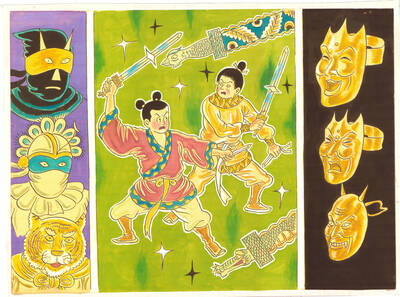
April 22 to April 28 The true identity of the mastermind behind the Demon Gang (魔鬼黨) was undoubtedly on the minds of countless schoolchildren in late 1958. In the days leading up to the big reveal, more than 10,000 guesses were sent to Ta Hwa Publishing Co (大華文化社) for a chance to win prizes. The smash success of the comic series Great Battle Against the Demon Gang (大戰魔鬼黨) came as a surprise to author Yeh Hung-chia (葉宏甲), who had long given up on his dream after being jailed for 10 months in 1947 over political cartoons. Protagonist

Peter Brighton was amazed when he found the giant jackfruit. He had been watching it grow on his farm in far north Queensland, and when it came time to pick it from the tree, it was so heavy it needed two people to do the job. “I was surprised when we cut it off and felt how heavy it was,” he says. “I grabbed it and my wife cut it — couldn’t do it by myself, it took two of us.” Weighing in at 45 kilograms, it is the heaviest jackfruit that Brighton has ever grown on his tropical fruit farm, located


 RSS
RSS