


Jonathan Miller has a highly mobile face. It's the face of a natural performer, someone whose features not only register but underscore his thoughts (and Miller thinks many thoughts). His most frequent expression might best be described as quizzicality verging on
wonderment.
One expects that was the look on Miller's face more than six decades ago when he came across an illustration of the brain in his psychiatrist father's copy of Gray's Anatomy. Only six, Miller sensed something was missing. "Where's the mind?" he asked his father.

PHOTO: REUTERS
The question was precocious -- and prescient. Few people have spent a career (or, in Miller's case, careers) demonstrating just how vital a human mind can be.
Miller, 69, was in Boston recently to give a lecture at the Museum of Fine Arts on reflection and mirrors in art. It concluded the inaugural season of the museum's Ruth and Carl Shapiro Lecture Series. The lecturers preceding Miller were Chuck Close and Mark Morris.

PHOTO: NY TIMES
Close is a painter, of course, and Morris is a choreographer. How, though, to characterize Miller? "Under `occupation' on my tax form, it says `theater director,'" Miller says with an amused shrug while having coffee at the Park Plaza. "It's simpler than `amateur

epistemologist.'"
"He's a universal man, a Renaissance man," says a longtime friend, Robert Brustein, the founding director of the American Repertory Theatre. "He's a remarkable human being, a remarkable artist."
Based in London, Miller has for decades been one of the world's foremost directors of theater and opera. In the early 1980s, he oversaw the BBC's filming of the complete plays of Shakespeare. His Mafia version of Rigoletto moved Verdi's opera to 1950s Little Italy. He set The Mikado in a 1920s British seaside hotel, and his version of The Merchant of Venice (starring Laurence Olivier) turned Shylock into a 19th-century businessman.
Most recently, Miller directed King Lear, starring Christopher Plummer, in New York and a version of Donizetti's opera L'Elisir d'Amore in Stockholm that drew on Wim Wenders' film Paris, Texas and the paintings of Edward Hopper.
His resume notwithstanding, Miller professes to be a theatrical amateur. "I don't think of myself as being a theater director," he says. "I think of myself as being all these other things I'm interested in which converge extremely profitably on the theater. I'm interested in perception, philosophy, psychology, cognition, anthropology, and so forth. If you start working in the theater as an amateur, you become professionally very adept because these things are so relevant."
Miller started out as a medical doctor, albeit one who'd dabbled in light theatricals as an undergraduate at Cambridge University. That led to his involvement as writer and performer in the legendary stage revue Beyond the Fringe, which made him a star in the early 1960s. He has contemplated returning to medicine at various times since and has continued doing work in cognitive science (his medical field was neuropsychology).
"I met Jonathan back in 1981 or 1982," says Daniel Dennett, professor of philosophy and director of the Center for Cognitive Studies at Tufts University. "Ever since I've known him, he has always been at or close to the cutting edge of research on the mind, even though he hasn't been `officially' a cognitive scientist for quite a few years."
In 1983, Miller presented a BBC series on cognitive science, States of Mind, which later became a book. He's also presented BBC series on madness and the history of medicine. For the latter, The Body in Question, he performed the first televised autopsy. (Donald Trump can declare "You're fired" until his comb-over combusts, but reality TV doesn't come any realer than that.)
Miller has published books on Freud, Darwin, and Marshall McLuhan, among other subjects. There's also a collection of photographs, and lately he's taken up collage and metal assemblage. "That's the big new thing for me," he says with enthusiasm. "I've had a couple of exhibitions in the last three years -- and even sold quite a lot."
"I just do what I do," Miller says. "Someone comes to the door with a Frisbee and says, `Come out and play,' I come out and play."
"Play," in Miller's vocabulary, is a synonym for "think." The boy who was unable to see where the mind was has spent his adult life demonstrating how variously it can be used. Miller has blunt fingers, a blunt nose, and a blunt head. Their thickness amounts to a physiognomic joke on his mental nimbleness -- what Dennett calls the "virtuosic speed" of his thought.
Miller uses his playful, quicksilver intelligence the way Fred Astaire used his feet. He dances with words -- "A remarkable talker," Brustein calls him, "the best in the world" -- and even dances around words. Miller suffers from a stammer but manages to improvise his way around the offending consonants so that his impediment is hardly detectable.
"The world is a comedy to those that think, and a tragedy to those that feel," said the 18th-century writer Horace Walpole. Miller's must be a very comic world indeed.
Redden the white hair, smooth away some wrinkles, straighten the slight stoop, and Miller could be back in Beyond the Fringe. There's an intellectual exuberance to him, a constant fizz. As a boy, he went through an obsession with Danny Kaye (the Robin Williams of his day), and one wonders if he ever altogether outgrew it. When a waitress refills his coffee, he mimics her speech with drop-dead accuracy. Usually, Miller speaks in tones of slightly nasal Oxbridge silkiness. One can almost feel his sense of relief -- like a boy let out of school -- as he mumbles away in Uhmurcan English about "milk or, uh, cream."
So swift and sure-tongued a transition from the queen's English to George W. Bush's is a reminder of what may be the unifying thread running throughout Miller's work. "I like seeing previously unforeseen connections," he says.
For Miller, such linkages are the essence of directing. They are, in a sense, another version of assemblage.
"I work on the stage and spend an enormous amount of time attending to negligible details," he explains. "With what someone is doing with their little finger while listening to someone, rubbing their eyebrow while they're talking: these minor, involuntary acts of theirs and the things that people do in deference to other people ... I keep on saying to my actors when I work with them, `Take care of the negligible and the great will take care of itself.' There's nothing else. There aren't any big things. Big things turn out to be huge heaps of negligible things."
Miller, who has various productions scheduled through the next two years, says he's "trying to withdraw" from directing. He's said that before, though. The energy remains high, the curiosity seemingly boundless. Still, someone who has always personified irrepressibility now gives off a whiff, however faint, of elder statesman. Miller turns 70 in July and was knighted last year. ("My wife can't bear any mention of it at all, but my children said, `Oh, Dad, why not accept?' So I did.")
"In the end, when you reach 70, you have to put up with what you've done," Miller says. "You say, `Alright, I think that's OK.' I know even if I was given another 15 or 20 years -- who knows how much I have got? -- I'm not going to suddenly make a big jump or a leap. I simply have to look back and say, `Well, that was quite good. No one's ever thought that. That was really quite an interesting notion.'"

Last week Joseph Nye, the well-known China scholar, wrote on the Australian Strategic Policy Institute’s website about how war over Taiwan might be averted. He noted that years ago he was on a team that met with then-president Chen Shui-bian (陳水扁), “whose previous ‘unofficial’ visit to the US had caused a crisis in which China fired missiles into the sea and the US deployed carriers off the coast of Taiwan.” Yes, that’s right, mighty Chen caused that crisis all by himself. Neither the US nor the People’s Republic of China (PRC) exercised any agency. Nye then nostalgically invoked the comical specter
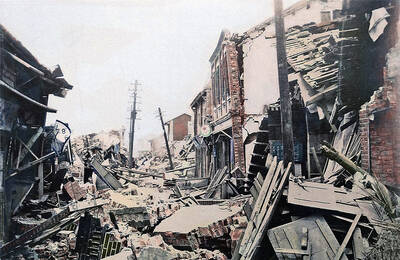
April 15 to April 21 Yang Kui (楊逵) was horrified as he drove past trucks, oxcarts and trolleys loaded with coffins on his way to Tuntzechiao (屯子腳), which he heard had been completely destroyed. The friend he came to check on was safe, but most residents were suffering in the town hit the hardest by the 7.1-magnitude Hsinchu-Taichung Earthquake on April 21, 1935. It remains the deadliest in Taiwan’s recorded history, claiming around 3,300 lives and injuring nearly 12,000. The disaster completely flattened roughly 18,000 houses and damaged countless more. The social activist and

Over the course of former President Ma Ying-jeou’s (馬英九) 11-day trip to China that included a meeting with Chinese Communist Party (CCP) leader Xi Jinping (習近平) a surprising number of people commented that the former president was now “irrelevant.” Upon reflection, it became apparent that these comments were coming from pro-Taiwan, pan-green supporters and they were expressing what they hoped was the case, rather than the reality. Ma’s ideology is so pro-China (read: deep blue) and controversial that many in his own Chinese Nationalist Party (KMT) hope he retires quickly, or at least refrains from speaking on some subjects. Regardless

Approaching her mid-30s, Xiong Yidan reckons that most of her friends are on to their second or even third babies. But Xiong has more than a dozen. There is Lucky, the street dog from Bangkok who jumped into a taxi with her and never left. There is Sophie and Ben, sibling geese, who honk from morning to night. Boop and Pan, both goats, are romantically involved. Dumpling the hedgehog enjoys a belly rub from time to time. The list goes on. Xiong nurtures her brood from her 8,000 square meter farm in Chiang Dao, a mountainous district in northern Thailand’s


 RSS
RSS