


Upstream from this dog-eat-dog capital, where the Congo River spills its tributaries into the belly of the equatorial rain forest, lies the jungle home of one of mankind's closest cousins and one of the most endangered primates on earth: the bonobo.
Genetically, humans and bonobos, a species of chimpanzee, are more than 98 percent similar. Socially, it is another matter. Matriarchal as a rule, bonobos eschew conflict. They do not fight over territory. They do not kill. Any small friction they resolve through sexual contact: a playful rub, oral sex, full intercourse.
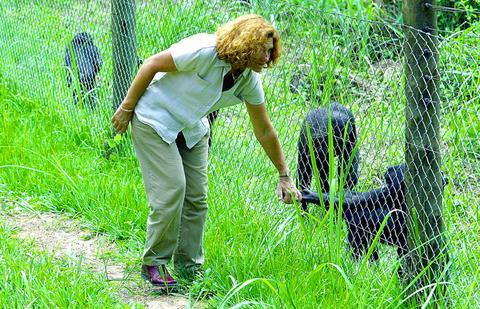
PHOTO: NY TIMES
Peace-loving they may be, but during Congo's latest war, the bonobos' jungle habitat fell smack on the front line between two fighting factions.
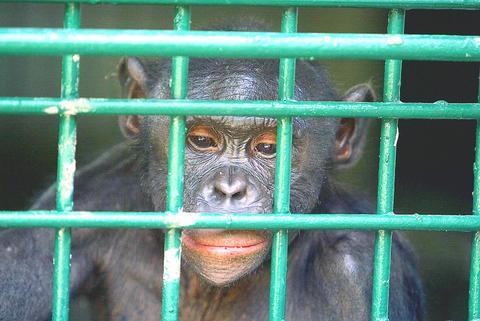
PHOTO: NY TIMES
Fishing and farming all but ground to a halt during the war, which officially ended last year. Civilians and soldiers alike turned to the forest to fill their bellies.
More and more, the bonobos turned up as supper. Their smoked remains showed up at riverine markets. Babies were orphaned, which is to say they were more or less destined to die: The bonobo infant, accustomed to staying on its mother's back for the first few years of life, has great trouble surviving on its own.
So it was that the bonobo orphans of the central African rain forest found themselves hurtling hundreds of kilometers down the Congo River to this gritty metropolis and into the arms of a redheaded Frenchwoman called Claudine Andre.
Andre recalls it as love at first sight. More than 10 years ago, after a famous, ruinous pillage of Kinshasa, Andre, then a businesswoman, went to the ravaged city zoo and chanced upon a bereft infant bonobo. He looked as though he wanted to die, she recalled. She named him Mikano, took him home and became, in her words, his surrogate mother.
When the war came, more orphans trickled in. She kept them on the grounds of an elite American school. Then, last year, when peace came, she opened Lola Ya Bonobo, a sanctuary for orphaned bonobos on a 75-acre patch of green on the fringes of the capital.
Infants are paired with surrogate mothers. There is an endless supply of bananas and sugar cane (bonobos have an incurable sweet tooth). An electric fence encircles the park, to keep the apes from scampering out of the woods and into Kinshasa's traffic. The park is open to visitors.
On a recent Sunday afternoon, the park's 31 young charges did what young bonobos do: chewed on blades of grass, swung from palm fronds, kissed, frolicked and fondled.
"It's the hippies of the forest," Andre said, taking their wrinkled hairy hands in hers. "When they feel anxious, when they are afraid, they have sex. And they calm down."
As if on cue, a big bonobo mounted a small bonobo. They rolled around on the grass, rubbed themselves against each other and went on their merry ways.
Bonobos are not proprietary about mates and sex is not always about procreation. Homosexuality is common, and sexual play begins when they are barely a year old, though intercourse must wait until they are teenagers. Much to Andre's delight, a teenage orphan, a male, arrived recently. Hopefully, she said, mating will soon begin.
"It's really make love, not war," Andre said of the bonobo way of life. "It was so sad to see such a pacific animal so destroyed by war."
The plight of the bonobos, a species found only in Congo, is a window into the repercussions of war on the ecology of the Congo River Basin, one of the most diverse ecosystems in the world and home to more than 400 species of mammals. Mining, logging and a sustained trade in bush meat have all put the squeeze on their habitats.
War having made vast swaths of the country inaccessible to researchers, it is impossible to know precisely how these creatures have fared. Certain habitats may have been left untouched, but others have been devoured.
In the Virunga Highlands near the border of Uganda and Rwanda, the mountain gorilla population has grown, according to a census by the Wildlife Conservation Society. By contrast, in the Kahuzi-Biega National Park, the eastern lowland gorilla's population has fallen by 70 percent to fewer than 5,000, according to Conservation International. The elephants in the same park may well have vanished.
As for the bonobo population, scientists have no reliable numbers but fear the species may be nearing extinction. Late last year, the UN Environment Program reported that the bonobo, along with the gorilla, chimpanzee and orangutan, could disappear in 50 years.
Peace is likely to present a new challenge to forest dwellers: Congo's rain forests have once again opened up to logging companies and today the first batches of timber can be seen floating downriver from Equateur province to the port in Kinshasa. With blessings from the World Bank, 150 million acres of rain forest could be opened up for logging.
As the World Bank sees it, timber concessions could pour hundreds of millions of dollars into government coffers. Environmentalists fear that the logging could also endanger the habitat of the Pygmy people, who have eked out a living in the forest for centuries. The bonobos are sometimes called Pygmy chimpanzees, because Pygmies too are averse to conflict; they too prefer to hunt and forage in the forest rather than fight one another for territory. UN investigators suspect some of them had been eaten during the war too.

In late October of 1873 the government of Japan decided against sending a military expedition to Korea to force that nation to open trade relations. Across the government supporters of the expedition resigned immediately. The spectacle of revolt by disaffected samurai began to loom over Japanese politics. In January of 1874 disaffected samurai attacked a senior minister in Tokyo. A month later, a group of pro-Korea expedition and anti-foreign elements from Saga prefecture in Kyushu revolted, driven in part by high food prices stemming from poor harvests. Their leader, according to Edward Drea’s classic Japan’s Imperial Army, was a samurai

Located down a sideroad in old Wanhua District (萬華區), Waley Art (水谷藝術) has an established reputation for curating some of the more provocative indie art exhibitions in Taipei. And this month is no exception. Beyond the innocuous facade of a shophouse, the full three stories of the gallery space (including the basement) have been taken over by photographs, installation videos and abstract images courtesy of two creatives who hail from the opposite ends of the earth, Taiwan’s Hsu Yi-ting (許懿婷) and Germany’s Benjamin Janzen. “In 2019, I had an art residency in Europe,” Hsu says. “I met Benjamin in the lobby
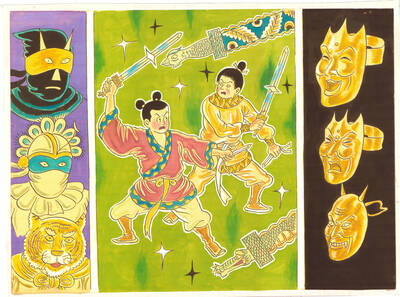
April 22 to April 28 The true identity of the mastermind behind the Demon Gang (魔鬼黨) was undoubtedly on the minds of countless schoolchildren in late 1958. In the days leading up to the big reveal, more than 10,000 guesses were sent to Ta Hwa Publishing Co (大華文化社) for a chance to win prizes. The smash success of the comic series Great Battle Against the Demon Gang (大戰魔鬼黨) came as a surprise to author Yeh Hung-chia (葉宏甲), who had long given up on his dream after being jailed for 10 months in 1947 over political cartoons. Protagonist

Peter Brighton was amazed when he found the giant jackfruit. He had been watching it grow on his farm in far north Queensland, and when it came time to pick it from the tree, it was so heavy it needed two people to do the job. “I was surprised when we cut it off and felt how heavy it was,” he says. “I grabbed it and my wife cut it — couldn’t do it by myself, it took two of us.” Weighing in at 45 kilograms, it is the heaviest jackfruit that Brighton has ever grown on his tropical fruit farm, located


 RSS
RSS