


The potential for disaster was clear from the start.
Fourteen strangers from around the world, all under 30, would come to Montreal and live together at no cost for nine months in a newly renovated mansion, complete with leather couches and a fully stocked kitchen. They would not be required to do anything and would each be handed US$1,000 a month to spend on whatever they pleased.

PHOTO: NY TIMES
Even the participants were worried. Would the Chinese man and the Taiwanese woman get along? Would someone blow the monthly stipend on shoes? Was this going to turn into a bad reality television show set in the frigid Canadian winter?
But The Real World this is not; in fact, most of the 14 had never heard of that MTV show. Swap the show's casual sex and endless stream of alcohol for rambling international debate and you get the Sauve House at McGill University.
The students are the first crop of Sauve Scholars, participants in a fellowship program that allows them to delve deeply into a social or political topic. The only request is that they produce something to post on the program's Web site. The scholars, who hail from 12 countries, arrived in August and left yesterday.
The program is financed by the Jeanne Sauve Foundation, an organization for young leaders established by Sauve, a former Canadian governor general who died in 1993, with seed money from the Canadian government.
Applicants must submit two 500-word essays, one detailing accomplishments and the other sketching a course of study, along with published works, academic transcripts and three recommendations.
The goal, according to the program's president, Harry Parnass, is for the scholars to find a subject they care about and approach it with reckless abandon. For this crop of scholars, topics include debunking Western myths about Africa, hitting the American presidential campaign trail and drafting policy to present to the Slovak government.
"I want them to have passion," Parnass said. "You just spend a year in self-discovery. They have my permission to do nothing, to think. And surprisingly, none of them have done that."
Surprising to everyone but these 14 workaholics, many of whom said they had never experienced unstructured time and did not know what to do with it other than get to work.
At first, however, some of them were overwhelmed by the contrasting cultures and personalities -- and were hesitant to voice their opinions for fear of offending someone. Even dinner, which the students are encouraged to eat together, was difficult. The Muslim woman from Algeria eats halal meat, the Zambian woman has never tasted shrimp -- and the British man prefers shepherd's pie.
"We had to start from zero, and it was hard," said Sherry Lee, 29, a reporter withCommonwealth Magazine in Taipei and one of the scholars. "But after we got to know each other's character, we realized no one had bad motivations and we could open our minds and discuss anything."
Lee spent much of her time in the city's strip clubs and illegal brothels, and on busy street corners, with a video camera. Her not-yet-completed result is a video about the sex industry in Canada.
Her point was to explore how an industry that with the exception of strip clubs, is illegal in Canada but operates in the open differs from Taiwan's clandestine one, and whether the openness benefits its workers, she said. The difference, she said, is that Canadian sex workers enter the profession for money, as opposed to Taiwanese workers, who are mostly forced into it.
"It's about social taboos," Lee said.
Different social issues intrigued Meriem Maza, 29, a Muslim from Setif Algeria, who spent months asking Montrealers to describe, on video, their ethnic backgrounds and
religious beliefs, and say how they were accepted by others. She said she wanted to turn the interviews into a program for Algerian television and hoped to teach Algerians tolerance through scenes like the one in which a Hispanic man explains the origin of bagels, Maza's new favorite food, as people of other ethnicities shop in the background.
"I understand why people are so scared of each other, but we have to break this idea," she said.
Even lighter moments at Sauve House have political overtones. As wine flowed before dinner one rainy April night, Saman Ahsan, 29, of Lahore, Pakistan, stood before her colleagues and pulled out a packet of official papers: she had passed a Canadian government immigration screening, certifying that she had not committed any crimes in Canada. That called for raised glasses.
"I'm so glad you're not a criminal," joked Sandra Lizardo of Peru, glancing at the paper, which was stamped "paid." "But how much did you have to pay them to pass?"
After a dinner that included chicken biryani, salmon bisque and pumpkin pie, some of the women danced to a Cher song, wine in hand.
Most of the scholars are returning home or will attend graduate school. And they were not looking forward to yesterday. "I think we grew up," Lee said. "I know how to cook, and how to make a living in a community of so many people."

In late October of 1873 the government of Japan decided against sending a military expedition to Korea to force that nation to open trade relations. Across the government supporters of the expedition resigned immediately. The spectacle of revolt by disaffected samurai began to loom over Japanese politics. In January of 1874 disaffected samurai attacked a senior minister in Tokyo. A month later, a group of pro-Korea expedition and anti-foreign elements from Saga prefecture in Kyushu revolted, driven in part by high food prices stemming from poor harvests. Their leader, according to Edward Drea’s classic Japan’s Imperial Army, was a samurai

Approaching her mid-30s, Xiong Yidan reckons that most of her friends are on to their second or even third babies. But Xiong has more than a dozen. There is Lucky, the street dog from Bangkok who jumped into a taxi with her and never left. There is Sophie and Ben, sibling geese, who honk from morning to night. Boop and Pan, both goats, are romantically involved. Dumpling the hedgehog enjoys a belly rub from time to time. The list goes on. Xiong nurtures her brood from her 8,000 square meter farm in Chiang Dao, a mountainous district in northern Thailand’s

Located down a sideroad in old Wanhua District (萬華區), Waley Art (水谷藝術) has an established reputation for curating some of the more provocative indie art exhibitions in Taipei. And this month is no exception. Beyond the innocuous facade of a shophouse, the full three stories of the gallery space (including the basement) have been taken over by photographs, installation videos and abstract images courtesy of two creatives who hail from the opposite ends of the earth, Taiwan’s Hsu Yi-ting (許懿婷) and Germany’s Benjamin Janzen. “In 2019, I had an art residency in Europe,” Hsu says. “I met Benjamin in the lobby
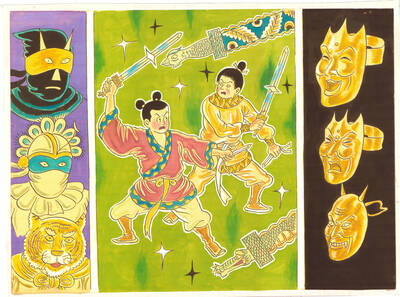
April 22 to April 28 The true identity of the mastermind behind the Demon Gang (魔鬼黨) was undoubtedly on the minds of countless schoolchildren in late 1958. In the days leading up to the big reveal, more than 10,000 guesses were sent to Ta Hwa Publishing Co (大華文化社) for a chance to win prizes. The smash success of the comic series Great Battle Against the Demon Gang (大戰魔鬼黨) came as a surprise to author Yeh Hung-chia (葉宏甲), who had long given up on his dream after being jailed for 10 months in 1947 over political cartoons. Protagonist


 RSS
RSS