


Performance Workshop's Stan Lai (賴聲川) has become so entranced by Mozart's opera Don Giovanni that, after being initially uncertain whether or not to take it on, he's now agreed to direct two more Mozart operas with Chien Wen-pin (簡文彬) and the National Symphony Orchestra (NSO) before the end of 2006.
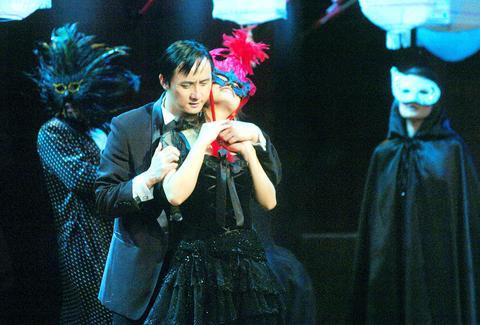
The name "Don Giovanni" is simply Italian for "Don Juan," and this is the old story of the aristocratic serial one-night-stander with 91 women under his belt in Turkey, 100 in France, 231 in Germany, 640 in Italy, and in Spain, where the action of the opera takes place, 1,003.
PHOTOS: CHIANG YING-YING, TAIPEI TIMES
In any production of this opera one major decision always has to be made -- how sympathetic is it going to be to the character of the title role?
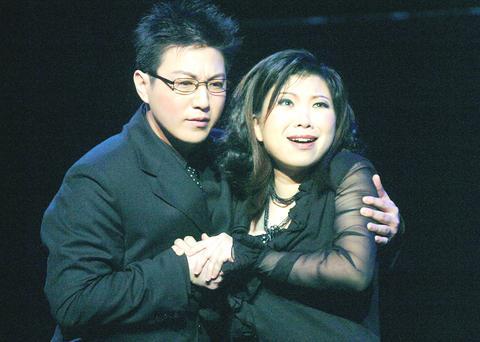
On the surface it's straightforward. In the work's first five minutes Giovanni kills the protesting father of one of his conquests, the Commendatore(commander), and in the last five minutes he's dragged down to hell by devils. In addition, he attracts many of his women by means of his aristocratic status. Mozart's previous opera, The Marriage of Figaro, was a protest against the ancient right of lords to take the virginity of any girl married on their estates. So both works, first staged in the years immediately prior to the French Revolution, appear to be dramatic assaults on the abuses of the nobility from the point of view of the rising middle class.
In reality, though, it's far from being this simple. Between the start and finish of the opera lies a plot full of comic situations where Giovanni and his servant, Leporello, combine to outwit prospective husbands, outraged former lovers and -- in effect the entire structure of conventional society. And Giovanni never rests. He is ceaselessly sweeping up new conquests, but he's also, at least in Stan Lai's opinion, sowing the seeds of doubt in the minds of the very women themselves. Once they've encountered Giovanni's extraordinarily contagious lust for sexual pleasure, they're never quite the same people ever again.
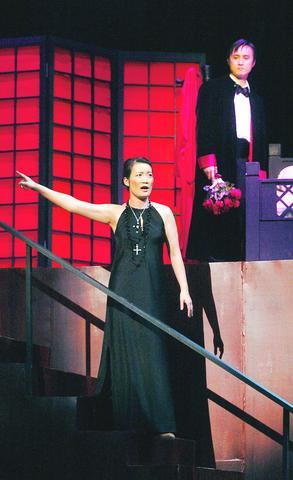
"This opera is incredible theater," said Lai at rehearsals last week. "I usually change a script, but not this time. At the moments when I feel I manage to touch Mozart I feel so wonderful -- because he's so wonderful!
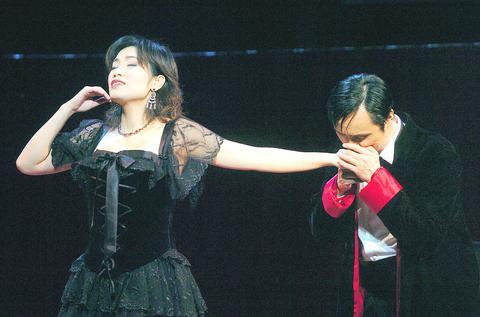
"I see Giovanni as larger than life, and essentially a Dionysian figure. He's an object of desire -- or even desire itself. And he stimulates desire in the women he encounters. Maybe he's a monster, but he brings out the longing to be a similar sort of monster in all of us!"
The production in Taipei's National Concert Hall this weekend, theoretically semi-staged, will in fact take over almost the entire available space for the dramatic action, banishing the orchestra to a pit at the back. "I consider this as fully-staged," said Lai, who is presenting the story as happening in the living-room of a couple of modern Taipei citizens (actors co-opted from Performance Workshop) who themselves get swept up into the stage
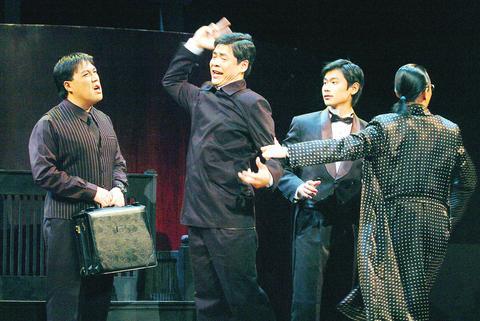
business.
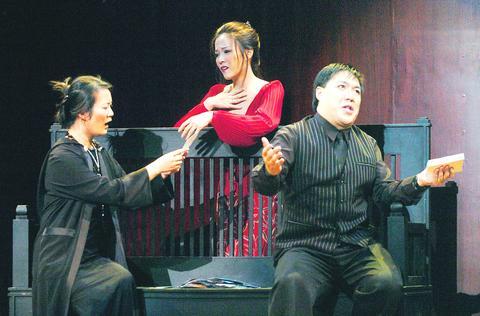
Both the beginning and the end of the opera will contain unexpected elements. The first music we hear, for instance, won't be Mozart at all, and in fact will be distinctly un-Mozartean. The production will contain eight young dancers, with the chorus singing at the back of the stage.
Maestro Chien Wen-pin said that his plan is to mount the two other operas Mozart wrote in collaboration with librettist Lorenzo Da Ponte, Figaro and Cosi fan Tutte, with essentially the same cast as this Giovanni, thereby following 18th century practice. He also confirmed that Stan Lai will direct both these new productions.
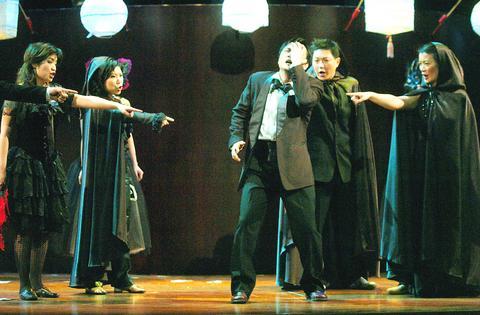
"I don't think Zerlina's innocent at all," said Lo Ming-fang (羅明芳) who plays the young bride-to-be who quickly features on Giovanni's wish-list. "I don't think she's even a virgin. She's actually a very knowing and powerful woman." It's hardly surprising, then, that in this production she virtually has sex with her reluctant boyfriend on-stage.
Chen Yen-Ling (陳妍陵), who sings Anna, the woman whose father Giovanni kills, is also playing her character as a very forceful figure. Chen sang the role of Puccini's Tosca, a woman who murders a chief-of-police, in the NSO's production last year, and she's scarcely less of a dynamic and dangerous presence here. She finds this music more challenging than what Puccini wrote for his heroine -- surprisingly for those who see operatic music as becoming harder to sing as composers approach the modern era.
In reality it's all but impossible for any director not to occupy the middle ground as far as the character of the Don is concerned. Few things are what they seem in this complex work. And the music's extraordinary energy and high-spirits simply don't permit the ending's pious condemnation to set the tone for what happens earlier. All the evidence, too, is that Mozart, a Freemason rather than a traditional Catholic, was fully aware of the story's essential ambivalence, even though Freemasonry was strong on family values (as his last opera The Magic Flute amply demonstrates).
Even so, Stan Lai is getting as near to a complete vindication of Giovanni's philosophy of sexual liberation and assault on convention as the text and music permit. A sequence of sexual couplings will take place in a bedroom on an upper level, and those who stand in Giovanni's way are likely to be shown as either menacing authority figures or hidebound conventional bores.
The production will follow the score first performed in Prague on Oct. 29, 1787. Two much-loved arias Mozart added for the Vienna premiere the following May will thus be omitted, but maestro Chien Wen-pin is unrepentant. "It simply makes the work a more manageable length," he said last week. "Anyway, I'm a purist, and besides we wanted to incorporate the doubling of the roles of Masetto and the Commendatore, as Mozart did in Prague" (and has rarely been attempted since).
This all-Taiwanese cast is a remarkably young one. Hung Yi-te (洪宜德), who sings Anna's boyfriend Ottavio, is still a student, for instance. On the other hand, key members are highly experienced, notably Bei Yu-hsi (白玉璽) who sings the Don. To watch this Taoyuan-based baritone, who was such a sober and morally responsible Sharpless in Felix Chen's 2001 Madama Butterfly, in rehearsal, displaying enormous thrust and drive, and combining quick-silver comedy with exceptionally versatile vocal acrobatics, was an amazing experience.
Tsai Wen-hao's (蔡文浩) Leporello is also likely to be remarkable. He's a very forceful singer, and as an actor highly effective as the dramatic lynch-pin of the whole complex, episodic plot.
Chien has been reported as saying that nowhere else in Asia would a production of Don Giovanni be attempted without any imported soloists. A certain amount of decibel-power might be foregone by this Taipei decision, but in a strange way it adds to the credibility of Mozart's 18th century opera. Big voices for big theaters were a 19th century requirement and they can easily detract from what is in essence an intimate work, ideally suited to productions featuring young voices such as this one.
Listening to recordings by past European operatic super-stars such as Elisabeth Schwarzkopf, Joan Sutherland and Birgit Nilsson after attending these Taipei rehearsals, I found to my surprise that I missed the local soloists, with their delicate timbres, youthful voices and incisive singing tones. These internationally-acclaimed recordings seemed to miss the intimacy, the purity, and especially the comedy so integral to Mozart, and these are the very qualities in which this new production is so strong.
In another interesting development, the NSO will be touring its 2003 production of Tosca round Taiwan next month, featuring several soloists from this Giovanni. Tosca will play in Hsinchu County Culture Bureau Theater (May 8), Chunghua County Yuanlin Performance Hall (May 11) and Tainan Municipal Cultural Theater (May 14).
The only question remaining about this Giovanni is how far the magic of those rehearsals -- in a moderately-sized ballet studio with only piano accompaniment (but what piano accompaniment!) -- will transfer to the National Concert Hall, which is after all itself a somewhat cavernous 19th century auditorium. Only tonight's performance will tell.
Performance notes:
Don Giovanni opens tonight at Taipei's National Concert Hall, with a second performance on Sunday. Both begin at 7.30pm. At press time a few tickets were still available at NT$1,000 and above for tonight, and rather more at NT$800 and above for Sunday. Tel: (02) 2343-1647 for details.

Last week Joseph Nye, the well-known China scholar, wrote on the Australian Strategic Policy Institute’s website about how war over Taiwan might be averted. He noted that years ago he was on a team that met with then-president Chen Shui-bian (陳水扁), “whose previous ‘unofficial’ visit to the US had caused a crisis in which China fired missiles into the sea and the US deployed carriers off the coast of Taiwan.” Yes, that’s right, mighty Chen caused that crisis all by himself. Neither the US nor the People’s Republic of China (PRC) exercised any agency. Nye then nostalgically invoked the comical specter

Relations between Taiwan and the Czech Republic have flourished in recent years. However, not everyone is pleased about the growing friendship between the two countries. Last month, an incident involving a Chinese diplomat tailing the car of vice president-elect Hsiao Bi-khim (蕭美琴) in Prague, drew public attention to the People’s Republic of China’s (PRC) operations to undermine Taiwan overseas. The trip was not Hsiao’s first visit to the Central European country. It was meant to be low-key, a chance to meet with local academics and politicians, until her police escort noticed a car was tailing her through the Czech capital. The
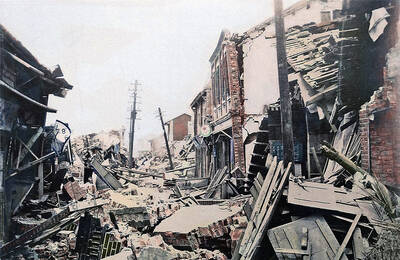
April 15 to April 21 Yang Kui (楊逵) was horrified as he drove past trucks, oxcarts and trolleys loaded with coffins on his way to Tuntzechiao (屯子腳), which he heard had been completely destroyed. The friend he came to check on was safe, but most residents were suffering in the town hit the hardest by the 7.1-magnitude Hsinchu-Taichung Earthquake on April 21, 1935. It remains the deadliest in Taiwan’s recorded history, claiming around 3,300 lives and injuring nearly 12,000. The disaster completely flattened roughly 18,000 houses and damaged countless more. The social activist and

Over the course of former President Ma Ying-jeou’s (馬英九) 11-day trip to China that included a meeting with Chinese Communist Party (CCP) leader Xi Jinping (習近平) a surprising number of people commented that the former president was now “irrelevant.” Upon reflection, it became apparent that these comments were coming from pro-Taiwan, pan-green supporters and they were expressing what they hoped was the case, rather than the reality. Ma’s ideology is so pro-China (read: deep blue) and controversial that many in his own Chinese Nationalist Party (KMT) hope he retires quickly, or at least refrains from speaking on some subjects. Regardless


 RSS
RSS