


In a long, crowded room stuffed full of small aquariums at the Zoological Institute of the University of Hamburg, oddities of the fish world swim back and forth behind glass to the background music of bubbling water.
Plucked from the pitch-black depths of caves around the world -- in Oman, Croatia, Brazil, Mexico -- many of these fish are blind, their unseeing eyes staring out, oblivious to the humans that stare in at them or the daylight that pours in the windows. Others are not only blind but eyeless, cruising along with their eerily blank heads alongside other bizarre-looking swimmers.
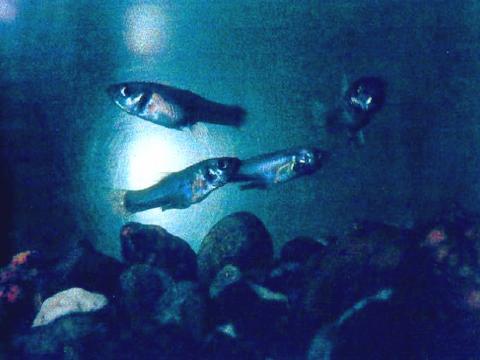
PHOTO: NY TIMES
Watching these queer creatures, anyone can understand why biologists have long studied the most striking of the physical changes -- like eyelessness and loss of coloration to near translucence -- that typically accompany the shift from daylight into eternal night. But such a focus has left much of life in caves a biological mystery.
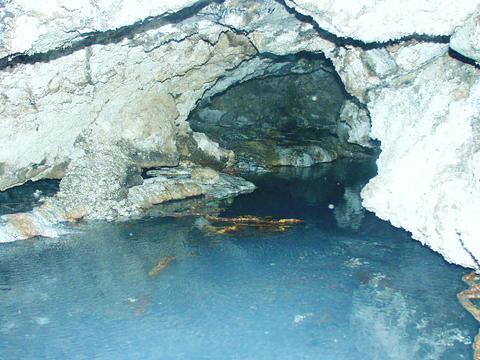
PHOTO: NY TIMES
Now some scientists, including researchers in Hamburg, have begun looking beyond the gross physical changes to the subtleties of life in caves, in particular mating. How, for example, can a female fish wisely choose a mate she cannot see?
In new studies of the Atlantic molly, these scientists are finding that mate choice is so critical and that size is so important that cave-dwelling females have developed a way to assess potential mates without seeing or contacting them, consistently going for the bigger, better-fed males, even in complete darkness.
"It was a surprise," said Martin Plath, a graduate student who has carried out the work with fellow behavioral biologists at Hamburg, Jakob Parzefall, Kay Koerner and Ingo Schlupp. Noting that the mollies had probably colonized the cave recently, he said, "Sexual selection for size must be very strong."
But the new studies, some recently published in Behavioral Ecology and Sociobiology, are not merely investigations of cave curiosities. Researchers say the question is how animals adapt to major environmental change: the switch to cave living serving as a proxy for any number of changes, like warming environment or deteriorating habitat.
Nearly all Atlantic mollies, or Poecilia Mexicana, live in well-lighted streams and rivers. But in 1962, in the state of Tabasco, Mexico, scientists discovered what remains the only known population of the species living in a cave.
And it is a bizarre cave at that. The river flowing through it is a milky white from heavy concentrations of hydrogen sulfide. The sulfur causes the darkened cave and much of the nearby forest to reek of rotten eggs, and makes the slippery walls drip with
sulfuric acid.
The milky pools where these 1.5cm-long fish live stretch far back into the cave. They are slimy with unusual bacteria that require sulfur, not sunlight, to live. In fact, the air is so heavy with sulfur odors that researchers do not stay in the cave for more than an hour or two at a time.
"It's not that bad, though," Plath insisted, noting that a bit of contact with sulfuric acid could be quite good for the skin. "You just have to have someone waiting for you at the cave entrance, in case you don't come out."
The fish, their cave and the smelly, milky river flowing from it are so striking that they have become central to an annual rite of the people of the area: They drop a poisonous plant into the waters just inside the cave, Plath said, killing mollies that flow out of the cave. They then collect and eat the fish in a fertility-related rite, he said.
Back in Hamburg, the scientists tested the preferences of the cave females in darkness by watching them by video camera in infrared light. In some species of fish, the females make obvious signals that they prefer or disdain particular males, but the Atlantic mollies show their preferences by swimming longer near larger males and spending less time around smaller prospects.
Scientists suspect the cave mollies are using a sensory organ known as the lateral line -- a line of pores along the side that, like eardrums, can sense pressure changes -- to find the bigger males. Fish normally use the lateral line to detect objects, and all mollies have such a lateral line.
But scientists found that females from sunny streams were able to use their eyes only to assess which males were bigger and that those females were unable to use their lateral lines to detect the bigger males when given a choice in darkness.
While the cave females have had to evolve a novel way of detecting large mates, they enjoy an advantage in mating with the lights out.
Standing in front of a tank full of mollies from a surface stream population, Plath describes how these zippy males never stop trying to mate with females. Pointing to a large male darting madly after a female that is dashing away, he says, "That's a nip and another nip," referring to the repeated movement of the male's head toward the female in an effort to taste the female's chemical signals.
"There!" he says, pointing out a brief instant when a male swimming alongside a female tried to mate, an action so rapid that it was visible only to well-trained eyes.
"If you don't separate males and females, the females just die," Plath said. "Males constantly harass them. It's copulating, copulating, nothing but copulating and the females can't feed."
But life in caves has calmed the molly males, which do not harass females and are overall a more sluggish bunch than their light-dwelling counterparts. The reason, researchers say, is probably that in the dark, oxygen-poor waters of the cave, simply finding a female is an energy-intensive task, making harassment on top of that too costly.

In late October of 1873 the government of Japan decided against sending a military expedition to Korea to force that nation to open trade relations. Across the government supporters of the expedition resigned immediately. The spectacle of revolt by disaffected samurai began to loom over Japanese politics. In January of 1874 disaffected samurai attacked a senior minister in Tokyo. A month later, a group of pro-Korea expedition and anti-foreign elements from Saga prefecture in Kyushu revolted, driven in part by high food prices stemming from poor harvests. Their leader, according to Edward Drea’s classic Japan’s Imperial Army, was a samurai

The following three paragraphs are just some of what the local Chinese-language press is reporting on breathlessly and following every twist and turn with the eagerness of a soap opera fan. For many English-language readers, it probably comes across as incomprehensibly opaque, so bear with me briefly dear reader: To the surprise of many, former pop singer and Democratic Progressive Party (DPP) ex-lawmaker Yu Tien (余天) of the Taiwan Normal Country Promotion Association (TNCPA) at the last minute dropped out of the running for committee chair of the DPP’s New Taipei City chapter, paving the way for DPP legislator Su

It’s hard to know where to begin with Mark Tovell’s Taiwan: Roads Above the Clouds. Having published a travelogue myself, as well as having contributed to several guidebooks, at first glance Tovell’s book appears to inhabit a middle ground — the kind of hard-to-sell nowheresville publishers detest. Leaf through the pages and you’ll find them suffuse with the purple prose best associated with travel literature: “When the sun is low on a warm, clear morning, and with the heat already rising, we stand at the riverside bike path leading south from Sanxia’s old cobble streets.” Hardly the stuff of your

Located down a sideroad in old Wanhua District (萬華區), Waley Art (水谷藝術) has an established reputation for curating some of the more provocative indie art exhibitions in Taipei. And this month is no exception. Beyond the innocuous facade of a shophouse, the full three stories of the gallery space (including the basement) have been taken over by photographs, installation videos and abstract images courtesy of two creatives who hail from the opposite ends of the earth, Taiwan’s Hsu Yi-ting (許懿婷) and Germany’s Benjamin Janzen. “In 2019, I had an art residency in Europe,” Hsu says. “I met Benjamin in the lobby


 RSS
RSS