


A new scramble is on for Africa, and the US wants to secure the vast continent of 800 million people not only for its oil but also as a buffer against future terrorist threats to Europe.
Instead of being left in the dust, as Washington was at the 19th century Berlin Conference, where European powers divided up the dark continent, the US military is already out in front with its own new programs.
For example, the US European Command, based in Germany, has already forged an anti-terrorist coalition in northern Africa that recently pursued the leader of the tourist-snatching, Algerian-based Salafist Group for Preaching and Combat across Niger and into Chad. The leader, a man who goes variously by the names Saifi Amari and Abderrazak le Para, escaped, but 43 followers were killed and 18 were detained.
At a seminar on Tuesday in Washington, US General Charles Wald, deputy commander for the US European Command, used bold terms to outline ambitious plans for Africa. The ideas presented at the American Enterprise Institute, a conservative, free-market think tank, will likely anchor discussions at a European-wide meeting next month in Luxembourg, Wald said.
Key to Washington's push is increasing US reliance on oil from West Africa and the offshore Gulf of Guinea reserves, which currently meet about 15 per cent of US needs and are expected to rise to 25 per cent of US needs over the coming decade. In addition to the apparent abundance of offshore oil, the direct trans-Atlantic shipping access allows US-bound tankers to avoid congested and potentially dangerous Middle Eastern bottlenecks.
As US interest in Africa's oil has grown, so have the al-Qaeda terrorist network and other groups seeking to make inroads around Africa. Al-Qaeda leader Osama bin Laden had a base in Sudan during the 1990s and was blamed for the 1998 twin bombings of US embassies in Kenya and Tanzania. Moroccan terrorists are believed to have been at the core of last month's Madrid railway bombings, which killed nearly 200 people.
With just the narrow strait of Gibraltar separating Europe and Africa's burgeoning population, Wald painted a bleak picture if the dual threats of terrorism and AIDS are allowed to develop unchecked.
"Europe is a safe haven for a lot of terrorists. They can grow and recruit there. That's going to raise more and more of an issue.
Those ... 1.3 billion (Africans) 20 years from now, is that going to be a curse or a benefit to Europe?" Wald asked.
Seminar participants suggested that Europe could stem its plummeting economy and "voluntary self extermination" -- the phrase David Hale of Hale Advisers LLS used to describe Western Europe's low birth rate and population decline -- through expanded economic and military cooperation with Africa and more liberal immigration policies.
"Western Europe doesn't need us any more," Wald said, sounding an increasingly familiar note among US military officials. The region must "step up and help the US. We've been protecting their economies for 50 years."
Other participants at the seminar anticipated that consumers of Africa's raw materials would pay higher prices in the coming decades as China and other Asian economies demand more resources on the open market.
China, for example, already has 4,000 troops stationed in Sudan to protect an oil line its workers built, according to David Hale of Hale Advisers LLC.
"This is a very major geopolitical development [which] will be for Africans a great growth opportunity," Hale said.
Hale also projected that at the current rate of imbalanced development, Frankfurt and other European cities would become urban centers for "old women" being cared for by black Africans and Middle Eastern women.
Wald advocated a comprehensive approach that would address Africa's AIDS problems and economic development, as well as the need to build regional military alliances to provide rapid-fire peacekeeping responses.
"What Africa needs more than anything is intellectual capital," Wald said. "It's not that they are dumb people ... but they can learn from our ethos."

Last week Joseph Nye, the well-known China scholar, wrote on the Australian Strategic Policy Institute’s website about how war over Taiwan might be averted. He noted that years ago he was on a team that met with then-president Chen Shui-bian (陳水扁), “whose previous ‘unofficial’ visit to the US had caused a crisis in which China fired missiles into the sea and the US deployed carriers off the coast of Taiwan.” Yes, that’s right, mighty Chen caused that crisis all by himself. Neither the US nor the People’s Republic of China (PRC) exercised any agency. Nye then nostalgically invoked the comical specter

Relations between Taiwan and the Czech Republic have flourished in recent years. However, not everyone is pleased about the growing friendship between the two countries. Last month, an incident involving a Chinese diplomat tailing the car of vice president-elect Hsiao Bi-khim (蕭美琴) in Prague, drew public attention to the People’s Republic of China’s (PRC) operations to undermine Taiwan overseas. The trip was not Hsiao’s first visit to the Central European country. It was meant to be low-key, a chance to meet with local academics and politicians, until her police escort noticed a car was tailing her through the Czech capital. The
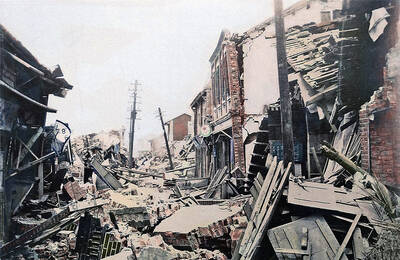
April 15 to April 21 Yang Kui (楊逵) was horrified as he drove past trucks, oxcarts and trolleys loaded with coffins on his way to Tuntzechiao (屯子腳), which he heard had been completely destroyed. The friend he came to check on was safe, but most residents were suffering in the town hit the hardest by the 7.1-magnitude Hsinchu-Taichung Earthquake on April 21, 1935. It remains the deadliest in Taiwan’s recorded history, claiming around 3,300 lives and injuring nearly 12,000. The disaster completely flattened roughly 18,000 houses and damaged countless more. The social activist and

Over the course of former President Ma Ying-jeou’s (馬英九) 11-day trip to China that included a meeting with Chinese Communist Party (CCP) leader Xi Jinping (習近平) a surprising number of people commented that the former president was now “irrelevant.” Upon reflection, it became apparent that these comments were coming from pro-Taiwan, pan-green supporters and they were expressing what they hoped was the case, rather than the reality. Ma’s ideology is so pro-China (read: deep blue) and controversial that many in his own Chinese Nationalist Party (KMT) hope he retires quickly, or at least refrains from speaking on some subjects. Regardless


 RSS
RSS