


Raul Reyes would have been the first to laugh if someone had told him he would enjoy bird-watching. Birds did not move him. "I knew several birds, that was it," he said.
Also, he is blind.
But now Reyes, 58, a mechanic from Edinburg, Texas, who lost his sight to diabetes and botched laser surgery, spends delicious hours in mosquitoey subtropical thickets in the birding mecca of the Rio Grande Valley, helping lead other blind and visually impaired men and
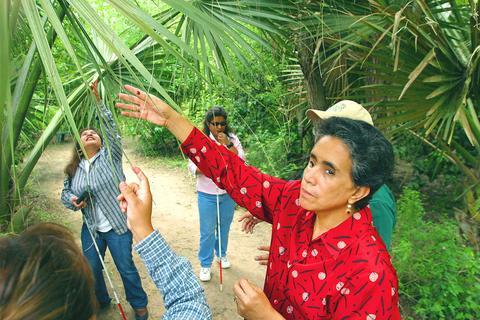
PHOTO: NY TIMES
women in bird-watching, or bird-listening.
They are the "Blind Birders," as Gladie Cruz, 24, another leader of the group, boasted on her T-shirt, which also had a green parakeet logo and the slogan "We Can't See You -- But We Can Hear You."
Studying CDs of bird songs the way sighted birders consult field manuals and carrying tape recorders instead of binoculars, they ooh and ahh over the extraordinary array of 500 identified species that make South Texas, with its migratory way stations, one of the world's birding capitals.
And for the first time, these birders will be included in one of the pastime's biggest events, the eighth annual Great Texas Birding Classic, which runs from this Saturday to April 25, along three tiers of coastline from Beaumont south to Brownsville. Participants who tally the most birds, using ears and eyes, in midnight-to-midnight segments get to allocate more than US$50,000 in prize money to conservation causes of their choosing.
The more limited blind birder's event, on April 18 in this area around the booming border city McAllen, has been officially designated, with cheerful good humor, the "Outta-Sight Song Birder Tournament."
"They thought it was a pretty cool play on words," said Roy Rodriguez, a leading bird-watcher here who has been working with the group as a project of the Rensselaerville Institute, a nonprofit organization seeking innovative approaches to community problems; in this case, how to better the lives of 12,000 blind people in a poor four-county region of the Rio Grande Valley. The area includes Starr County, by many indicators the poorest in the country.
"Few people realize the number is so large because the blind rarely venture outside -- they live in self-imposed exile," said Eric Ellman, local project director of the institute, based in Rensselaerville, New York. Its methodology is to seek out and sponsor community "spark plugs" like Cruz and Reyes to rally their peers to action.
In their competition, three teams of three blind birders each, along with a sighted and more experienced fourth member wearing a blindfold, will be guided through thickets for eight hours, seeking to compile the longest list of birds identified. The teams, named for business sponsors, which put up US$500 each, are the Wild Bird Center Inca Doves, the Espana Tweety Birds and Damar's Kingfishers. No special prizes have been announced yet for the blind birders.
On Saturday, team members and a dozen sighted birders gathered at the 4.8 hectare Frontera Audubon Center in the border city Weslaco for some practice.
One of the first to be dropped off was Jessica Garza, 31, a massage therapist from neighboring Pharr, who sported a cap with a plump cloth cardinal stitched to the bill.
"My parents were always naturalists, hunting and fishing," Garza said. "At the time I had full sight and never paid attention."
But at 14, she said, she developed a brain tumor around her optic nerve that cut off most of her vision. She said she grew devoted to birding four years ago after she prayed to be granted the sight of a hummingbird. One materialized, she said, and even with her hazy vision, she could see it hovering a few feet from her face.
"It turned and stared at me," she said. "That moment was amazing. I have never seen such beauty in my life."
Joining the group was Maria Tijerina, 51, from nearby San Juan, who lost her sight when her husband shot her 22 years ago. Also there were Juanita Torres, 30, from Pharr, and Esmeralda Pesina, 47, from neighboring Elsa, who were born blind; and Lydia Guevara, 49, a migrant worker from Edinburg, north of McAllen, who lost her sight to diabetes.
Supported by grants from the Texas Parks and Wildlife Department and the Texas Health Department, they and others were recruited by Reyes and Cruz, a rehabilitation counselor and college student from Edinburg, who was also blinded by a tumor. Some began by handling stuffed birds.
"I love bird-watching," said Cruz, who arrived with recordings of bird songs to compare with those she heard and with her Braille list.
In the center's parking lot, they were greeted by the cries of long-tailed large brown birds that they had little trouble identifying as chachalacas, from their distinctive cries of "cha-cha-cha" and "laca-laca."
"The birds are bird-watcher-watching," said Rodriguez, 37, who credits bird-watching with turning him away from a youthful life of hell-raising. Now he is an authority who several days before this gathering escorted former president Jimmy Carter and his wife, Rosalynn, avid bird-watchers, through these same thickets.
"Roy," Torres announced as they entered the brush: "I spotted a golden-fronted woodpecker. A white-winged dove, too."
A sudden bird song stopped them. "I know it! I know it! I know it!" Garza said. "It's on the top of my mind. Kind of like a flycatcher."
Rodriguez prompted her. "It's in the flycatcher category."
She got it. "Couch's kingbird," she said triumphantly.
"Oh, listen, right above us," Rodriguez said. "Those are green parakeets. I think I have the voice of it." He played a tape recording.
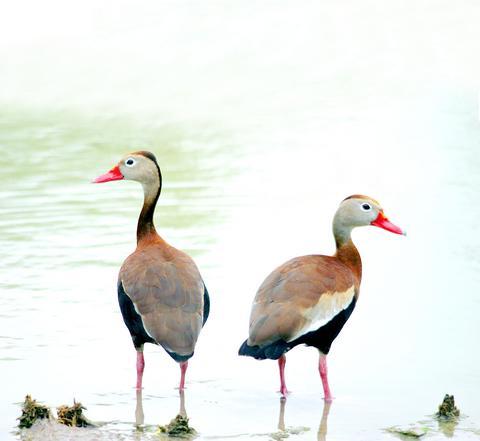
Torres said she just heard a black-bellied whistling duck.
No, he said, that was another green parakeet, with a yellow bill.
Torres said she had never seen colors. But, she said: "If somebody tells me green, I say OK, like grass. If they say yellow, it's like the sun."
From down the trail came Cruz's voice. "See, I told you, Reyes, it's a chachalaca."
A rustle to the side, at 3 o'clock in the directional parlance of the blind birders, signaled the arrival of a white-eyed vireo. Rodriguez mimicked the song. "It starts and ends in an accent," he said. "It kind of sounds like the scraping back of a rubber band."
The bird called; another answered.
"What do you think is going on there?" Rodriguez asked.
"Boyfriend girlfriend?" someone guessed.
"Maybe not," Rodriguez answered. They were two territorially competitive males. "One's saying `I'm over here,"' he said; "the other's saying `I'm over here."'
What color? Someone wanted to know. "It's a grayish bird," he said. "Very small. It does not like to come out in the open. It's the kind of bird you always hear and almost never see."
That made the group especially happy.

In late October of 1873 the government of Japan decided against sending a military expedition to Korea to force that nation to open trade relations. Across the government supporters of the expedition resigned immediately. The spectacle of revolt by disaffected samurai began to loom over Japanese politics. In January of 1874 disaffected samurai attacked a senior minister in Tokyo. A month later, a group of pro-Korea expedition and anti-foreign elements from Saga prefecture in Kyushu revolted, driven in part by high food prices stemming from poor harvests. Their leader, according to Edward Drea’s classic Japan’s Imperial Army, was a samurai

Located down a sideroad in old Wanhua District (萬華區), Waley Art (水谷藝術) has an established reputation for curating some of the more provocative indie art exhibitions in Taipei. And this month is no exception. Beyond the innocuous facade of a shophouse, the full three stories of the gallery space (including the basement) have been taken over by photographs, installation videos and abstract images courtesy of two creatives who hail from the opposite ends of the earth, Taiwan’s Hsu Yi-ting (許懿婷) and Germany’s Benjamin Janzen. “In 2019, I had an art residency in Europe,” Hsu says. “I met Benjamin in the lobby

April 22 to April 28 The true identity of the mastermind behind the Demon Gang (魔鬼黨) was undoubtedly on the minds of countless schoolchildren in late 1958. In the days leading up to the big reveal, more than 10,000 guesses were sent to Ta Hwa Publishing Co (大華文化社) for a chance to win prizes. The smash success of the comic series Great Battle Against the Demon Gang (大戰魔鬼黨) came as a surprise to author Yeh Hung-chia (葉宏甲), who had long given up on his dream after being jailed for 10 months in 1947 over political cartoons. Protagonist

Peter Brighton was amazed when he found the giant jackfruit. He had been watching it grow on his farm in far north Queensland, and when it came time to pick it from the tree, it was so heavy it needed two people to do the job. “I was surprised when we cut it off and felt how heavy it was,” he says. “I grabbed it and my wife cut it — couldn’t do it by myself, it took two of us.” Weighing in at 45 kilograms, it is the heaviest jackfruit that Brighton has ever grown on his tropical fruit farm, located


 RSS
RSS