


Thailand, Cambodia, Myanmar and Laos today begin three days of exuberant, water-soaked celebrations marking the traditional new year, refusing to be deterred by historically low levels on the Mekong which connects them.
Water is at the heart of the mid-April festival in the four Buddhist-majority countries, signifying the washing away of sins and rancor, and refreshing the region as it is embraced by scorching summer weather.
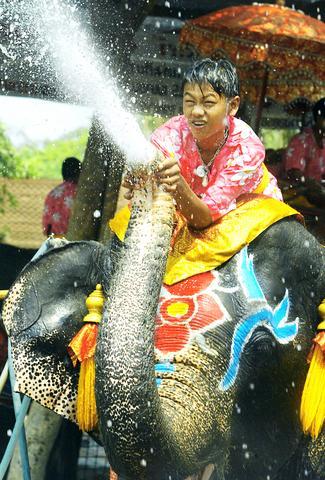
PHOTO: REUTERS
"It will be a symbolic cleansing and washing away of sins accumulated during the old year and to prepare for the new one," a Buddhist scholar in Myanmar said of the ancient ceremony.
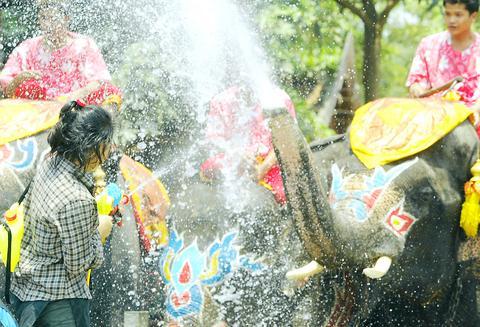
The water festival represents the most popular, raucous and colorful celebration of the year for more than 120 million people who will abandon any thoughts of work and bring their nations to a standstill.
Cambodia and Laos are both entering year 2548 of the Buddhist era, while Thailand will do so on Jan. 1 after adopting the Gregorian calendar. Myanmar is only passing into the year 1366 according to its numbering system.
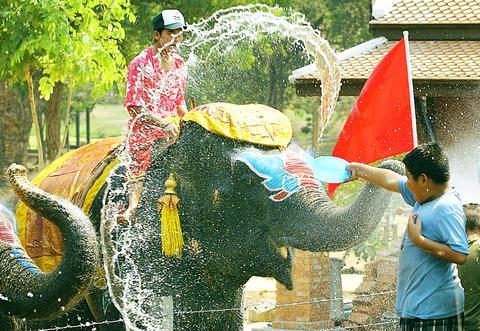
The celebration is called Songkran in Thailand, Chaul Chnam Thmey in Cambodia, Thingyan in Myanmar and Pimai in Laos but at street corners everywhere, everyone can expect to be splashed with icy cold water.
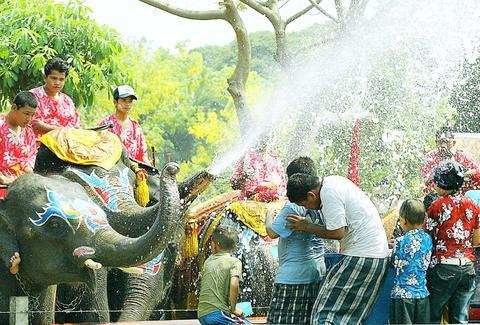
From basic plastic buckets to high-tech pump-action water pistols which allow revellers long-range, high-precision soaking, every type of container is deployed to throw water, sometimes laced with talcum powder, colored flour, charcoal, mud and ice cubes.
City-dwellers embark on a massive exodus to the countryside for family reunions punctuated by visits to pagodas, offerings to monks, ancestor worship, traditional games and dances, sports competitions, gift-giving to parents and symbolic bathing of elders -- all to acquire "merit" in the Buddhist tradition.
The new year is also a highlight of the tourist season, for visitors who are lucky to see splendid processions of monks wrapped in saffron robes who remain composed amid the revelries in Luang Prabang, the former royal capital of Laos.
In Cambodia, small sand pagodas are built along the banks of the Mekong, while newly ordained monks are paraded on elephants deep in northern Myanmar, and music shows are staged in platforms on the rivers of northern Thailand.
The festival is also an occasion for people to wear new clothing, give Buddha statues and their houses a thorough washing, and even to donate blood.
The governor of Phnom Penh has asked residents to scrub the city clean with vast amounts of water, despite the region's drought which has helped reduce the once-mighty Mekong to a trickle in some stretches.
The effort "is to welcome the upcoming traditional Khmer New Year ... by making Phnom Penh more and more clean and create a better environment," Keb Chuktema said.
Thingyan has taken on political dimensions in Myanmar this year. As it is customary to release birds from cages at this time, many hope opposition leader Aung San Suu Kyi could be freed from house arrest at the dawn of the new year.
In Thailand, the explosive situation in the Muslim south is overshadowing Songkran. A heavy security presence has been deployed in fear that Muslim extremists who have killed 60 people this year could mount a major attack.
In all four countries, traditional New Year's day also is also well lubricated with alcohol, usually cheap local whisky or rice alcohol which fuels rampant drink-driving and carnage on the roads.
Authorities in Bangkok, Phnom Penh, Yangon and Vientiane have once again issued urgent warnings and bans to try to curb the problem.
In Thailand, where 20,000 police officers have been mobilized, blood-alcohol tests will be carried out at checkpoints. Last Songkran, more than 800 people were killed on the roads, 70 percent due to drunk-driving.
Water-throwing is prohibited after 6pm and parents have been warned they face up to three months in jail if their offspring use the festivities as an excuse to sexually harass women. The young women themselves have been asked not to wear "provocative" clothing like miniskirts.
In Myanmar, the official press noted: "It is important that people take part in the festival in line with Myanmar tradition and avoid behaviors and wearing clothes that are foreign to our culture."
In Yangon, hundred of makeshift wooden structures have been thrown up as platforms for water-throwing, especially around the capital's Inya Lake -- although revelries are banned near Aung San Suu Kyi's home.
In Cambodia, where the new year is rung in at precisely 5:36pm on Tuesday, newspapers have published official directives against "theft and other crimes, especially gambling" and security forces have been warned they will "will have to work very hard" according to a city official quoted by Cambodge Soir.
In Laos, the authorities noted that last year, "Pimai saw hundreds of people driving drunk or involved in pick-up wars which resulted in loss of life" and encouraged citizens to meet on the banks of the Mekong and leave their cars at home.

Last week Joseph Nye, the well-known China scholar, wrote on the Australian Strategic Policy Institute’s website about how war over Taiwan might be averted. He noted that years ago he was on a team that met with then-president Chen Shui-bian (陳水扁), “whose previous ‘unofficial’ visit to the US had caused a crisis in which China fired missiles into the sea and the US deployed carriers off the coast of Taiwan.” Yes, that’s right, mighty Chen caused that crisis all by himself. Neither the US nor the People’s Republic of China (PRC) exercised any agency. Nye then nostalgically invoked the comical specter

Relations between Taiwan and the Czech Republic have flourished in recent years. However, not everyone is pleased about the growing friendship between the two countries. Last month, an incident involving a Chinese diplomat tailing the car of vice president-elect Hsiao Bi-khim (蕭美琴) in Prague, drew public attention to the People’s Republic of China’s (PRC) operations to undermine Taiwan overseas. The trip was not Hsiao’s first visit to the Central European country. It was meant to be low-key, a chance to meet with local academics and politicians, until her police escort noticed a car was tailing her through the Czech capital. The
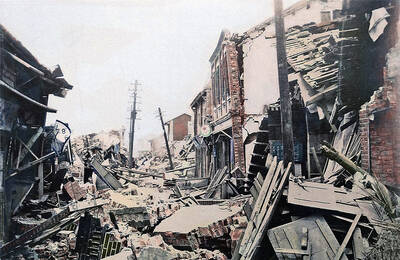
April 15 to April 21 Yang Kui (楊逵) was horrified as he drove past trucks, oxcarts and trolleys loaded with coffins on his way to Tuntzechiao (屯子腳), which he heard had been completely destroyed. The friend he came to check on was safe, but most residents were suffering in the town hit the hardest by the 7.1-magnitude Hsinchu-Taichung Earthquake on April 21, 1935. It remains the deadliest in Taiwan’s recorded history, claiming around 3,300 lives and injuring nearly 12,000. The disaster completely flattened roughly 18,000 houses and damaged countless more. The social activist and

Over the course of former President Ma Ying-jeou’s (馬英九) 11-day trip to China that included a meeting with Chinese Communist Party (CCP) leader Xi Jinping (習近平) a surprising number of people commented that the former president was now “irrelevant.” Upon reflection, it became apparent that these comments were coming from pro-Taiwan, pan-green supporters and they were expressing what they hoped was the case, rather than the reality. Ma’s ideology is so pro-China (read: deep blue) and controversial that many in his own Chinese Nationalist Party (KMT) hope he retires quickly, or at least refrains from speaking on some subjects. Regardless


 RSS
RSS