


Hushed crowds jostle for a better view as a shaft of sunlight passes across the shrine, inscribed with the vow taken by pioneer Afrikaners: "We for you South Africa."
The once-a-year spectacle at the imposing Voortrekker Monument on a hill outside the capital Pretoria is a seminal moment for the descendants of Dutch and French settlers who landed in the shadow of Table Mountain three centuries ago.
The vow and the light that falls upon it are the centerpiece of a ceremony that commemorates a famous 1838 battle in which a small band of Afrikaner farmers ringed their wagons and repelled an onslaught by 10,000 Zulu warriors -- a sign from God, they said, of white man's pre-eminence over blacks.
Since then of course, apartheid has come and gone and South Africa's political realities have turned full circle.
Ten years after Nelson Mandela became their first black president, only a tiny minority of Afrikaners still cling to the hope of white rule. But many feel they are being unfairly punished through policies such as affirmative action and land redistribution.
The group's recent checkered history is rooted in the four decades of post-war rule by the Afrikaner-dominated National Party. The "Nats" institutionalized apartheid, and despite the quiet complicity of most Anglophone white South Africans, it is the Afrikaners who have taken the lion's share of the blame.
While white supremacists undoubtedly remain,
commentators agree that most Afrikaners, who make up 60 percent of South Africa's 4.3 million whites, have reformed a great deal since white rule ended in 1994.
"I think their worst fears of a black government have not come true. They are getting used to those in power being black very, very quickly," said Max du Preez, a veteran journalist and long-time critic of the apartheid state.
A white ultra-right plot to topple the African National Congress (ANC) government and kill Mandela, currently being tried in Pretoria's high court, is viewed by most Afrikaners as the work of a lunatic fringe. But in the run-up to the 1994 election, a rightwing army takeover was a real threat.
"I think that the whole notion that the Afrikaners could rule again has gone from all minds, apart perhaps from those Boeremag (Afrikaner Force) fools," said du Preez.
Sitting in the shadow of the Voortrekker Monument -- built in praise of the great 19th Century trek that sought to escape British rule -- young Afrikaner Yolanda le Roux says the scars of racial segregation are fading.
"Things are easier now. A lot of fear and anger has gone. We were the last generation to grow up in apartheid and we have thrown something off we were ashamed of," said le Roux.
Reconciliation between blacks and whites has largely been hailed a success but resentments and fear over the Afrikaners' land and jobs simmer beneath the surface.
While some joined a "white flight" from the country, many Afrikaners argue that they are a true white African tribe and far more committed to Africa than English speakers who are seen as hankering after life in Europe.
With no desire or opportunity to live abroad, others have have withdrawn from Mandela's "Rainbow Nation" altogether.
On the edge of the Karoo desert in Northern Cape province is Orania -- a small whites-only town which flies the old republic's flag and considers itself a totally separate state.
As President Thabo Mbeki's government puts greater store on policy execution following Mandela's focus on nation building, even a rare line or two of Afrikaans from the president raises hopes of better relations with those in power.
"After the speech people were saying `well maybe Thabo is our man.'" There is a kind of desperation for a sign that they are loved," said du Preez.
One clear sign of change is the political fragmentation of the once cohesive Afrikaner "volk," or people.
In an ironic twist, the renamed New National Party (NNP) now rules the Western Cape province in cooperation with the ANC, while the Democratic Alliance (DA) -- successors to white anti-apartheid parliamentarians -- are seen as conservatives.
Stellenbosch University politics professor Willie Breytenbach said that the Anglophile DA is likely to mop up most Afrikaner votes in the April 14 general election, entrenching their position in the last decade as the heavily outgunned opposition.
"The DA has become the party of conservative white South Africa. The NNP is seen as in bed with the ANC and it's just too much to stomach for conservative Afrikaners," he said.
Pollsters predict the NNP will shrink to around 4 percent -- much of it coming from mixed race "coloreds" in the Cape -- down from 20 percent of the vote in 1994.
Outside the walls of Cape Town's parliament, Afrikaner culture -- or more precisely, the language of Afrikaans -- is cutting up the streets of gangster-ridden ghettos nearby.
Freed from its associations with the repressive past and spoken by millions of coloreds, the distinction between a people defined by race and those defined by language has blurred into a vibrant cultural movement.
Deon Maas, a TV documentary maker and media guru says Afrikaans music, theater and literature are booming in contrast to the import-dominated offerings in Anglophone South Africa.
"You can draw a comparison between Afrikaans culture and post-Franco Spain ... all the restrictions have been lifted and there's been a huge creative explosion," Maas said.
"I feel really sorry for English-speaking South Africans. They are the one group in this country that has absolutely no identity. They get pop music from England and plays from Broadway; they've never formed a strong African identity."

In late October of 1873 the government of Japan decided against sending a military expedition to Korea to force that nation to open trade relations. Across the government supporters of the expedition resigned immediately. The spectacle of revolt by disaffected samurai began to loom over Japanese politics. In January of 1874 disaffected samurai attacked a senior minister in Tokyo. A month later, a group of pro-Korea expedition and anti-foreign elements from Saga prefecture in Kyushu revolted, driven in part by high food prices stemming from poor harvests. Their leader, according to Edward Drea’s classic Japan’s Imperial Army, was a samurai

Located down a sideroad in old Wanhua District (萬華區), Waley Art (水谷藝術) has an established reputation for curating some of the more provocative indie art exhibitions in Taipei. And this month is no exception. Beyond the innocuous facade of a shophouse, the full three stories of the gallery space (including the basement) have been taken over by photographs, installation videos and abstract images courtesy of two creatives who hail from the opposite ends of the earth, Taiwan’s Hsu Yi-ting (許懿婷) and Germany’s Benjamin Janzen. “In 2019, I had an art residency in Europe,” Hsu says. “I met Benjamin in the lobby
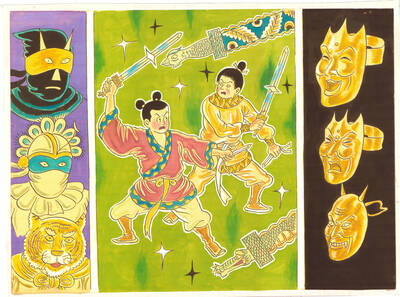
April 22 to April 28 The true identity of the mastermind behind the Demon Gang (魔鬼黨) was undoubtedly on the minds of countless schoolchildren in late 1958. In the days leading up to the big reveal, more than 10,000 guesses were sent to Ta Hwa Publishing Co (大華文化社) for a chance to win prizes. The smash success of the comic series Great Battle Against the Demon Gang (大戰魔鬼黨) came as a surprise to author Yeh Hung-chia (葉宏甲), who had long given up on his dream after being jailed for 10 months in 1947 over political cartoons. Protagonist

A fossil jawbone found by a British girl and her father on a beach in Somerset, England belongs to a gigantic marine reptile dating to 202 million years ago that appears to have been among the largest animals ever on Earth. Researchers said on Wednesday the bone, called a surangular, was from a type of ocean-going reptile called an ichthyosaur. Based on its dimensions compared to the same bone in closely related ichthyosaurs, the researchers estimated that the Triassic Period creature, which they named Ichthyotitan severnensis, was between 22-26 meters long. That would make it perhaps the largest-known marine reptile and would


 RSS
RSS