


Washed by a southwesterly Pacific breeze, a line of B-52 Stratofortress bombers stand parked on the hot tarmac here, their tails stenciled with "MT," a reminder that they flew here recently from the snows of Minot, North Dakota.
Away for more than a decade, the B-52s, the US' largest bombers, are back in Guam, part of a wide-ranging drive by the Pentagon to make this island, a US territory, a "power projection hub" on the edge of Asia.
"We are openly talking about putting a fighter wing there, a tanker squadron there, a Global Hawk group there," General William Begert, commander of Pacific Air Forces, said by telephone from Hawaii, almost 4,000 miles (6,437km) east of here. The Global Hawk is an unmanned surveillance plane.
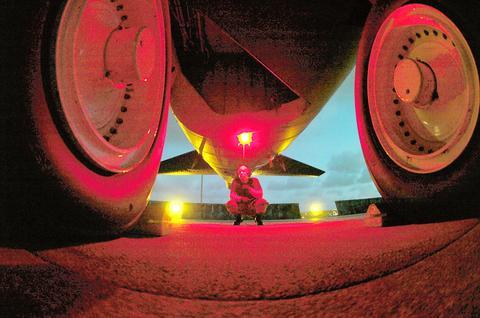
PHOTO: NY TIMES
"Guam, first of all, is US territory," Begert said. "I don't need overflight rights. I don't need landing rights. I always have permission to go to Guam. It might as well be California or New Jersey."
Next year, Washington is to decide on a new round of base closings, the first in a decade. Opening the debate, US Defense Secretary Donald Rumsfeld reported to the US Congress on March 23 that the military had 24 percent more base capacity than it needed.
Judging by Rumsfeld's comments after his trip here last November, Guam will be a winner in the base-closing process. This volcanic island fits the Pentagon's new strategy of creating "lily pads" to allow for rapid deployment of military muscle.
"Rumsfeld keeps saying, `What about Guam? Let's build up Guam,"' said a US diplomat in Tokyo, where the defense secretary stopped after visiting here. American memories are still sharp of the Navy's loss of a base at Subic Bay, the Philippines, in 1992 after the Philippine Senate refused to extend the lease. The diplomat added, "We don't want to be somewhere where they don't want us, where they can throw us out."
At US Naval Forces Marianias, the naval station here, Rear Admiral Arthur Johnson, the commander, said the wars in Iraq and Afghanistan had raised Guam's strategic value as the Pentagon realized the usefulness of an all-American outpost in Asia.
US interests
"We invested huge amounts of money in facilities we could not use when we needed them, for example Saudi Arabia," Johnson. "Places where the US is autonomous have come greatly to the fore."
Military officials here decline to discuss how Guam would fit into a US response to the rapid rise of China. But by moving ships and submarines to Guam, the Pentagon cuts "the tyranny of distance," trimming five days off a Pacific crossing from Hawaii, said Richard Halloran, a military analyst based in Hawaii.
"A lot of these moves are intended to deter China," Halloran, a freelance military writer, said from Honolulu, where the US Pacific Command is based. "You are not threatening China, not in any way jeopardizing their security. On the other hand, if China becomes belligerent, you are in position to do something about it, particularly with the submarines and an aircraft carrier."
Carl Peterson, a businessman on Guam, said of Washington's low-key military buildup on Guam: "It just sort of happens. Why disclose it? Why tell the Chinese what you are going to do before you do it?"
Later this year, a new nuclear-powered attack submarine is to arrive here, the third to make Guam its home port since 2002. While Washington debates whether an aircraft carrier should come here or to Hawaii, Guam's outer harbor is being dredged and World War II-era wharves are to be repaired for more efficient munitions handling.
"Guam's geostrategic importance cannot be overstated," Admiral Thomas Fargo, the senior military officer in the Pacific, with 300,000 soldiers, sailors and marines under his command, said in testimony before the House Armed Services Committee on March 31. "Both Navy and Air Force facilities will continue to figure prominently in Guam's increasing role as a power projection hub."
Across the naval station here, new housing is being built, part of a near-doubling of military spending on the island from levels of a decade ago.
"Guam is no longer the trailer park of the Pacific," Johnson said of the new military investment. "Guam has emerged from backwater status to the center of the radar screen. This is rapidly becoming a focus for logistics, for strategic planning."
Washington's investment in Guam is most easily seen from the catwalk of Andersen's 13-story air traffic control tower.
In clockwise order, work is under way on an air-conditioned, typhoon-resistant hangar for B-1 bombers, a huge war reserve material warehouse, a new base exchange shopping center, a new fitness and health center and a new base security center. Out of sight, new underground pipes are delivering aviation fuel directly to parking pads for jets, and the first of 60 munitions storage "igloos" are being built. To foil terrorists, workers are drilling water wells on base and are burying power lines off base.
"This is by far the largest amount of construction I have seen at any Air Force base in my years in the service," said Captain David Vandenburg, a 29-year-old Oklahoman who is chief of base development.
While new apartments, fitness centers and military support offices are not particularly glamorous, they are essential for increasing what Captain David Boone, a Navy Seabee, calls Guam's "surge capacity." In a military emergency, the island could quickly swell with planes, submarines, and ships.
"The real trick for me is to figure out how many people are going to be living here 10 years from now," said Captain Boone, who has command of military construction on Guam. "It is a moving target."
Guam has been a supply base since Spanish galleons from Manila stopped here to pick up fresh water and food before crossing the Pacific to Acapulco, Mexico. In the late 19th century, the island was a Spanish coaling station. In recent decades, Air Force pilots dubbed Guam "the world's largest gas station." The US gained control in 1898 after the Spanish-American War.
Training for war
But it is increasingly being used for training. The Marines have rented typhoon-damaged structures for urban warfare exercises. Rural warfare training has been conducted in the southern jungles, forests so thick that one holdout Japanese soldier from World War II was captured only in 1972.
During the December 1972 bombing of North Vietnam, more than 150 B-52s flew from here. On a recent morning, bulldozers and pavers were upgrading the acres of tarmac that make Andersen comparable to a major international airport.
In this treeless landscape, even B-52s look small. In the shade of one the planes' huge, drooping wings, Master Sargent Ralph Gillikan, a mechanic last stationed at the North Dakota base, surveyed the surrounding sea of concrete and said, "The parking here is good."

Last week Joseph Nye, the well-known China scholar, wrote on the Australian Strategic Policy Institute’s website about how war over Taiwan might be averted. He noted that years ago he was on a team that met with then-president Chen Shui-bian (陳水扁), “whose previous ‘unofficial’ visit to the US had caused a crisis in which China fired missiles into the sea and the US deployed carriers off the coast of Taiwan.” Yes, that’s right, mighty Chen caused that crisis all by himself. Neither the US nor the People’s Republic of China (PRC) exercised any agency. Nye then nostalgically invoked the comical specter
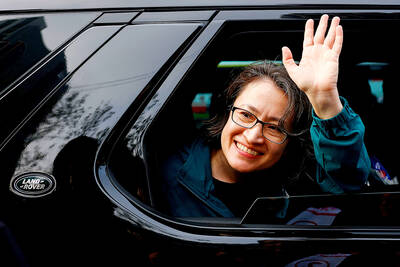
Relations between Taiwan and the Czech Republic have flourished in recent years. However, not everyone is pleased about the growing friendship between the two countries. Last month, an incident involving a Chinese diplomat tailing the car of vice president-elect Hsiao Bi-khim (蕭美琴) in Prague, drew public attention to the People’s Republic of China’s (PRC) operations to undermine Taiwan overseas. The trip was not Hsiao’s first visit to the Central European country. It was meant to be low-key, a chance to meet with local academics and politicians, until her police escort noticed a car was tailing her through the Czech capital. The
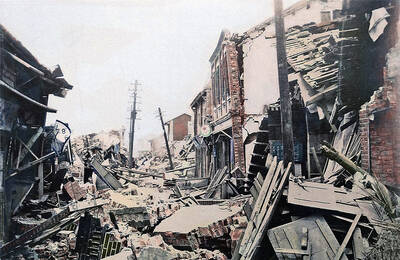
April 15 to April 21 Yang Kui (楊逵) was horrified as he drove past trucks, oxcarts and trolleys loaded with coffins on his way to Tuntzechiao (屯子腳), which he heard had been completely destroyed. The friend he came to check on was safe, but most residents were suffering in the town hit the hardest by the 7.1-magnitude Hsinchu-Taichung Earthquake on April 21, 1935. It remains the deadliest in Taiwan’s recorded history, claiming around 3,300 lives and injuring nearly 12,000. The disaster completely flattened roughly 18,000 houses and damaged countless more. The social activist and

Over the course of former President Ma Ying-jeou’s (馬英九) 11-day trip to China that included a meeting with Chinese Communist Party (CCP) leader Xi Jinping (習近平) a surprising number of people commented that the former president was now “irrelevant.” Upon reflection, it became apparent that these comments were coming from pro-Taiwan, pan-green supporters and they were expressing what they hoped was the case, rather than the reality. Ma’s ideology is so pro-China (read: deep blue) and controversial that many in his own Chinese Nationalist Party (KMT) hope he retires quickly, or at least refrains from speaking on some subjects. Regardless


 RSS
RSS