


Subtitled "Expat Residents Look at their Second Home," this is a collection of essays penned by 16 foreigners who either currently live in Taipei or have done so in the recent past. A full-page author photo precedes each essay, and many other color pictures adorn the texts.
It's a mistake really to call them essays. All follow a similar pattern, and the signs are that they originated as extended answers to a questionnaire, or at least were thoughts prompted by the same set of questions. It's easy to imagine the circumstances of the book's conception -- a wish-list of possible contributors drawn up, and then a list of headings under which they might like to order their thoughts. This is the main reason why Reflections on Taipei often makes for uninspiring reading.
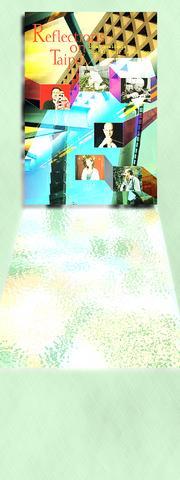
Those responsible for it are probably more familiar with putting together magazines than books, with the result that this reads like a bumper issue of the city's bi-monthly Discover Taipei -- worthy enough, but unlikely to inspire anyone to spectacular deeds of glory.
The imposed similarity detracts from what might have been the respondents' differences of approach. If they'd all been asked to write an article about the city as they'd experienced it, the result might have been more striking. As it is, they all begin with how the writer came here, most include a section on what they miss when they're away, and most end with some criticisms, occasionally outspoken.
The list of contributors doesn't contain any mavericks. There are no jokers in this deck, no wild cards likely to precipitate any upturning of the apple-cart. There are some interesting views expressed, but the individuals chosen scarcely represent a cross-section of the expat community. There are no language teachers (who surely constitute the majority of Western residents), no pop musicians or DJs, and certainly no contract laborers.
On the other hand, those responsible for this book were clearly aware of the need for a spread of some kind. There is a range as regards origins, for instance. A quick count reveals five Americans, three Canadians, and one each from Indonesia, Japan, Vietnam, the Philippines, Holland, Germany and France. There are 11 men and four women. This distribution could be faulted by a radical, but a criticism more likely to attract wider assent is that their attitudes to the city vary little. This is hardly surprising, because the truth is that they almost all belong to that ever-reliable war-horse when it comes to stumping up contributions to magazines or charity boxes, the great middle class.
The photos the contributors have supplied of themselves merit a review of their own. A couple of the Americans have opted for cowboy outfits, one or two would grace the pages of a fashion magazine, and all combine a complimentary self-image -- which is only natural -- with a somewhat cautious approach. No one, for instance, displays himself with his tongue stuck out, let alone with a piercing through it.
The uniformity that results is at times remarkable. Memories of Taipei's major thoroughfares in the 1970s as dirt-tracks sporting rickshaws and ox-carts reappear with astonishing frequency. The variety and value-for-money of the city's food outlets is regularly remarked on. The MRT is almost routinely praised (one contributor, Jerry Keating, even helped build it), and the surrounding hills arouse widespread enthusiasm. Several of the writers, when asked to voice criticisms, urge the Taiwanese to work less hard and take time off to enjoy life's "real" pleasures.
Because blandness is the book's central weakness, the criticisms of Taipei represent its strongest suit. One of the sharpest of these comes from Indonesian Tony Thamsir. His job is to help contract workers solve their problems, and he states "It seems to be an Asian tradition to exploit workers ... Foreign workers," he continues, "are invited guests and are not the enemy." These forthright remarks are worth the book's price in themselves.
A comment that I suspect goes to the heart of why so many Western expats are happy in Asia comes from lawyer Brian Kennedy. Here he's special, he writes, whereas at home in California he's no one in particular. Another telling remark comes from Canadian environmentalist Pierre Loisel when he honestly confesses, to his delight, the fact that "the streets of Taipei are filled with female works of art."
For the rest, writers Kondo Tomoko and Marie Feliciano both like stinky tofu, Dutch puppet-master Robin Ruizendaal (who describes himself as a "conservative hippy") approves of the increasing funkiness of the young, translator Johannes Twellmann appreciates the National Library, and editor Angela Peterson even enjoys the rain.
Because many readers will know some of them personally, here's a list of the contributors: Marie Feliciano, Jerome F. Keating, Brian Kennedy, Father Jean Lefeuvre, Ted Lipman, Pierre Loisel, Angela Peterson, Robin Ruizendaal, Ruan Yan-Juan, Tony Thamsir, Kondo Tomoko, Johannes Twellmann, John Van Deursen, Earl Wieman and Jeffrey R. Williams.
Far and away the most memorable of the contributions is from the Jesuit priest and scholar Father Jean Lefeuvre. He's been in Taiwan for 50 years and speaks of the depth of Taiwanese friendship ("If you are a friend of a local person you are friends forever. Friendship continues until death"), of the local style of reaching consensus and then working together, and of how the strength of the family, and especially that of the mother, pervades local life.
Another contributor attests to the generosity of the Taiwanese. It's impossible to out-give them, he states. They'll always give you more than anything you manage to give to them.
In view of recent events, Father Lefeuvre provides a fittingly up-beat note to end on. He praises the people for Taipei's political development, and adds "You have become free men in a new world."
All things considered, it's impossible to disagree, and it's enormously uplifting to see the normal good-nature of Taipei people reasserting itself after the difficult post-election days.

In late October of 1873 the government of Japan decided against sending a military expedition to Korea to force that nation to open trade relations. Across the government supporters of the expedition resigned immediately. The spectacle of revolt by disaffected samurai began to loom over Japanese politics. In January of 1874 disaffected samurai attacked a senior minister in Tokyo. A month later, a group of pro-Korea expedition and anti-foreign elements from Saga prefecture in Kyushu revolted, driven in part by high food prices stemming from poor harvests. Their leader, according to Edward Drea’s classic Japan’s Imperial Army, was a samurai

The following three paragraphs are just some of what the local Chinese-language press is reporting on breathlessly and following every twist and turn with the eagerness of a soap opera fan. For many English-language readers, it probably comes across as incomprehensibly opaque, so bear with me briefly dear reader: To the surprise of many, former pop singer and Democratic Progressive Party (DPP) ex-lawmaker Yu Tien (余天) of the Taiwan Normal Country Promotion Association (TNCPA) at the last minute dropped out of the running for committee chair of the DPP’s New Taipei City chapter, paving the way for DPP legislator Su
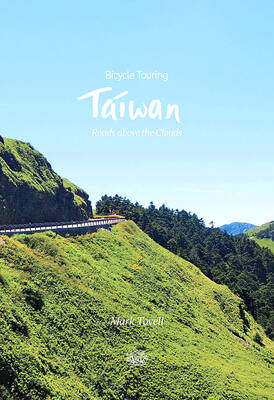
It’s hard to know where to begin with Mark Tovell’s Taiwan: Roads Above the Clouds. Having published a travelogue myself, as well as having contributed to several guidebooks, at first glance Tovell’s book appears to inhabit a middle ground — the kind of hard-to-sell nowheresville publishers detest. Leaf through the pages and you’ll find them suffuse with the purple prose best associated with travel literature: “When the sun is low on a warm, clear morning, and with the heat already rising, we stand at the riverside bike path leading south from Sanxia’s old cobble streets.” Hardly the stuff of your
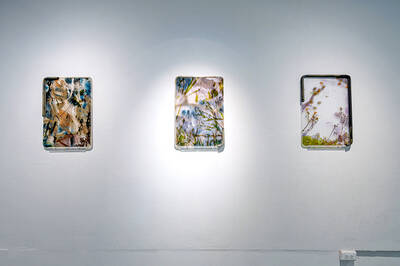
Located down a sideroad in old Wanhua District (萬華區), Waley Art (水谷藝術) has an established reputation for curating some of the more provocative indie art exhibitions in Taipei. And this month is no exception. Beyond the innocuous facade of a shophouse, the full three stories of the gallery space (including the basement) have been taken over by photographs, installation videos and abstract images courtesy of two creatives who hail from the opposite ends of the earth, Taiwan’s Hsu Yi-ting (許懿婷) and Germany’s Benjamin Janzen. “In 2019, I had an art residency in Europe,” Hsu says. “I met Benjamin in the lobby


 RSS
RSS