


When flames swept through the chipboard and corrugated iron of Bangkok's Bonkai slum two years ago, 50-year-old Kai Pongsongsee and her son clutched their most expensive possession and dashed for the street.
The color television, saved by the family's passion for kick boxing, now sits in Kai's new two-story concrete house in a building project hailed as a model for housing the poor in Asia.
Just over half a billion Asians live in slums and the UN expects the number to double by 2030 because of rapid population growth and urbanization.

PHOTO: REUTERS
"It's so comfortable, I'll never leave this place whatever anyone offers me," Kai said, looking up from a sewing machine that helps her earn US$1 for every 1kg of aprons she stitches.
Kai, who left her farming village for a servant's life in Bangkok at the age of 11, shared a tent with her taxi-driver husband, two children, son-in-law and two grandchildren before buying the US$5,000 terrace house from the slum's cooperative.
The 50m2 house occupies the site of a wooden shack she bought in the Bonkai slum for US$3,000 seven years ago.
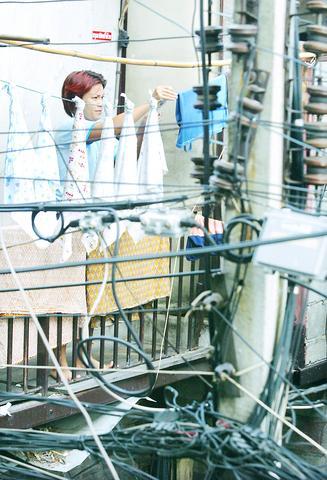
PHOTO: REUTERS
Then, she had no right over the land in an expensive part of Bangkok among embassies and sparkling new skyscraper offices and next to a plush executive club.
But Kai can now sleep easy because the Bonkai community has sealed a 15-year lease from Thailand's biggest landlord, the Crown Property Bureau, which manages the royal family's assets.
The slum's cooperative borrowed US$900,000 from a state-funded body, at one percent annual interest, to build 200 houses it sold to the 2,000 victims of the fire at 3 percent interest.

It now plans to borrow more to build houses for the 1,200 people who live in a corner of the slum untouched by the blaze, still a honeycomb of shacks and open drains, where clothes, chillies and garlic sausages are ranged to dry in the sun.
The money the cooperative earns from the extra interest funds emergency loans to residents, who typically work on construction sites, sell noodles or thread flower garlands sold to motorists in the city's notorious traffic jams.
Several men serve in the slum's new fire brigade, manning a converted pick-up truck, but they have been called into action only once, to catch a python the length of an oar.
Residents helped build the new houses and Kai was a foreman.
"It was really fun," she said. "I checked everything met specifications and if there was a problem, I told the chairman."
The chairman of the cooperative, Sangwaen Boonson, said he helped set up the slum organization after seeing police evict squatters when he was a truck driver two decades ago.
"The police were beating everyone," Sangwaen said. "And I just thought, that could happen to us any day."
A firm which leased land in Bonkai once tried to clear the slum but demonstrations stalled it and, in the end, the company went bust during the 1997 to 1998 Asian economic crisis.
"Around 300 police came with bulldozers, but we armed ourselves with rocks and attacked them," Sangwaen said. "The bulldozer drivers ran away, their heads bleeding."
Sangwaen now receives visitors from around the world wanting to see how Bonkai residents have improved their lives. This year he has met groups from East Timor, Sri Lanka, Cambodia, Nepal, Iran and Kenya and the UN's top housing official.
"It's encouraging what you're seeing in central Bangkok," said Anna Tibaijuka, head of UN Habitat, a Tanzanian who advocates improving occupancy rights for slum dwellers.
"You have to negotiate with the poor," she said. "If you're not shooting them, the poor will just move from one place to the next. It's futile to think you can get rid of the poor."
On its Web site, UN Habitat says investing resources in massive social housing schemes is a "don't" of slum policy.
But the Thai government has done just this since Prime Minister Thaksin Shinawatra was inspired by Moscow's tower blocks during a trip to Russia two years ago.
Thaksin said his government would build a million subsidized homes in five years to help spur the economy.
Hopeful factory workers and low-level civil servants have been queuing in the thousands to reserve one.
Bangkok authorities say they will move thousands of squatters into the apartment blocks, mostly on the outskirts of the city.
Critics say the move has been tried before and does not work because many poor people prefer to sell at a profit and return to squatting if they have no say in where they live.
The body that lent to the Bonkai slum, the Community Organisations Development Institute (CODI), helps Thailand's 5,500 slums buy land or negotiate occupancy pacts.
The Bonkai community has emerged from the fire stronger than ever, Sangwaen said.
"Business people think this land is expensive and it should be used more efficiently to get more money. But now we have new rights we will fight to keep them," he said.

In late October of 1873 the government of Japan decided against sending a military expedition to Korea to force that nation to open trade relations. Across the government supporters of the expedition resigned immediately. The spectacle of revolt by disaffected samurai began to loom over Japanese politics. In January of 1874 disaffected samurai attacked a senior minister in Tokyo. A month later, a group of pro-Korea expedition and anti-foreign elements from Saga prefecture in Kyushu revolted, driven in part by high food prices stemming from poor harvests. Their leader, according to Edward Drea’s classic Japan’s Imperial Army, was a samurai

Located down a sideroad in old Wanhua District (萬華區), Waley Art (水谷藝術) has an established reputation for curating some of the more provocative indie art exhibitions in Taipei. And this month is no exception. Beyond the innocuous facade of a shophouse, the full three stories of the gallery space (including the basement) have been taken over by photographs, installation videos and abstract images courtesy of two creatives who hail from the opposite ends of the earth, Taiwan’s Hsu Yi-ting (許懿婷) and Germany’s Benjamin Janzen. “In 2019, I had an art residency in Europe,” Hsu says. “I met Benjamin in the lobby
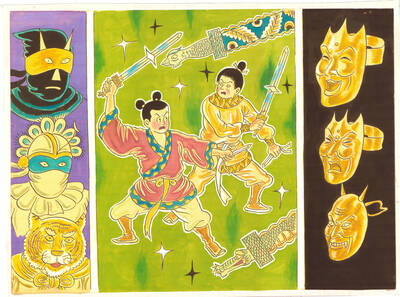
April 22 to April 28 The true identity of the mastermind behind the Demon Gang (魔鬼黨) was undoubtedly on the minds of countless schoolchildren in late 1958. In the days leading up to the big reveal, more than 10,000 guesses were sent to Ta Hwa Publishing Co (大華文化社) for a chance to win prizes. The smash success of the comic series Great Battle Against the Demon Gang (大戰魔鬼黨) came as a surprise to author Yeh Hung-chia (葉宏甲), who had long given up on his dream after being jailed for 10 months in 1947 over political cartoons. Protagonist

Peter Brighton was amazed when he found the giant jackfruit. He had been watching it grow on his farm in far north Queensland, and when it came time to pick it from the tree, it was so heavy it needed two people to do the job. “I was surprised when we cut it off and felt how heavy it was,” he says. “I grabbed it and my wife cut it — couldn’t do it by myself, it took two of us.” Weighing in at 45 kilograms, it is the heaviest jackfruit that Brighton has ever grown on his tropical fruit farm, located


 RSS
RSS