


Tele, a Sumatran tiger, is at once an awesome and pathetic sight. A fully-grown female, she hobbles around in a cage in Medan Zoo on front paws maimed by snares she freed herself from. Her tail, an amputated stump, is testimony to the final crude wire trap she was unable to escape.
Her good fortune was that rangers in Indonesia's Gunung Leuser National Park got to her before the trappers. Otherwise, Tele would have been another victim of the trade in traditional Chinese medicine that is helping push the Sumatran Tiger to the very brink of extinction.

PHOTO :EPA
After selling her skin, hunters would have hawked her bones probably for less than US$200 for her full skeleton. The bones would then have been crushed down for use in Chinese medicine to treat rheumatism and a variety of other ailments.
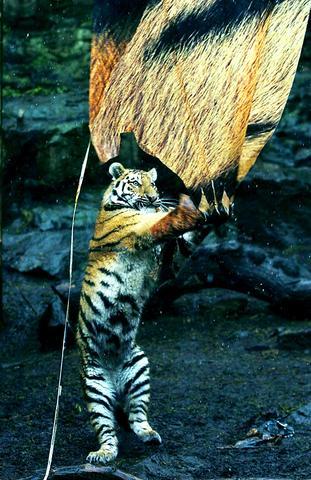
PHOTO :EPA
In the early 1900s, Dutch colonists reported a plague of Sumatran Tigers, then one of three sub-species in Indonesia along with the tigers of Bali and Java. Now there are reckoned to be only 400 to 500 Sumatran Tigers left while the last tigers in Bali and Java were sighted in the late 1930s and 1976 respectively.
A combination of hunting and rapidly-disappearing habitat is now raising fresh alarm over the plight of the Sumatran Tiger. A report issued last week by Traffic, the wildlife trade monitoring network, and the World Wide Fund for Nature says the tigers have since 1998 been hunted and killed at the rate of 50 a year.
"If we are even close to being right in our estimates, we are looking at a possible 10-year horizon for the Sumatran Tiger," said James Compton, Director of Traffic Southeast Asia.
"However, if there is a measurable effort to crack down on the trade and make these tiger products unavailable, as well as looking at habitat protection for the tiger, that 10-year horizon might be moved back."
In Hong Kong and China, that means focusing attention on the continuing trade in tiger bones for traditional Chinese medicine and appealing to anyone who hears of any trade in the critically endangered species to turn suspects in.
Penalties in Hong Kong are formidable. Since the 1990s, anyone caught trading in or smuggling tiger parts can face a fine of up to HK$5 million (US$640,000) and two years in jail, according to a spokesman for the Agriculture Fisheries and Conservation Department (AFCD).
The situation is vastly different from a decade ago when traditional medicine shops in Hong Kong would openly sell tiger bone used to treat rheumatism, ulcers, typhoid, malaria dysentery and burns.
At that time, tiger bone would be sold by the tael (38g) and a shop in the city in 1993 reportedly had tiger paws on sale in a display cabinet with an asking price of around US$6,000 each.
"The chances of finding tiger parts and packaged medicines in Hong Kong are much lower than 10 years ago," Compton said. "We don't have any recent information about the open availability of tiger medicines.
"The Traditional Chinese Medicine Community was originally very much against the very high penalties but over time, and through consultation, their understanding is higher as to why this is important."
China too, as a signatory of CITES (Convention on International Trade in Endangered Species) has introduced severe sentences for traders and smugglers. But Traffic believes the crackdown has had the effect of driving the trade in tiger parts underground.
The increased penalties in Hong Kong has also made smugglers change their routes to avoid the territory and instead take advantage of China's porous land borders with Vietnam, Laos and Myanmar with their 4,000 crossing points to keep the supply of tiger parts flowing.
"We have heard from hunters and traders in Sumatra that demand is coming from China," Compton said. "Demand for tiger products in China comes from the older generation of consumers who use it to treat rheumatism.
"Tiger wine is also used as a general tonic. We understand there is a black market for this tonic and that it is often made for personal use or produced on a one-to-one level rather than in factories. That is the case right across China."
Ultimately, conservationists believe, education in alternative forms of medicine and a gradual switch away from traditional remedies may provide the best hope of saving the Sumatran Tiger from extinction.
"Over time, demand for wild species will taper off as the older generation dies off," said Compton. "Maybe this is reflected in Hong Kong's relative pace of development and the growing popularity of Western-style products. We are seeing the same thing happening in other parts of Southeast Asia such as Vietnam where many more people from the younger generation are turning to Western medicine.
"People's attitudes to health are changing. From time to time you get a flashback, like during SARS when people were trying any remedy they thought might protect them against this unknown disease. But generally there is a shift in attitudes and we are watching to see where this takes us."
There is a serious question mark over whether those new attitudes can take hold in time to save the Sumatran Tiger. Susan Lieberman, Director of the World Wide Fund for Nature International Species Program warned: "With so few left there are doubts about whether the population is still viable. The Sumatran Tiger is on the brink of extinction."
In Medan Zoo, northern Sumatra, there is hope of a kind. After a long convalescence, Tele has been successfully mated with another captive tiger and recently gave birth to a male cub. The next 10 years may determine whether the breed's only chance of a future is in captivity.

Last week Joseph Nye, the well-known China scholar, wrote on the Australian Strategic Policy Institute’s website about how war over Taiwan might be averted. He noted that years ago he was on a team that met with then-president Chen Shui-bian (陳水扁), “whose previous ‘unofficial’ visit to the US had caused a crisis in which China fired missiles into the sea and the US deployed carriers off the coast of Taiwan.” Yes, that’s right, mighty Chen caused that crisis all by himself. Neither the US nor the People’s Republic of China (PRC) exercised any agency. Nye then nostalgically invoked the comical specter

Relations between Taiwan and the Czech Republic have flourished in recent years. However, not everyone is pleased about the growing friendship between the two countries. Last month, an incident involving a Chinese diplomat tailing the car of vice president-elect Hsiao Bi-khim (蕭美琴) in Prague, drew public attention to the People’s Republic of China’s (PRC) operations to undermine Taiwan overseas. The trip was not Hsiao’s first visit to the Central European country. It was meant to be low-key, a chance to meet with local academics and politicians, until her police escort noticed a car was tailing her through the Czech capital. The

April 15 to April 21 Yang Kui (楊逵) was horrified as he drove past trucks, oxcarts and trolleys loaded with coffins on his way to Tuntzechiao (屯子腳), which he heard had been completely destroyed. The friend he came to check on was safe, but most residents were suffering in the town hit the hardest by the 7.1-magnitude Hsinchu-Taichung Earthquake on April 21, 1935. It remains the deadliest in Taiwan’s recorded history, claiming around 3,300 lives and injuring nearly 12,000. The disaster completely flattened roughly 18,000 houses and damaged countless more. The social activist and

Over the course of former President Ma Ying-jeou’s (馬英九) 11-day trip to China that included a meeting with Chinese Communist Party (CCP) leader Xi Jinping (習近平) a surprising number of people commented that the former president was now “irrelevant.” Upon reflection, it became apparent that these comments were coming from pro-Taiwan, pan-green supporters and they were expressing what they hoped was the case, rather than the reality. Ma’s ideology is so pro-China (read: deep blue) and controversial that many in his own Chinese Nationalist Party (KMT) hope he retires quickly, or at least refrains from speaking on some subjects. Regardless


 RSS
RSS