


Eighty years ago, the smelter that anchors this company town was at the center of a dispute over whether a Canadian company could be held liable for environmental damage it caused in the US.
The US was awarded damages in that case, which endures as a landmark in international environmental law. But now the same smelter is the focus of a new dispute between the two countries.

PHOTO: NY TIMES
The current impasse concerns nearly 20 million tons of industrial waste that the Trail smelter dumped into the Columbia River over the course of 100 years. The river carried much of it 16km across the border and into Washington state.
In December, the Environmental Protection Agency ordered the smelter's Canadian parent company, Teck Cominco, to study the human health risks of contamination in the upper Columbia and assess cleanup options.
The company responded by telling the agency that it had no obligation to honor US law. The Canadian government also entered the fray with a formal diplomatic letter to the State Department asking that the environmental agency, in effect, back off.
Canada, the letter said, is concerned that the agency's stance "may set an unfortunate precedent by causing transboundary environmental liability cases to be initiated in both Canada and the United States."
Daniel Bodansky, a professor at the University of Georgia and an expert on international environmental law, said the earlier Trail smelter case might be the best framework for understanding the current one. Otherwise, he said, "there's very little precedent for successful litigation of transboundary pollution cases."
In the earlier case, farmers in the US concerned about their crops began complaining in the early 1920s about fumes drifting south from the Cominco smelter. The US government took up their cause, and the dispute was referred to the International Joint Commission, a rarely used arbitration panel, and then to a separate tribunal convened by the two countries. The US was eventually awarded US$428,000 in damages.
More important, though, was the tribunal's finding that under international law no nation could allow activity in its territory that caused serious damage to another country.
The current smelter conflict began when the environmental agency's regional office in Seattle conducted a routine study of possible contamination of the Columbia.
Last year, after a request by local Indian tribes, the office completed a partial survey of the upper Columbia, which for 210km above the Grand Coulee Dam is a vast recreational area known as Lake Roosevelt, popular with boaters, anglers and campers. The survey found elevated levels of arsenic, lead, mercury and other contaminants in the lake, enough for it to qualify as a Superfund site.
The study also determined that the Trail smelter was the "primary source of contamination to the upper Columbia River," making the company potentially liable for cleanup and exposing it to lawsuits.
One of Teck Cominco's US subsidiaries, Teck Cominco American of Spokane, Washington, offered to pay for a US$13 million study of the possible health risks posed by contamination in Lake Roosevelt if the agency would defer pursuing a cleanup under Superfund law.
For a while it seemed that this offer might lead to a solution, but negotiations between the company and the agency's regional office broke down. The regional office, on the advice of government lawyers, then ordered Teck Cominco to plan for further studies and a possible cleanup.
John Iani, the environmental agency's regional administrator, said the company's proposal did not meet the agency's standards for site testing and cleanup. Teck Cominco says the US$13 million offer is still on the table.
Doug Horswill, the company's senior vice president for environment and public affairs, said the agency had broken off discussions without explanation. "We're not shirking our responsibilities whatsoever in this matter," he said.
Discussions are now under way in Washington and Ottawa involving the environmental agency and the State and Justice departments. Horswill said that any agreement would probably be between Canada and Teck Cominco, but that it would have to satisfy US expectations that the lake be cleaned up.
In the current case, some fear that the smelter may have created a lasting health problem for residents of the upper Columbia basin.
Walking recently along a snow-crusted Columbia riverbank just south of the border, Robert Jackman of the local environmental group Citizens for a Clean Columbia picked up a handful of black, glassy sand by the water's edge and let it sift through his fingers.
"This whole area is slag," he said.
Slag, a thick, grainy discharge, is a byproduct of smelting that contains lead, zinc, copper and other metals. From 1896 to 1995, operating within Canadian and provincial law, the smelter discharged nearly 20 million tons of it into the Columbia. Much of that made its way into the US.
Teck Cominco has maintained that the slag is inert, and sells it as an ingredient in concrete. The US environment agency asserts that it could have a negative impact on wildlife and visitors at Lake Roosevelt.
Jackman, 77, said the potential health risks along Lake Roosevelt had been ignored for too long. "We feel that our health concerns are not being properly dealt with," he said.
Merrill Ott, a Stevens County, Washington, commissioner, said it was wrong for the environmental agency to pursue Teck Cominco without being certain that the lake posed a health risk.
"People have been playing in the lake, people have been fishing in the lake, people have been swimming in the lake for 60 years," he said, "and now all of a sudden there is a human health hazard?"

Last week Joseph Nye, the well-known China scholar, wrote on the Australian Strategic Policy Institute’s website about how war over Taiwan might be averted. He noted that years ago he was on a team that met with then-president Chen Shui-bian (陳水扁), “whose previous ‘unofficial’ visit to the US had caused a crisis in which China fired missiles into the sea and the US deployed carriers off the coast of Taiwan.” Yes, that’s right, mighty Chen caused that crisis all by himself. Neither the US nor the People’s Republic of China (PRC) exercised any agency. Nye then nostalgically invoked the comical specter
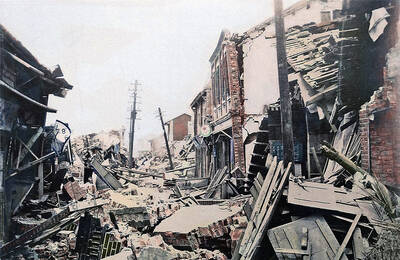
April 15 to April 21 Yang Kui (楊逵) was horrified as he drove past trucks, oxcarts and trolleys loaded with coffins on his way to Tuntzechiao (屯子腳), which he heard had been completely destroyed. The friend he came to check on was safe, but most residents were suffering in the town hit the hardest by the 7.1-magnitude Hsinchu-Taichung Earthquake on April 21, 1935. It remains the deadliest in Taiwan’s recorded history, claiming around 3,300 lives and injuring nearly 12,000. The disaster completely flattened roughly 18,000 houses and damaged countless more. The social activist and

Over the course of former President Ma Ying-jeou’s (馬英九) 11-day trip to China that included a meeting with Chinese Communist Party (CCP) leader Xi Jinping (習近平) a surprising number of people commented that the former president was now “irrelevant.” Upon reflection, it became apparent that these comments were coming from pro-Taiwan, pan-green supporters and they were expressing what they hoped was the case, rather than the reality. Ma’s ideology is so pro-China (read: deep blue) and controversial that many in his own Chinese Nationalist Party (KMT) hope he retires quickly, or at least refrains from speaking on some subjects. Regardless

Approaching her mid-30s, Xiong Yidan reckons that most of her friends are on to their second or even third babies. But Xiong has more than a dozen. There is Lucky, the street dog from Bangkok who jumped into a taxi with her and never left. There is Sophie and Ben, sibling geese, who honk from morning to night. Boop and Pan, both goats, are romantically involved. Dumpling the hedgehog enjoys a belly rub from time to time. The list goes on. Xiong nurtures her brood from her 8,000 square meter farm in Chiang Dao, a mountainous district in northern Thailand’s


 RSS
RSS